
Construction Partners Advances Growth and Margin Control Through Vertical Integration and Strategic Acquisition
ROAD's latest quarter underscores the operational benefits of its vertical integration amidst input cost volatility.
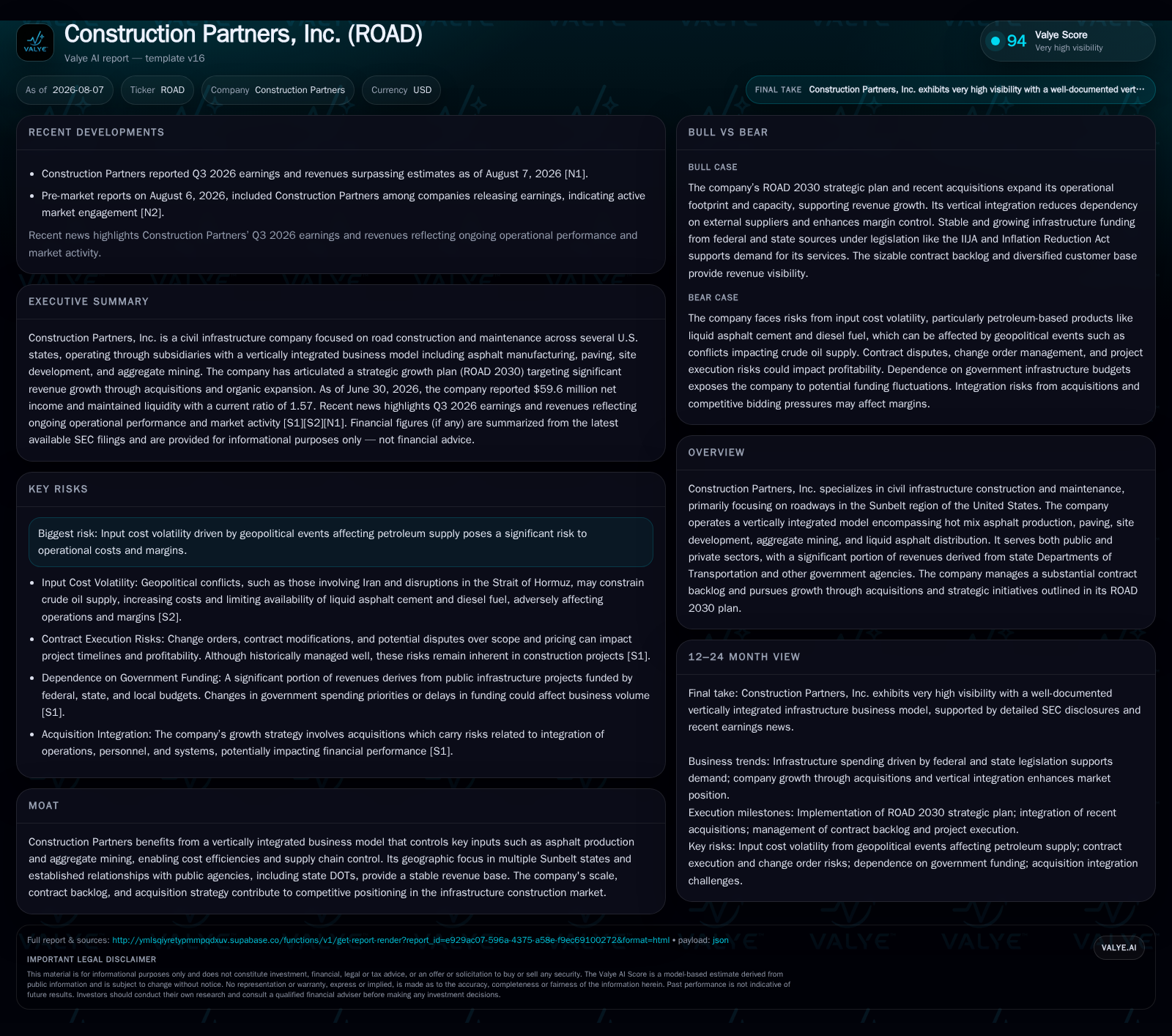
In its Q3 2026 filings, Construction Partners, Inc. (ROAD) reported stronger-than-expected financial results driven by expanded capacity and a robust contract backlog anchored by public infrastructure projects in the Sunbelt. The company's vertically integrated model—from aggregate mining to hot mix asphalt production and paving—provides it with supply chain control and operating leverage that partially insulate margins from rising petroleum-based input costs. ROAD's growth strategy, embodied in the ROAD 2030 plan, relies on continued acquisitions across key states and disciplined contract bidding. However, external risks such as geopolitical disruptions affecting liquid asphalt and diesel pricing remain salient. The company’s financial position shows significant leverage consistent with past acquisition financing but maintains moderate liquidity.
Recent Operating Update: Stronger-Than-Expected Q3 Execution Highlights Backlog Conversion
Construction Partners released its Q3 2026 results on August 7, surpassing consensus expectations with robust revenue delivery and profitability reflective of high backlog conversion rates [S2][N1]. The press release confirms continued steady demand for infrastructure construction services predominantly along major Sunbelt corridors where ROAD operates. Management’s discussion points to effective cost controls despite prevalent inflationary pressures on petroleum-based inputs critical for asphalt production and onsite equipment operation.
Simultaneously filed amendment agreements provided the company expanded credit facility capacity—specifically an increase in revolving credit from $500 million to $700 million—and refinanced portions of Term Loan B to reduce interest margins while adding incremental term loans totaling $300 million [S24]. This improved financial flexibility aligns with ongoing strategic acquisition activity intended to expand geographic footprint presence in Texas and Oklahoma among other states.
Business Model: Vertical Integration Anchored in Material Production Enhances Competitive Position
ROAD exemplifies a vertically integrated civil infrastructure construction company specializing in roadways across eight Sunbelt states including Alabama, Florida, Georgia, North Carolina, Oklahoma, South Carolina, Tennessee, and Texas [S1][S12]. Its operations encompass multiple linked value chain segments: hot mix asphalt (HMA) manufacturing used internally for paving projects or sold commercially; aggregate mining supplying raw materials; liquid asphalt cement distribution; paving services including base layer construction; and broader site development activities like utility trenching and drainage installation.
This vertical linkage provides essential supply chain control over critical inputs whose price volatility—especially liquid asphalt derived from crude oil—can materially impact project margins [S2][S23]. By controlling its own aggregate sources and asphalt plants (27 new HMA facilities added via acquisitions in FY 2025 alone), ROAD gains negotiating leverage on commodity procurements relative to less integrated peers.
Revenue derives largely from long-term public sector contracts with fixed unit prices based on approved quantities—a mechanism distinctly different than private sector lump sum agreements where risk profiles shift more towards project scope management [S20]. Substantial reliance on state Departments of Transportation (DOTs), accounting for well over 40% of revenues offers predictable volume though customers retain rights to modify or cancel contracts.
Industry Context: Infrastructure Funding Cycles Favor Those With Scale and Backlog Visibility
Within civil infrastructure construction markets dominated by regional contractors like Granite Construction Inc. or heavy materials suppliers such as Vulcan Materials Company, firms like ROAD differentiate by their integrated product-service offerings tailored for highways and transportation networks within favorable legislative environments enriched by federal programs like the Infrastructure Investment and Jobs Act (IIJA).
Public spending programs create cyclical demand waves best navigated by firms maintaining extensive work backlogs—a KPI ROAD reports at $2.2 billion in uncompleted work plus another $0.8 billion classified as low bid/no contract projects as of FY 2025 year-end [S28]. This backlog covers a substantial portion of near term revenues, tempered by historical stability in contract completion rates despite the theoretical ability for customer cancellation.
Equipment intensity magnifies fixed cost burdens; thus throughput efficiency measured through plant utilization rates materially affects margin outcomes. ROAD’s addition of rail-served aggregates terminals further boosts logistical advantages over competitors reliant solely on truck transport.
Growth Drivers: Acquisitions Amplify Scale Complemented By Organic Tender Success
ROAD’s cornerstone growth initiative named “ROAD 2030” sets explicit aims for surpassing $6 billion revenue within four years via expanding operational capacity principally through acquisitions supplemented by organic market wins [S1][S17]. In FY 2025 alone, five targeted acquisitions costing about $1.5 billion enhanced the fleet of HMA plants (27), aggregate sites (4), specialized terminals including a rail-served facility in Texas plus liquid asphalt terminal capacity establishing footholds in key growth markets.
The geographic spread covered creates cross-selling opportunities on multi-state infrastructure contracts driven by population growth trends favoring Sunbelt metro areas alongside federal funding influx under IIJA.
Organic growth levers comprise a disciplined competitive bidding framework focusing on fixed unit price public contracts that favor established local operators familiar with state DOT specifications across the core states served.
Risks and Watchpoints: Input Cost Volatility And Contractual Flexibility Pose Margin Challenges
Petroleum-based input cost swings remain a persistent threat given geopolitical risks such as conflicts around the Strait of Hormuz that could choke global crude supplies sharply raising liquid asphalt cement costs alongside diesel fuel expense integral to heavy machinery usage [S2][S23]. Contractual mechanisms may not always provide full pass-through protection leaving margins squeezed especially on fixed-price contracts.
Contract cancellations or modifications technically allowed under customer agreements could disrupt backlog conversion although historically such occurrences have been minimal according to company disclosures [S20][S28]. Weather seasonality introduces timing unpredictability since extended rainy or cold spells delay outdoor paving activities impacting quarterly revenue recognition.
Environmental compliance related to quarry operations disclosed under recent EPA consent decrees may impose remediation costs albeit expected to be largely covered by insurance policies minimizing net financial impact currently known [S1]. Labor availability constraints common in the sector could also affect project scheduling or cost inflation intensity.
What To Watch Next
Investors should monitor subsequent quarterly backlog releases closely for signs of strengthening low bid / no contract pipeline beyond current levels indicating sustained future revenue growth potential. Quarterly updates on acquisition integration progress including synergy realization metrics will clarify return profiles on recent heavy capital deployment.
Additionally, tracking input cost trends versus contractual escalation clauses will be pivotal to assessing margin durability amidst geopolitical energy market uncertainties. Progress against ROAD 2030 milestones particularly any updates regarding expansion beyond existing eight-state footprint may illuminate strategic direction adaptations.
Operational KPIs such as active plant numbers across regions combined with equipment fleet utilization statistics serve as leading indicators for throughput efficiency influencing gross margin movement.
Financial Profile Discussion
As of June 30, 2026, Construction Partners held approximately $94.5 million cash against total debt near $1.8 billion resulting in an adjusted net debt position consistent with prior acquisition financing levels but balanced by healthy current assets ($961 million) versus liabilities ($614 million), yielding a current ratio of about 1.57 indicative of manageable near-term liquidity coverage [F1]
The company's amended credit facilities now feature a revolving credit line boosted from $500 million to $700 million plus refinanced term loan tranches reducing interest expense burdens following the June TLB Amendment transaction increasing financial covenant headroom supporting leverage management flexibility going forward [S24]
Capital intensive asset additions associated with recent acquisitions underline ongoing investment requirements; however free cash flow generation capacity tied closely to project execution pace remains a pivotal metric to watch for sustainable deleveraging progress.
Overall financial gearing mirrors typical industry norms for mid-tier vertically integrated infrastructure contractors growing via acquisitions yet reflects sensitivity to economic cycles affecting government capital spending cycles.
Disclaimer: This analysis is for informational purposes only. It does not constitute investment advice or research views regarding any securities mentioned herein.
Disclaimer: This is research-only, informational analysis and not investment advice. It may include AI-generated interpretation and general industry context. Always verify important details using primary sources.

Comments