
Transcat Inc Strengthens Dual-Segment Model with Accredited Calibration and Value-Added Distribution
Transcat's latest quarter highlights progress in calibration services and strategic expansions amid competitive distribution pressures.
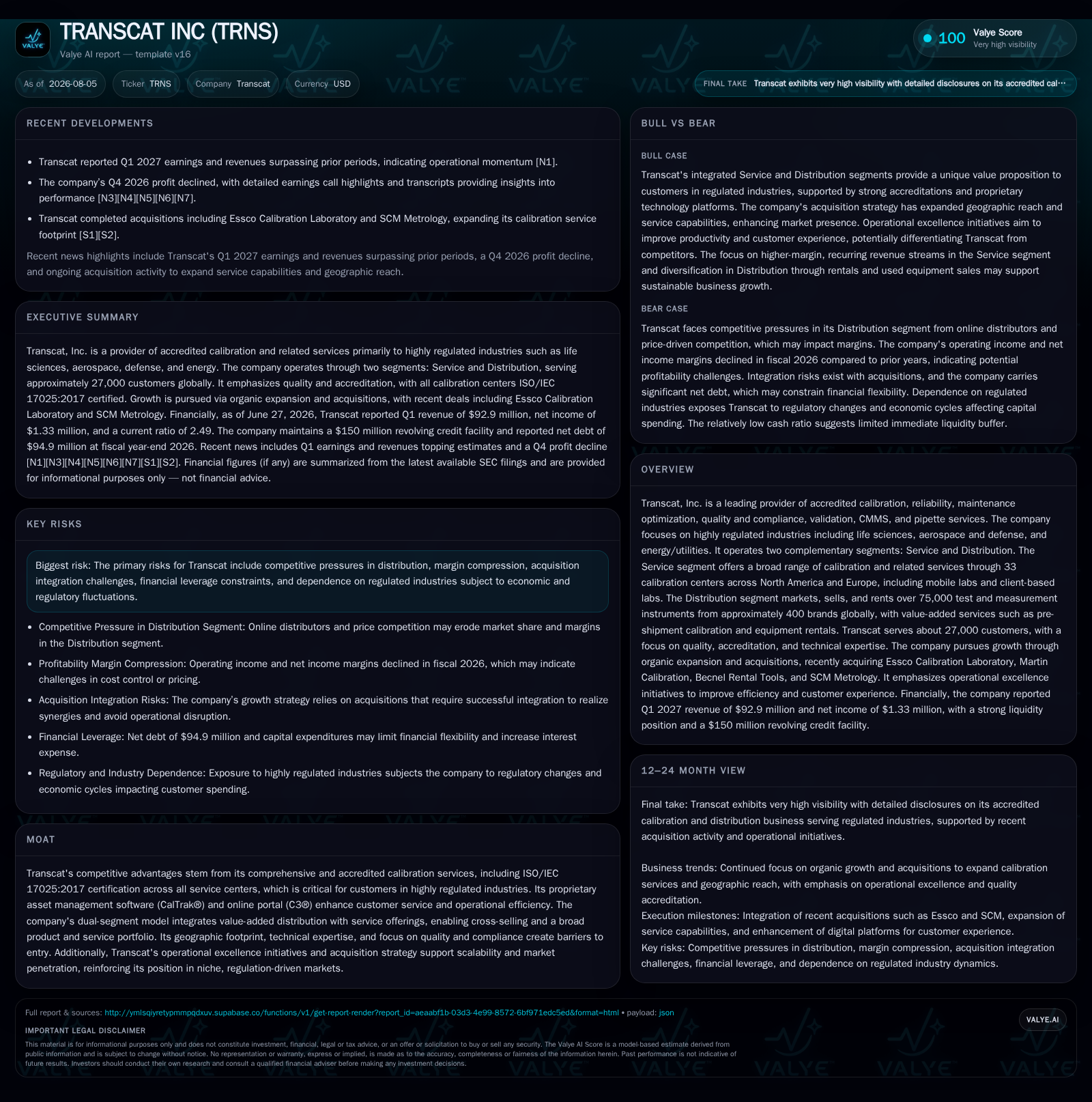
Transcat Inc reported solid performance in its fiscal 2027 first quarter reflecting continued organic growth in accredited calibration services and value-added distribution, supported by acquisitions and operational excellence initiatives. The company operates through two segments—Service and Distribution—which are complementary yet face distinct margin and competitive dynamics. Accreditation and proprietary software enhance Transcat’s moat in highly regulated markets like life sciences and aerospace. However, margin compression in distribution due to online competitors remains a headwind. Liquidity is stable with moderate leverage following recent acquisitions supporting growth and geographic expansion.
Recent Operating Update
Additionally, Transcat completed the acquisition of SCM Metrology & Laboratories S.A., expanding its geographic footprint into Costa Rica with a new calibration service center and reinforcing its presence in Latin American markets—an important growth vector in line with their strategy to enter adjacent geographies through targeted acquisitions [S23][S1]. This acquisition further complements prior deals such as Essco Calibration Laboratory LLC and Martin Calibration LLC that added technical capabilities and regional penetration in North America [S1].
Business Model
Transcat’s business model uniquely combines two complementary operating segments: Service (accredited calibration and related technical services) and Distribution (sales and rental of test & measurement instruments) [S1]. The Service segment generates revenue through recurring contracts performing precise instrument calibrations compliant with stringent quality standards like ISO/IEC 17025:2017 accreditation at all facilities. This ensures critical compliance for customers in FDA-regulated life sciences, aerospace defense, energy/utilities sectors where measurement accuracy impacts product safety or process reliability. Calibration services are delivered via a network of over 33 fixed labs plus mobile calibration labs providing onsite services and embedded client locations for continuous support
The Distribution segment offers an extensive catalog of over 75,000 new/used instruments sourced from approximately 400 global brands. Monetization includes direct sales, equipment rentals—a higher-margin line—and value-added services like pre-shipment calibrations allowing customers to deploy instruments immediately on receipt, reducing downtime [S1][S24]. Rentals provide customers a flexible alternative to capital purchases important in cyclical or budget-conscious industrial environments. Notably, Transcat focuses on consolidating high-margin rental channels while managing legacy distribution pressures intensified by online low-cost competitors such as Amazon which primarily compete on price without offering comprehensive compliance-related services or technical expertise that Transcat provides
Proprietary software platforms CalTrak® for asset management automation and C3® customer portals facilitate real-time service monitoring, renewal notifications, usage tracking, enhancing customer retention through sticky workflows that create switching barriers uncommon among peers [S1]. Cross-selling between Service and Distribution segments—approximately 20-25% of customers transact across both—boosts average revenue per customer while broadening end-to-end instrument lifecycle solutions [S1]. The company emphasizes technical sales teams with specialist training to guide complex product selections fitting specific compliance needs.
Industry Structure & Competitive Position
Transcat occupies a niche within the industrial calibration & test equipment sector where regulatory compliance is a major barrier to entry. Accreditation under ISO/IEC standards combined with deep domain expertise positions it defensively against commoditized online distributors lacking value-added certification or mobile calibration capabilities.
Competition spans from large national distributors offering broad product availability to smaller regional players focused on service or select verticals. Online marketplaces have disrupted legacy pricing models for handheld instruments but fail to replicate the embedded technical service ecosystems Transcat builds—a critical differentiator given customers’ risk aversion over instrument reliability in mission-critical regulated processes.
Peers such as Fluke Calibration and AMETEK also integrate service + distribution but differ in scale or market focus; for instance, Fluke’s brand prominence prioritizes proprietary instruments while AMETEK may focus more on testing capital equipment sales wholesale. In contrast, Transcat’s strategic emphasis on rentals plus consumables within life sciences aims at margin diversification away from purely transactional distribution sales pressured by e-commerce competition.
Acquisition integration remains an ongoing challenge but also an engine for scaling geographic access to regulated markets where local presence is often essential given onsite service demand. Transcat’s continuous investments into digital platforms mirror wider industry shifts toward omnichannel sales paired with personalized technical support.
Growth Drivers
Growth prospects center on several structural industry tailwinds:
- Rising regulatory demands across life sciences (pharmaceuticals/biotech/medical devices), aerospace & defense (FAA/DoD standards), energy/utilities sectors increase need for precise calibrated instrumentation compliance.
- Expansion of mobile onsite calibration serving large industrial clients reducing downtime.
- Increasing penetration of equipment rental as an operational expense alternative amid capex constraints.
- New geographic markets accessed via acquisitions (e.g., Costa Rica) open emerging customer bases requiring regulated service offerings.
- Digital asset management software adoption boosting customer stickiness through real-time compliance tracking.
- Enhanced cross-selling between Service + Distribution segments tapping broader wallet share per client.
- Consolidation potential within fragmented calibration services supports M&A acceleration.
These drivers are measurable via KPIs including number of calibration centers (translating capacity), equipment rental utilization rates reflecting margin contribution shifts, customer retention across both segments signaling integration success, service contract renewal rates indicating recurring revenue durability, and average revenue per customer combining product/service mix effects.
Risks / Watchpoints / Constraints
Margin compression risks persist particularly in Distribution due to competition from low-price online sellers lacking value-added offerings that pressure legacy catalog sales but threaten volume mix nonetheless [S24]. Successful differentiation depends on maintaining accreditation standards which require ongoing capital investment not only for compliance audits but also skilled labor training.
Integration risk from multiple acquired businesses requires careful onboarding to avoid operational disruptions or cultural clashes that can dilute realized synergies or inflate costs temporarily [S1][S23]. Financial leverage rose materially due to acquisition financing; although covenant-compliant now (leverage ratio approx. 2x), indebtedness constrains flexibility for further large-scale M&A without deleveraging over time [F1][S5].
Dependence on regulated end-markets means exposure to cyclical economic fluctuations affecting R&D budgets or capital spending in pharmaceuticals or aerospace could dampen order volumes unexpectedly.
Supply chain disruptions impacting availability of distributed instruments could delay fulfillment or reduce inventory turns affecting working capital efficiency if prolonged. Technological obsolescence necessitates continuous reassessment of product lines offered through distribution channels.
Finally, internal control weaknesses noted in latest filings around financial reporting spotlight need for strengthened governance to maintain investor confidence while scaling complexity [S24].
What to Watch Next
Key near-term milestones include:
- Integration progress on SCM Metrology acquisition including final purchase accounting completion expected within measurement period post-April 2026 closing [S23].
- Further organic Service revenue growth rates especially high single-digit targets signaling sustained demand momentum.
- Equipment rental utilization trends acting as proxy for shifting mix toward higher-margin Distribution sub-segments.
- Renewal rates of multi-year service contracts evidencing recurring revenue base expansion.
- Updates on Operational Excellence productivity metrics impacting gross margins or turnaround time improvements.
- Management commentary around responses to intensifying online competitor pricing pressure or advancements in digital sales platform functionality.
- Any indication of changes to leverage policy or capital allocation priorities balancing acquisitions versus debt reduction/opening shareholder returns.
Financial Profile Discussion
As of June 27, 2026, Transcat held $6.7 million cash & equivalents against total debt approximating $110 million producing net debt near $103.7 million consistent with recent year-end levels post-acquisition activity [F1]. Current assets stand at $95.7 million versus current liabilities at $38.4 million delivering a healthy current ratio of approximately 2.49 indicating solid near-term liquidity cushions [F1]. Interest expense increased reflecting higher gross debt but remains manageable with operating income covering interest comfortably under covenant requirements [F1][S5]. Capital expenditures focus largely on maintaining the calibrated infrastructure along with investments enhancing rental equipment fleets totaling mid-single-digit millions annually with scope to scale as rental demand grows [S26][F1].
Overall free cash flow continues positive after capex supporting operational reinvestment capacity alongside acquisitions financed under existing revolving credit facilities sized at $150 million with ability to fund further bolt-ons subject to leverage limits set at maximum 3x EBITDA [F1][S5]
Disclaimer: This analysis is for informational purposes only based on available public filings and industry context as of August 2026. It is not investment advice.

Comments