
nVent Electric’s $2.6B Backlog Anchors Growth Amid AI Data Center Expansion
Strong backlog and strategic partnerships bolster nVent Electric's position in industrial electrical hardware markets.
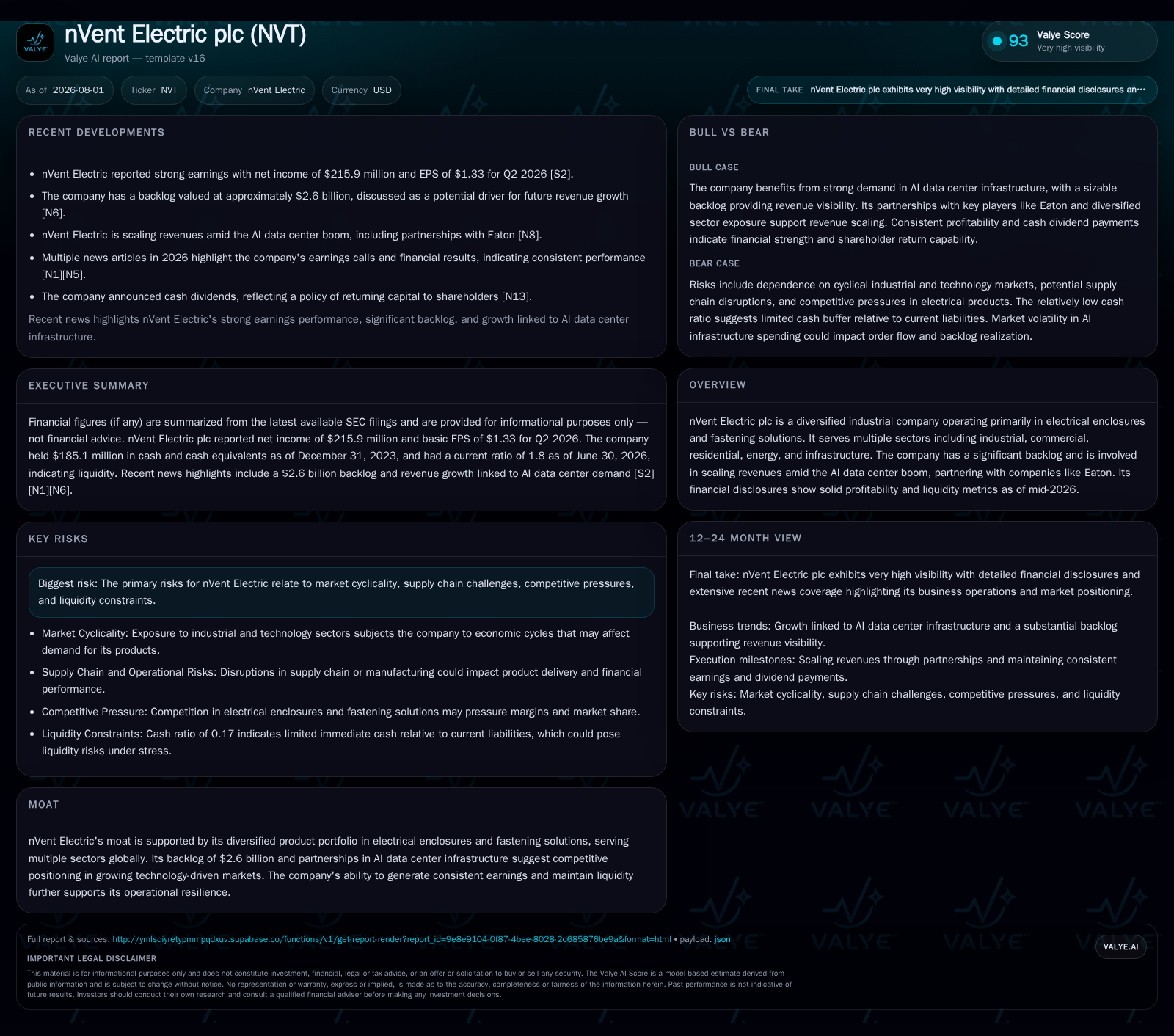
nVent Electric plc’s latest quarter highlights a robust $2.6 billion backlog, driven notably by growth in AI data center infrastructure demand. The company’s diversified electrical enclosures and fastening solutions product lines support multiple end markets including industrial, commercial, and energy sectors. Strategic collaboration with OEM partners like Eaton enhances its competitive stance amid cyclical pressures and supply chain complexities. While the financial profile remains solid with manageable leverage and strong liquidity, operational execution against backlog conversion and supply constraints will be key near-term performance indicators.
Recent Operating Update
nVent Electric plc’s second quarter of 2026 filings reflect a robust operating backdrop marked by a sizable order backlog of approximately $2.6 billion [S2],[N5]. This backlog signals strong underlying demand for its electrical connection and protection solutions during ongoing growth in AI data center infrastructure investments — a trend that represents a structurally expanding market segment within the broader industrial electrical hardware space. The reporting segments consist of Systems Protection and Electrical Connections divisions delivering critical components such as enclosures and fastening systems that cater to an entrenched base across industrial automation, commercial construction, power grids, and storage facilities [S2].
Furthermore, nVent's partnership with Eaton — a prominent electrical industry OEM — enables it to scale revenues effectively as AI data centers proliferate worldwide. This collaboration provides advanced product integration potential in grid-to-rack solutions which are vital for high-density computing environments where power access and cooling reliability are paramount [N10],[N9]. Maintaining supply chain agility during component shortages remains a priority for nVent given the complexity of upstream sourcing in industrial hardware manufacturing [S1],[S2].
Business Model
nVent generates revenue primarily from product sales of diversified electrical hardware including enclosures designed to protect sensitive electronics from environmental hazards and fastening solutions that ensure mechanical integrity of assemblies in various applications. The firm sells largely through direct channels targeting system integrators, contractors, original equipment manufacturers (OEMs), and distributors serving multi-sector end markets such as energy infrastructure, data centers, commercial/residential buildings, and manufacturing plants.
Revenue growth depends on new infrastructure project rollouts (notably AI data centers), replacement/upgrades cycles in installed bases, and aftermarket parts/services. Pricing mechanisms can vary by contract type but generally involve fixed pricing with escalation for longer-term engagements.
Margins benefit from product mix optimization favoring higher-value engineered solutions over commodity components; however, gross margins can be pressured by raw material cost inflation or supply bottlenecks necessitating strategic supplier diversification and lean inventory management. nVent allocates R&D investment towards innovations in thermal management (although that segment was divested), improved fastening reliability, and enhanced connector designs to sustain differentiation in increasingly competitive markets [S1].
Industry Structure and Competitive Position
Operating within the industrial electrical hardware industry places nVent among manufacturers specializing in essential infrastructure components—specifically electrical enclosures and fastening systems—which serve as foundational elements for complex installations such as power distribution boards in data centers or industrial automation facilities. Demand drivers tend toward structural themes like electrification upgrades worldwide, cloud computing expansion (especially AI workloads requiring dense power modules), renewable energy projects, smart grids, and broad commercial construction cycles.
Competitors encompass diversified electrical component producers such as Eaton Corporation (noted peer), Littelfuse (focus on circuit protection), Schneider Electric (energy management solutions), Vertiv (data center power/cooling hardware), and specialized fastening providers like 3M Electrical Markets. In this mix, nVent’s moat rests on its product diversification across segments and geographies plus longstanding OEM partnerships enabling access to premium markets less susceptible to commoditization risks.
A material competitive advantage stems from its order backlog size which implies strong booking efficiency relative to billings — a critical signal amid an industry where project lead times are long and build schedules tight. Its ability to fulfill large-scale orders on time while navigating supply uncertainties is central to sustaining customer loyalty versus peers reliant on narrower product lines or more volatile end-market exposure.
Growth Drivers
Key growth catalysts include:
- AI Data Center Expansion: The rapidly increasing global deployment of AI computing infrastructure necessitates specialized electrical enclosures designed for high-power density environments coupled with enhanced safety/connection features [N9],[N10].
- Global Infrastructure Modernization: Widespread upgrades in power grids and industrial plants require resilient connections and protection hardware supporting digitalized energy management systems.
- Product Innovation: Although the Thermal Management division was divested in early 2025 to Brookfield-managed funds for approximately $1.6 billion net proceeds [S1], nVent continues investing in next-gen fastening technologies and connector solutions that address evolving industrial standards.
- Strategic Acquisitions & Partnerships: Targeted bolt-on acquisitions complement product portfolio breadth while partnerships like the one with Eaton amplify market reach into premium segments.
- Emerging Market Industrialization: Expanding electrification efforts across developing regions generate steady demand for standard enclosure products supporting basic infrastructure projects.
Risks / Watchpoints / Growth Constraints
Despite promising tailwinds,and well-managed liquidity profile,[F1] several risks persist:
- Cyclicality Exposure: Dependence on construction and industrial spending cycles can induce demand fluctuations impacting order flows.
- Supply Chain Volatility: Disruptions or cost escalations affecting raw materials/components could squeeze margins or delay shipments [S1],[S2].
- Competitive Pressure: Pricing intensity from peers operating with overlapping products may erode profit pools without product differentiation.
- Currency Fluctuations: Global footprint exposes earnings to foreign exchange risks though partially offset via hedging instruments managed proactively by the company [S2].
- Integration Risks: Future acquisitions carry customary execution challenges regarding cultural alignment or achieving expected synergies.
- Customer Concentration: Though no single customer accounts for more than 10% sales currently, reliance on a base of large customers puts emphasis on relationship management.
What to Watch Next
Upcoming quarters should be closely monitored for:
- Backlog Conversion Pace: Tracking how efficiently the $2.6 billion backlog translates into recognized revenue will indicate operational momentum sustainability.
- Book-to-Bill Ratios: Ratios above unity confirm new orders exceeding shipments signaling robust demand; slipping ratios would warrant caution.
- Margin Trends: Evidence of margin improvement or deterioration tied to supply dynamics or pricing changes.
- Supply Chain Metrics: On-time delivery performance or inventory turnover improvements would affirm operational resilience against external headwinds.
- Foreign Exchange Impact: Realized FX effects on profitability given ongoing currency volatility.
- Capital Deployment: Any announced acquisitions or capital expenditures enhancing production capacity or product innovation pipeline.
Further quarterly disclosures will also shed light on regional revenue mix shifts reflecting emerging market penetration or exposure changes due to geopolitical developments.
Financial Profile Discussion
As of June 30, 2026,[F1][S2] nVent carries approximately $1.5 billion in total debt with about $185 million in cash equivalents resulting in net debt near $1.31 billion. Interest expense metrics appear consistent with fixed-rate senior notes including a notable issuance in May 2023 of $500 million at 5.65% coupon due 2033.[S2]
Operating activities generated significant cash flows ($356 million net income from continuing operations over six months ended June 2026 adjusted for non-cash expenses such as depreciation amortization totaling about $116 million) evidencing solid cash conversion ability despite ongoing investments into growth initiatives [S2]
This financial structure balances capital allocation between servicing debt liabilities while preserving ammunition for strategic acquisitions or share repurchases if prioritized going forward [F1,S2]
This analysis is based solely on information available through public filings dated up to July 31, 2026. It does not constitute investment advice.
Disclaimer: This is research-only, informational analysis and not investment advice. It may include AI-generated interpretation and general industry context. Always verify important details using primary sources.

Comments