
Elme Communities’ Asset Dispositions and Liquidation Path Reshape its Residential REIT Profile
The latest quarterly and recent filings confirm Elme Communities is executing a liquidation strategy anchored in residential asset sales, impacting its operational metrics and capital structure.
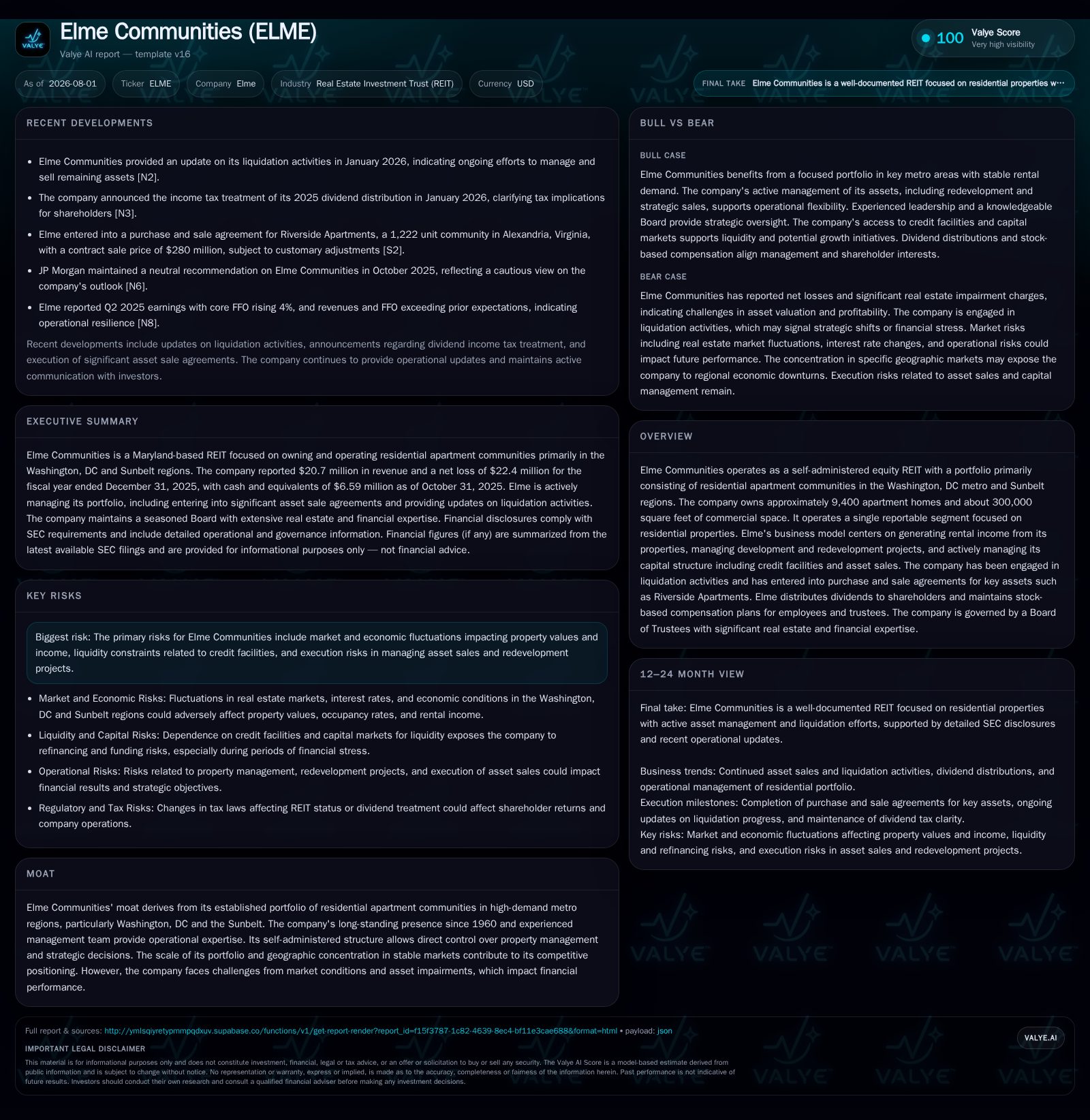
Elme Communities, a self-administered equity REIT with a portfolio concentrated in Washington, DC and the Sunbelt, continues its orderly wind-down through strategic asset dispositions. The recent purchase and sale agreement for Riverside Apartments at $250 million exemplifies Elme’s focus on crystallizing value from its roughly 9,400 residential units. This process is coupled with repayment of substantial secured debt and ongoing liquidity management. While liquidation mitigates some market risks associated with ownership, it also presents execution challenges including timing of sales and meeting financial obligations linked to the $520 million senior secured term loan. The company’s path to dissolution will remain tied to asset sale progress and distribution timing.
Recent Operating Update Highlights Liquidation Progress
Elme Communities’ July 31, 2026 10-Q reveals ongoing execution against its plan of sale and liquidation. Notably, the company entered into a definitive purchase agreement for Riverside Apartments for $250 million—a sizable community comprising 1,222 residential units in Alexandria, Virginia. This transaction underscores Elme’s methodical divestment strategy targeting remaining high-value assets within its portfolio to crystallize cash proceeds ahead of eventual wind-down [S3]. The company continues to update estimates related to transaction costs, debt repayment on its secured $520 million term loan (original principal), and operating expenses expected through liquidation completion. These adjustments reflect actual and projected sales progress plus updated financial obligations tied to the Term Loan’s balance sheet impact [S8], [S14], [S21].
Most asset sales require customary closing conditions including local regulatory compliance such as tenant protections (TOPA in DC) which can delay final closings but are integral to preserving value [S21]. Success in these sales directly impacts the availability of funds to repay secured debt promptly and realize distributions to shareholders as part of the dissolution process.
Business Model Shift from Operating REIT to Liquidating Entity
Elme Communities historically has operated as a self-administered equity residential REIT focused on owning apartment communities primarily in the Washington DC metro area and selected Sunbelt markets. Rental income was generated through leasing approximately 9,400 apartment homes complemented by around 300,000 square feet of commercial space embedded within or near residential complexes. The firm supported growth via redevelopment activity alongside active capital management including refinancing and asset rotation.
As such, revenue was dominantly rental-based recurring income driven by occupancy rates, average rent per unit metrics, lease renewal spreads and incremental NOI—typical KPIs within residential REITs measuring property operations effectiveness. Capital expenditures generally targeted sustaining property quality plus value creation through renovations or repositioning.
However, recent corporate actions pivot Elme’s focus markedly from operational growth toward liquidity maximization via systematic asset sale facilitation leading to managed portfolio shrinkage and eventual corporate wind-down pursuant to approved Plan of Sale and Liquidation arrangements [S2], [S3], [S8]. Rental cash flow now largely supports administrative expenses during transition rather than dividend sustainability or reinvestment.
This transition frames Elme similarly to liquidating trusts or distressed real estate funds where realization events dominate capital deployment considerations over conventional property management successes.
Industry & Competitive Context: Residential REITs Under Distress Pressure
In an industry landscape typically driven by demographic tailwinds like urbanization and rental demand growth—factors supporting stable occupancy rates and steady rental increases—Elme’s liquidating posture contrasts with peers pursuing portfolio expansion or redevelopment (e.g., AvalonBay Communities or Equity Residential). Whereas these larger peers emphasize cap rate compression capture via high occupancy/lease renewal metrics under relatively stable financing regimes, Elme faces elevated refinancing risks amid its maturing term loan exposure.
Unlike more diversified or growth-oriented residential REITs benefiting from scale economies across multiple geographies or product types, Elme’s geographic concentration exposes it to localized market risk intensification. Sale timing pressures could compress pricing received relative to market values if liquidity needs outpace buyer demand.
Substantial leverage remaining amplifies sensitivity to interest rate shifts especially as floating rate benchmarks rise; the Term Loan’s scheduled interest step-up beginning August 2026 introduces material incremental cost absent full repayment before that date.
Overall competitive dynamics are subdued as Elme phases out ownership stakes rather than compete for new tenancy or acquisitions; instead third-party multifamily investors actively evaluate opportunities created by this forced disposition process.
Growth Drivers Have Yielded Place to Execution Risks
Traditional drivers like rising rent due to housing affordability constraints or demographic trends favoring multifamily living no longer materialize as growth catalysts here due to strategic liquidation decisions. Value creation now depends on successful negotiation of sale terms that reflect underlying asset quality amid broader economic uncertainty impacting real estate pricing.
Liquidity realization events hinge upon close coordination with capital providers (especially Goldman Sachs-backed term lenders), buyer diligence completion, regulatory approvals especially tenant right-to-purchase laws prevalent in DC-area assets and maintaining operational stability during sales marketing phases.
Resolution of legal contingencies related to prior portfolio sale transactions constitutes another variable affecting timeline predictability.
Cash generated will fund estimated transaction fees including brokerage commissions plus administrative wind-down costs which have exhibited upward revisions reflecting extended wind-down horizons reported recently alongside employee retention incentives necessary for operational continuity until formal dissolution [S8], [S14].
Risks and Watchpoints: Timing Uncertainty & Cost Escalation Potential
Key risks pivot around uncertainties regarding:
- Timely consummation of pipeline property sales under existing agreements with buyers including CAPREIT Acquisition Corporation for Bethesda Hill assets and FPA Multifamily LLC for Riverside apartments given required closing conditions.[S3]
- Elevated execution risks tied to unexpected transaction delays or cancellations which can increase carrying costs on legacy portfolio components still requiring security maintenance or regulatory compliance.
- Liquidity constraints especially if realized net proceeds deviate from forecasted gross sale values after deducting transactional fees and debt obligation repayments.[S8]
- Maintaining Real Estate Investment Trust tax status throughout liquidation remains critical; loss could trigger significant taxable events impacting distributable earnings capacity[S18].
- Interest expense jumps following August 2026 rate step-ups intensify refinancing urgency amid adverse market rate trends.[S21]
- Employee retention challenges may affect capability during protracted wind-down periods risking suboptimal closure timing.[S18]
Security holder distributions have become largely contingent on liquidating proceeds after clearing all known liabilities reducing dividend predictability going forward [S8]. Enhanced scrutiny around reserve adequacy for unascertained liabilities compounds investor uncertainty.
What To Watch Next: Milestones In Asset Sales & Capital Events
Investors should monitor:
- Closing dates on major remaining sale agreements notably Riverside Apartments following amendment cycles through July 23, 2026 [S3].
- Updates regarding repayment schedules and full discharge of the $520 million secured Term Loan including any prepayment penalties or refinancing alternatives announced[S8],[S21].
- Board communications relating to timing of wind-down activities including potential conversion into a liquidating trust vehicle or final corporate dissolution filings[S18],[S24].
- Quarterly earnings commentary updating projections for transaction cost absorption levels versus actual incurred amounts[S8],[S14].
- Any material legal proceedings affecting outstanding assets or management liabilities connected to recent portfolio transactions[S18].
- Regulatory developments impacting local tenant protections that may delay closings in DC-area properties notably those governed by TOPA rules[S3].
Indicators like successful lease renewals during transition phases could stabilize some operating cash flow temporarily but overall financial resilience primarily tracks asset disposition velocity plus realized net sales proceeds relative to liabilities.
Financial Profile Discussion
Cash balances were limited at just over $6.5 million as of late October 2025[F1], underscoring constrained liquidity amid ongoing disposal campaign demands. Taken together these dynamics position Elme squarely in a deleveraging phase funded largely through transactional proceeds with no discernible lever for organic earnings-driven capital generation until disposal program completion.[S2],[S3]
Capital allocation has shifted decisively toward repaying creditor claims first under Plan of Sale mandates before any residual returns become distributable as liquidating dividends.[S8],
This financial posture is standard for entities transitioning towards exit outcomes but diverges sharply from more robust operating residential REIT peers prioritizing same-property NOI growth supported by rent levies and occupancy improvements.
This analysis synthesizes SEC filings through mid-2026 reflecting Elme Communities’ transition from an operating residential equity REIT into a liquidation entity managing complex asset dispositions within high-value metro markets. Continued attention is warranted on asset sale closures against debt reduction goals coupled with regulatory compliance risks inherent in Washington DC area rental properties framework.
This document does not constitute investment advice or research views but aims to highlight key operational transitions shaping Elme's evolving business model amid broader real estate sector considerations.
Disclaimer: This is research-only, informational analysis and not investment advice. It may include AI-generated interpretation and general industry context. Always verify important details using primary sources.

Comments