
TXNM Energy’s Regulatory Frontiers and Capital Strategy Shape Next Phase
TXNM’s recent quarterly results spotlight the critical influence of regulatory approvals on its capital-intensive utility operations and financial trajectory.
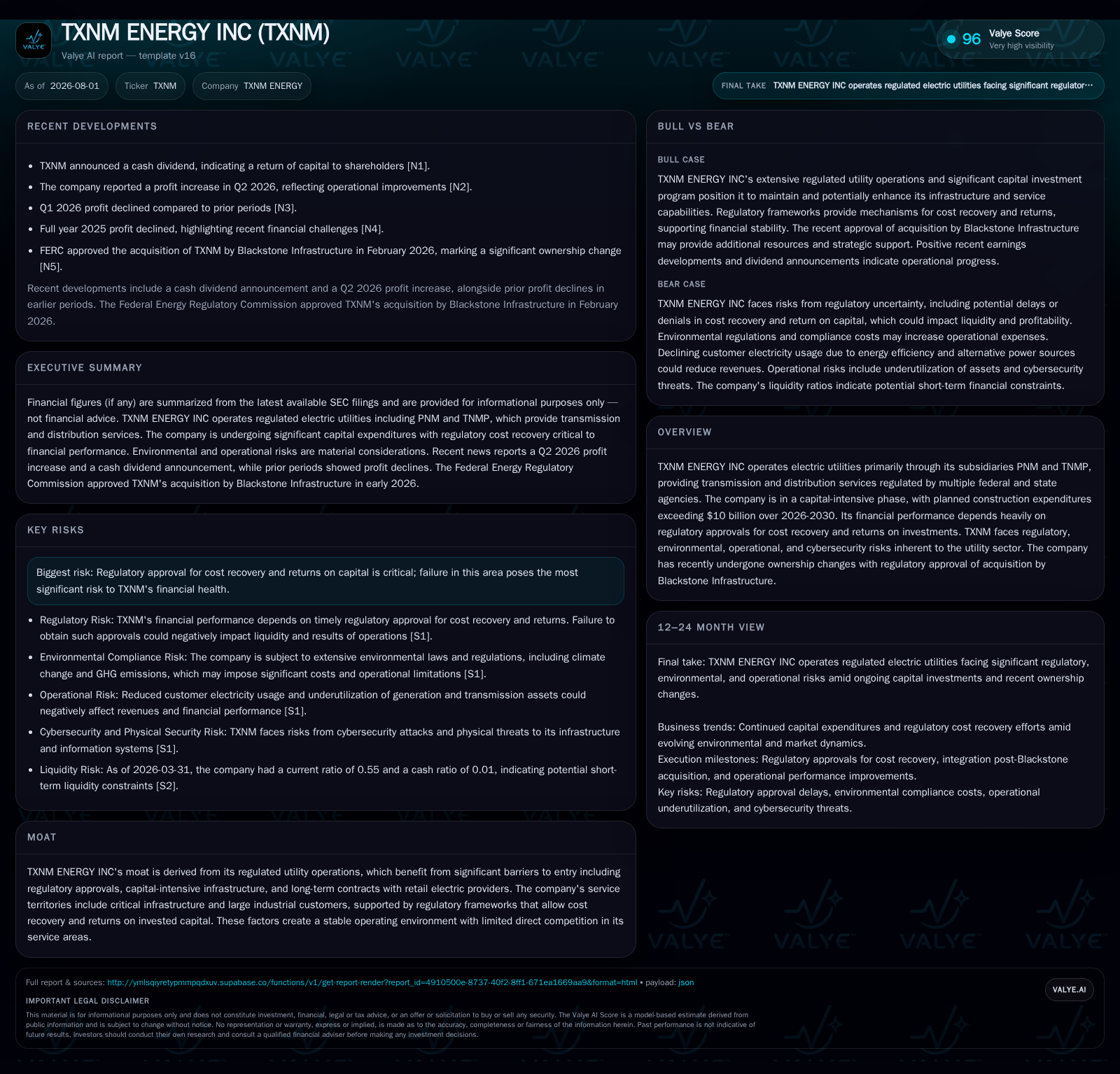
TXNM Energy’s Q2 2026 filing reveals steady execution of a multibillion-dollar capital expenditure plan amid unchanged regulatory risk factors and evolving load demand dynamics. The company derives revenue primarily from regulated transmission and distribution services operated through subsidiaries PNM and TNMP, anchored by rate cases administered by state commissions. TXNM’s growth prospects hinge on timely regulatory cost recovery to sustain returns on invested capital during a period marked by significant grid investments and shifting customer consumption patterns. Liquidity remains constrained by heavy capex funding needs, underscoring sensitivity to regulatory outcomes in the near term.
Q2 Operating Update Shows Capital Execution Amid Tight Regulatory Screens
TXNM Energy’s latest quarterly filing dated July 31, 2026, reports continued execution of its extensive capital investment program without material changes to previously disclosed risk factors [S2]. Financial headlines include incremental profit gains reported alongside investments concentrated in transmission and distribution infrastructure upgrades operating mainly through its subsidiaries Public Service Company of New Mexico (PNM) and Texas-New Mexico Power Company (TNMP) [N2]. This steady operating cadence suggests management is navigating the complexities of multijurisdictional regulation effectively during this transition phase post Blackstone Infrastructure acquisition [S3]. A recent announcement of cash dividends further signals confidence in near-term cash flows supported by operational steadiness despite the capital strain [N1].
The absence of new or heightened risk disclosures reaffirms that near-term uncertainty predominantly revolves around regulatory approvals rather than operational or market shocks. These approvals dictate the firm’s ability to recover increased construction costs, depreciation, and financing expenses embedded in their rate cases.
Regulatory Architecture: The Gatekeeper to TXNM’s Profitability and Cash Flow
TXNM operates within a heavily regulated framework where public utility commissions govern allowed rates for transmission and distribution services. PNM is overseen primarily by the New Mexico Public Regulation Commission (NMPRC) and Federal Energy Regulatory Commission (FERC), while TNMP falls under Texas Public Utility Commission (PUCT) jurisdiction [S1]. These bodies approve cost recoveries that translate infrastructure spending into revenue allowances plus authorized returns on invested capital (ROIC), establishing both top-line growth potential and margin stability.
The company’s profitability hinges critically on timely approvals within these rate-setting processes. Delays or unfavorable rulings can introduce regulatory lag, compress liquidity, restrict recovery of undepreciated assets upon retirement, or deny recovery of renewable integration costs—each threatening TXNM’s financial health [S1]. Current macroeconomic conditions—especially rising interest rates—compound challenges by inflating financing costs tied to ongoing CapEx programs. The dynamics underscore a nuanced balancing act between aggressive infrastructure renewal needs and obtaining regulator buy-in for corresponding rate adjustments.
$10B CapEx Program Sets Backbone for Future Transmission & Distribution Growth
TXNM’s five-year forecast entails construction expenditures exceeding $10 billion through 2030—a scale comparable to other large regulated utilities undergoing grid reinforcement cycles [S1]. This investment spree reflects mandates spanning asset modernization, system reliability enhancements, cyber-physical security upgrades, environmental compliance measures including renewable portfolio standards adherence, and decommissioning of aging fossil assets.
Capital outlays drive expansion of the regulated rate base, underpinning future revenue growth as regulators permit cost pass-through accompanied by a fair ROIC. Like peers such as Southern Company or NextEra Energy, this phase is capital intensive with substantial upfront funding requirements before benefits accrue via rate filings. Any slippage in permitted cost recovery or protracted approval timelines risks magnifying financing burdens while constraining earnings visibility.
'Load Demand Under Pressure': Customer Behavior Meets Utility Economics
A persistent challenge facing TXNM’s business model is mitigating the impact of declining or volatile electricity consumption volumes due to accelerating energy efficiency adoption, distributed generation penetration (e.g., rooftop solar), alternative power sources usage, and broader economic slowdowns [S1]. This volume contraction pressures absolute revenue since T&D revenues partially depend on MWh throughput delivered to retail electric providers who serve end customers.
To offset this structural decline in load growth, unit prices must increase to maintain cost recovery levels—pushing tariff rates higher per MWh consumed. This pricing dynamic can create a feedback loop where further price hikes incentivize additional conservation efforts or technology shifts away from grid reliance. Navigating this balance requires sophisticated regulatory engagement coupled with innovative rate design approaches that align utility incentives with evolving customer behaviors.
'Moat Analysis': Regulated Service Territories and Barrier to Entry Sustain Stability
TXNM's strategic strength lies in its position as a regulated natural monopoly holding exclusive franchise territories secured through licensing agreements for PNM in New Mexico and TNMP in parts of Texas [F1], [S1]. These territorial rights prevent direct competition at the distribution level while anchoring long-term customer relationships via contracts with retail electric providers.
This moat is reinforced by significant barriers to entry including capital intensity of infrastructure development, complex federal/state permitting regimes involving multiple agencies (PUCT/NMPRC/FERC etc.), and established grid interconnections integral to local economies. However, this regulatory shield comes with dependency risks; adverse regulatory decisions could impair allowed returns or constrain cost recovery profiles thus directly impacting creditworthiness and profitability.
'Growth Enablement': Grid Modernization, Electrification Trends, and Renewable Integration Potential
Future growth opportunities for TXNM are closely linked to mandated grid modernization programs designed to enhance system reliability indices (such as SAIDI/SAIFI), enable smarter electrical networks capable of integrating distributed resources efficiently, and comply with renewable portfolio standards championed at state levels [S1]. Investments in battery energy storage systems (BESS), advanced metering infrastructure (AMI), cybersecurity upgrades, and network automation are primed to expand utility service capabilities.
Additionally, expanding electrification initiatives across transportation sectors coupled with potential population growth trends in core service areas predicate structural increases in electricity demand over longer horizons. Each development needs concurrent alignment within the multi-jurisdictional regulatory environment to secure cost pass-throughs enabling financially accretive deployments.
'Watchpoints': Pending Rate Cases, Recovery Risks, and Cybersecurity Challenges Ahead
Near-term risk management centers on several pending base rate cases such as those concerning TNMP that will govern allowed cost recoveries post-capital spend ramp-up [S1], [S2]. Unfavorable outcomes could delay reimbursement timing or limit inclusion of certain expenditures thereby squeezing margins.
Furthermore, rising operational demands from enhanced cybersecurity protocols—essential amid increasing threats to grid integrity—may elevate operating & maintenance expenses beyond historical norms affecting operating leverage.
Environmental regulations pose additional uncertainty related to GHG reductions or asset retirements requiring incremental spend not fully predictable today. An active docketed litigation environment around these themes adds complexity ahead.
Disclaimer: This is research-only, informational analysis and not investment advice. It may include AI-generated interpretation and general industry context. Always verify important details using primary sources.

Comments