
Meritage Homes Advances Affordable, Energy-Efficient Housing Amid Changing Market Dynamics
Meritage Homes' Q2 2026 report underscores backlog resilience and strategic focus on affordable, energy-efficient homes amid cyclical headwinds.
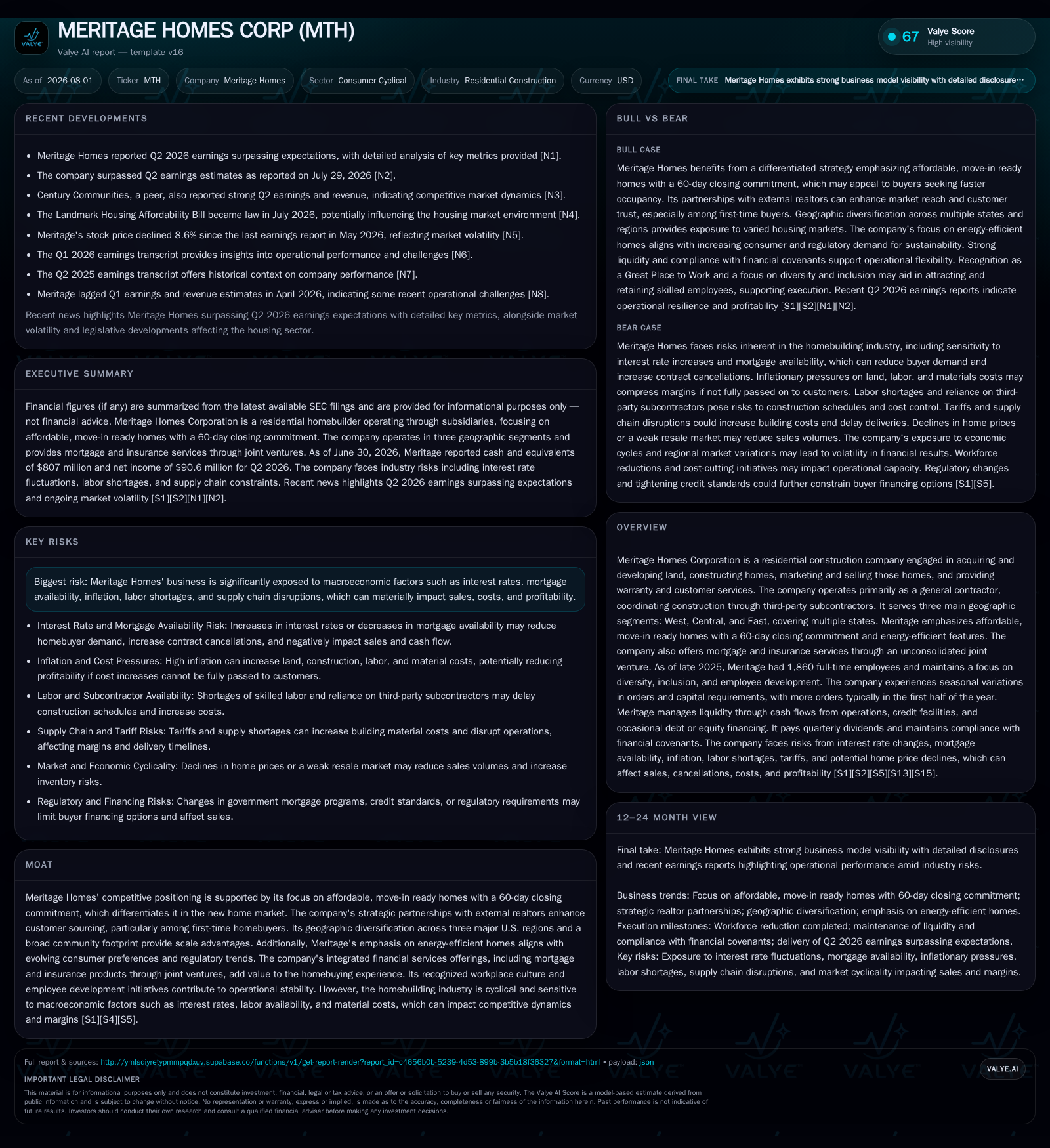
In its latest quarterly filing, Meritage Homes highlighted a stable backlog supported by its focus on affordable, energy-efficient housing and a fast closing cycle, which help mitigate the impact of fluctuating interest rates and demand. The company’s general contractor model leverages subcontractor coordination to maintain operational flexibility amid labor market constraints. Geographic diversification across key U.S. regions underpins risk management, while integrated mortgage and insurance joint ventures enhance customer value and revenue streams. Risks remain from macroeconomic pressures such as rising mortgage rates and supply chain volatility.
Q2 Operating Update Highlights Backlog Resilience during Demand Fluctuations
Meritage Homes’ Q2 2026 10-Q filing portrays a housing backlog that remains resilient despite pressure on new orders during an environment of elevated interest rates [S2]. While order volumes softened compared to prior periods—a typical cyclical response exacerbated by mortgage rate volatility—the backlog of homes under contract reportedly held at a level providing revenue visibility through upcoming quarters. This mix of stable backlog with tempered current selling activity reflects typical seasonal trends where the first half of the calendar year generates more orders than the second half but also illustrates how Meritage’s geographic diversification prevents any one regional market downturn from significantly impairing overall sales momentum [S1], [N1]. Maintaining consistent backlog levels mitigates working capital swings associated with new community pacing and supports predictable home closing cadence.
Cancellation rates were not explicitly detailed in the latest filing but historically are a key metric for gauging backlog quality in residential construction. Meritage’s ability to uphold a firm backlog through fluctuating mortgage availability signals some durability in customer demand for its value proposition.
Meritage's General Contractor Model Leverages Subcontractor Coordination Efficiency
Meritage operates solely as a general contractor, coordinating construction mainly through third-party subcontractors rather than employing large direct labor forces [S1]. This model is critical in an industry where skilled labor shortages and rising wage pressures are persistent challenges. By managing subcontractors across its regional operations, Meritage can adjust labor utilization flexibly in response to fluctuations in project starts or completions without bearing full fixed employment overheads.
This reliance on subcontractors enhances margin management by shifting some variable cost exposure while allowing the company to maintain construction cycle times necessary for its quick closing promise—around 60 days from contract to settlement for move-in ready homes. In comparison with some peers who maintain direct labor forces or vertically integrate more construction activities, Meritage’s approach balances operational leverage with agility during volatile labor markets.
Geographic & Product Strategy Anchored in Affordable, Energy-Efficient Housing
A notable strategic pillar for Meritage is its emphasis on affordable housing combined with energy-efficient features that respond to both consumer preference shifts and tightening regulatory standards [S1]. The company's communities span three major U.S. regions—West, Central, and East—covering multiple high-growth states. This geographic spread lessens concentration risk, insulating performance against localized economic slowdowns or regulatory changes.
Affordable homes priced within reach of first-time buyers dominate Meritage’s portfolio with guaranteed quick closings acting as a critical differentiator versus competitors like Toll Brothers who focus more on luxury markets. Additionally, Meritage integrates green building elements aligning with federal tax incentives under IRC §45L credits, though evolving eligibility rules are influencing effective tax rates [S13]. This positions the company well among peers such as KB Home known for sustainability but differs from national builders like D.R. Horton who have broader segment coverage.
Mortgage & Insurance Joint Ventures: Enhancing Customer Retention & Revenue Streams
Meritage supplements its homebuilding revenue by providing mortgage financing and insurance products through unconsolidated joint ventures [S1]. This integration creates switching costs for customers who benefit from streamlined purchasing experiences and fosters cross-selling opportunities. The arrangement generates indirect financial service income while increasing buyer stickiness—a significant advantage given the cyclical and competitive nature of residential construction.
Compared to peers like Lennar Corporation that have diversified financial service operations more deeply embedded into their business lines, Meritage’s venture model maintains risk containment yet taps into growing ancillary revenue pools—a balance that contributes positively to lifetime customer value.
Competitive Positioning Versus National Peers on Pricing Power and Delivery Speed
Meritage’s commitment to delivering move-in ready homes within approximately 60 days from contract signing enhances pricing power in an environment where buyers increasingly demand speed coupled with affordability [S1], [N2]. This contrasts with many homebuilders whose longer construction timelines expose them to cancellations or margin erosion through cost overruns.
In peer context, PulteGroup also emphasizes affordable homes with efficient delivery though precise closing period tactics differ. Maintaining consistency here is vital since interest rate hikes raise holding costs for buyers awaiting settlement.
Growth Drivers Focus: Land Acquisition Discipline and Strategic Community Expansion
The company exercises discipline in land acquisition targeting community development projects that align with absorption rate goals and support sustained backlog replenishment [S1]. The land acquisition strategy is prudently balanced against available financing capacity under an amended credit facility that recently extended maturity to mid-2031 with increased size up to $980 million—and accordion availability beyond—that ensures liquidity to fund growth initiatives without onerous refinancing risk [S27].
Maintaining optimal lot inventory is crucial to avoiding overbuilding risks common in residential construction cycles while capturing market demand effectively. The ability to time acquisitions based on market intelligence supports smoother working capital deployment versus competitors aggressively expanding during volatile phases.
Operational Risks from Macroeconomic Pressures and Supply Chain Volatility
Meritage faces typical industry headwinds including sensitivity to mortgage interest rate fluctuations which constrain homebuyer affordability and reduce new orders [S1], [N5]. Inflationary pressures affecting raw materials (lumber, steel) and subcontractor wages threaten gross margin stability unless sufficiently passed onto pricing or offset by productivity gains.
Supply chain interruptions remain a variable impacting construction scheduling despite intensified logistics oversight efforts. Regulatory compliance demands create additional operating complexity given differing state licensing requirements for contractors and real estate agents involved in home sales [S1]
Customer cancellation risk escalates notably during rising rate cycles as financing availability tightens or alternative housing options become more attractive—this dynamic remains a watchpoint for backlog quality assessment going forward.
What To Watch: Order Trends, Backlog Conversion, Margin Trajectory and Settlement Timing
Investors should monitor upcoming quarterly reports for updates on order volumes relative to seasonality patterns observed historically. Backlog conversion velocity into closed sales will be essential for validating near-term revenue projections especially if economic headwinds persist.
Margin trajectory post-normalization of supply chain issues will indicate whether operational efficiencies balance cost inflation. Settlement cadence tied to the ~60-day closing target must hold steady or improve to avoid liquidity strain related to homebuyer deposits or cancellations.
Additional disclosures around cancellation rates or deposit forfeiture trends would clarify backlog firmness amid macroeconomic uncertainty.
Financial Profile Discussion
This liquidity strength coupled with access to a large revolving credit facility extending through mid-2031 reduces refinancing risk materially over the medium term while funding strategic growth investments in targeted markets. Free cash flow generation should continue benefiting from completed community sales even if new order intake pauses during tougher interest rate environments.
This analysis synthesizes Meritage Homes Corporation's most recent operational disclosures alongside broader industry dynamics characteristic of national residential builders emphasizing affordable housing solutions complemented by financial service offerings. It highlights the company's strategic levers used to buffer cyclicality inherent in homebuilding sectors while delineating risks tied primarily to macroeconomic variables external to firm control.
Disclaimer: This is research-only, informational analysis and not investment advice. It may include AI-generated interpretation and general industry context. Always verify important details using primary sources.

Comments