
RBC Bearings Balances Aerospace Cyclicality and Industrial Diversification Amid Margin Pressures
RBC Bearings' Q1 fiscal 2027 results reinforce its engineering-led niche in precision bearings while navigating cyclical aerospace demand and operational costs.
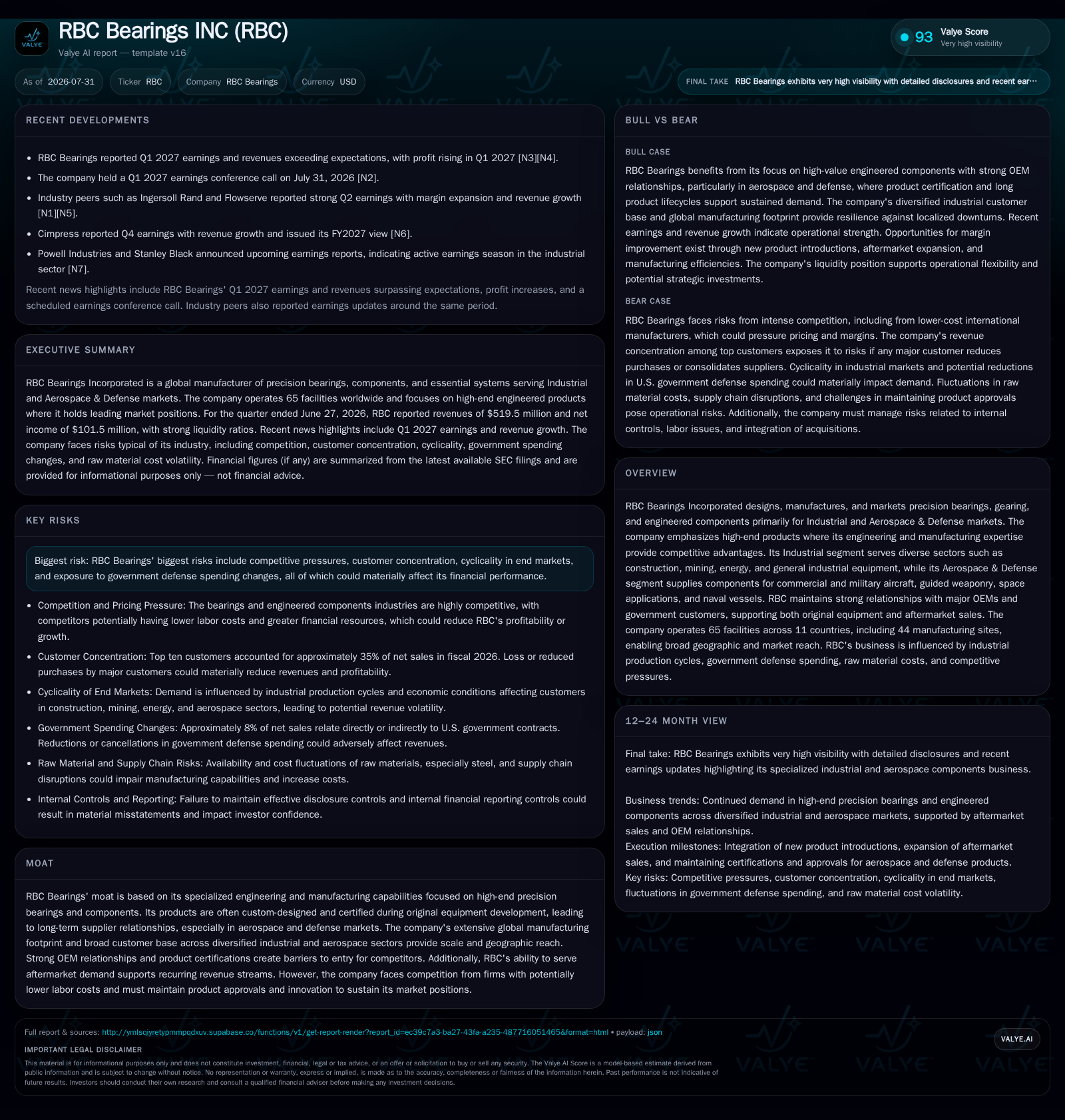
RBC Bearings reported solid financial performance for Q1 fiscal 2027, reflecting steady demand from its diversified industrial markets alongside a cyclical aerospace and defense segment. The company’s focus on high-end precision bearings and engineered components, supported by extensive product certification and long-term OEM relationships, sustains its competitive moat. However, margin pressures from raw material inflation and supply chain constraints persisted. The strategic balance between original equipment sales and aftermarket revenue streams, underpinned by a broad manufacturing footprint across 11 countries, positions RBC to capitalize on aerospace production ramps and defense modernization while mitigating industrial cyclicality risks.
Recent Operating Update
The Q1 earnings beat estimates led to improved investor attention on the company's ability to navigate macroeconomic headwinds including raw material inflation (notably steel) and constrained supply chains [N3][S1]. Margins faced some compression attributable to increased input costs; however, management emphasized ongoing manufacturing efficiency gains intended to arrest margin erosion during evolving cost pressures
Business Model Analysis
RBC Bearings operates as a specialized manufacturer of precision bearings, gearing, and engineered components aimed predominantly at industrial machinery sectors as well as aerospace and defense customers. Revenue is generated by selling both original equipment manufacturer (OEM) parts used in new builds and aftermarket replacement components crucial for maintenance cycles.
The company's industrial segment accounts for roughly 58% of net sales and spans diverse sectors such as construction machinery (serving customers like Caterpillar and Komatsu), mining equipment, energy extraction systems (including Halliburton), packaging machinery, semiconductor equipment, and logistics applications serviced via distributors including Motion Industries and Baldwin Supply [S1][S15]. This wide span reduces exposure to any discrete downturn within one vertical or geopolitical market change.
Conversely, the Aerospace & Defense segment forms approximately 42% of revenues. RBC supplies highly engineered products—many custom-designed during aircraft or weapons system development—to major OEMs like Boeing, Airbus, Lockheed Martin, Northrop Grumman, Raytheon as well as U.S. government defense agencies. The company's products are deeply integrated into aircraft life cycles with many components requiring formal certifications that establish RBC as a primary supplier through the life of the aircraft or military platform [S1][S26]. Given this embedded nature, a significant portion of aftermarket sales derive from prior OEM contracts.
The business model relies heavily on long-term OEM certifications which act as a barrier to entry for competitors lacking engineering expertise or product approvals—a moat further fortified by RBC's vast manufacturing footprint: over 65 facilities spanning 11 countries with 44 dedicated manufacturing centers enabling geographic reach alongside supply-chain agility [S1].
Revenue mechanics are influenced by new equipment production rates driving OEM orders plus recurring aftermarket replacements driven by operational wear or scheduled maintenance. Factors such as engineering change orders affect product mix complexity and consequently manufacturing margins.
Industry Structure & Competitive Position
The precision bearing industry is typified by fragmented competition alongside entrenched relationships between suppliers like RBC Bearings and major aerospace or industrial OEMs. Competitors tend to range from global diversified players such as SKF or NSK Ltd., who leverage scale-based efficiencies across broad geographies, to niche firms competing on engineering innovation or price.
RBC positions itself toward the higher-value end where precision engineering capabilities enable customer-specific customization—especially important in aerospace where compliance with military specifications can require five to six years for product approval [S26]. This focus contrasts with commoditized bearing segments dominated by lower-cost manufacturers.
Strong OEM relationships facilitate not only initial equipment sales but also recurring aftermarket penetration—a key driver for stable revenue streams given less volatility than new-build demand alone. However, exposure remains sensitive to aerospace production cycles which fluctuate with commercial aircraft order backlogs or government defense appropriations.
RBC's geographic diversification reduces vulnerability to regional downturns but exposes it to currency translation fluctuations mitigated partially by derivative instruments [S25]. Its top ten clients constitute about 35-44% of annual net sales—a moderate concentration that amplifies risks if any key customer experiences an adverse business event or restructures supplier arrangements [S15][S21].
Growth Drivers
Several factors underpin RBC’s growth outlook: - Aerospace Production Ramps: Commercial aircraft manufacturers increasing build rates create opportunities for higher OEM content orders [S1][S15]. New model launches also drive demand for innovative component designs requiring certification.
- Defense Modernization Programs: Government spending on upgraded fighter jets, naval vessels, satellites, and guided weaponry promotes recurring contracts—especially aftermarket maintenance.
- Industrial Market Expansion: Ongoing capital investments in mining, construction equipment upgrades amid economic growth spur new demands for precision bearings.
- Aftermarket Sales Growth: With installed base expansion comes increased replacement parts demand providing relatively stable revenue streams less affected by new build cyclicality.
- Manufacturing Process Improvements: Continuous efficiency enhancements aim at margin recovery amidst inflationary cost pressures.
- International Market Penetration: Expansion beyond domestic incumbency into global industrial hubs offers growth potential aided by RBC’s multi-country manufacturing footprint
KPIs such as order backlog (reported at $2.3 billion at end FY2026) reflect forward demand but remain subject to cancellation risk especially given macroeconomic uncertainties impacting end-markets [S19]. Manufacturing capacity utilization rates are critical quarterly metrics influencing volume leverage effects.
Risks & Watchpoints
RBC’s operational profile entails several watchpoints:
- Cyclicality across aerospace production volumes coupled with defense budgetary shifts can lead to revenue volatility.
- Customer Concentration risks arise from substantial dependence on a limited number of large industrial OEMs and Aero/Def contractors.
- Raw Material Inflation, particularly steel pricing fluctuations directly impact production costs; partial pass-through is subject to competitive pricing pressures.
- Supply Chain Constraints, including lead times for critical subcomponents or materials could hinder timely deliveries affecting customer satisfaction.
- Product Certification Retention is essential; loss would reduce competitive positioning dramatically.
- Competitive Pressures from lower-cost foreign suppliers require continuous innovation and efficiency improvements.[S25]
- Order Backlog Cancellations may materially affect near-term revenue recognition if economic conditions deteriorate.
- Debt Levels stemming from recent acquisitions constrain financial flexibility despite currently manageable leverage ratios.[F1]
- Legal & Regulatory Matters, including ongoing DOJ investigations related to pandemic relief claims, although currently not expected to be materially adverse.[S5]
What To Watch Next
Investors should monitor several near-term indicators: - Quarterly order backlog updates indicating durability of Aerospace & Industrial bookings. - Margin trends reflecting raw material cost pass-through effectiveness vs efficiency gains. - Progress on international expansion efforts enhancing geographic diversification. - New product certification approvals or delays impacting program wins/losses. - Defense budget announcements affecting government contract renewals. - Any developments regarding ongoing DOJ investigations or litigation exposures [N3][F1][S2]
Financial Profile Discussion
RBC Bearings maintains a balanced financial position albeit with moderate leverage primarily due to past acquisition funding. As of June 27, 2026, cash and equivalents stood at $124.5 million versus total debt approximating $496.4 million yielding a net debt position near $371.9 million [F1]
Maintaining compliance with debt covenants remains critical given interest rate sensitivity linked to variable rate borrowings noted in earlier disclosures [S4][S6]
Conclusion
RBC Bearings navigates a complex interplay between cyclical aerospace demand tempered by robust diversification into industrial end markets supported by aftermarket revenue streams. Its moat rooted in engineering expertise and product certification affords pricing power though margin resilience faces challenges amid inflationary inputs. Strategic emphasis on global footprint expansion and manufacturing efficiency gains will be key for sustaining competitive differentiation. Monitoring backlog stability alongside raw material cost trends will provide early signals of operational momentum going forward.
This analysis is provided solely for informational purposes without investment advice.
Disclaimer: This is research-only, informational analysis and not investment advice. It may include AI-generated interpretation and general industry context. Always verify important details using primary sources.

Comments