
Patent Defense and Operational Leverage Define Outdoor Specialty Products’ Growth Barriers
Outdoor Specialty Products, Inc. remains constrained by reliance on its patented Reel Guard and a single-operator model despite ongoing product innovation and steady patent maintenance.
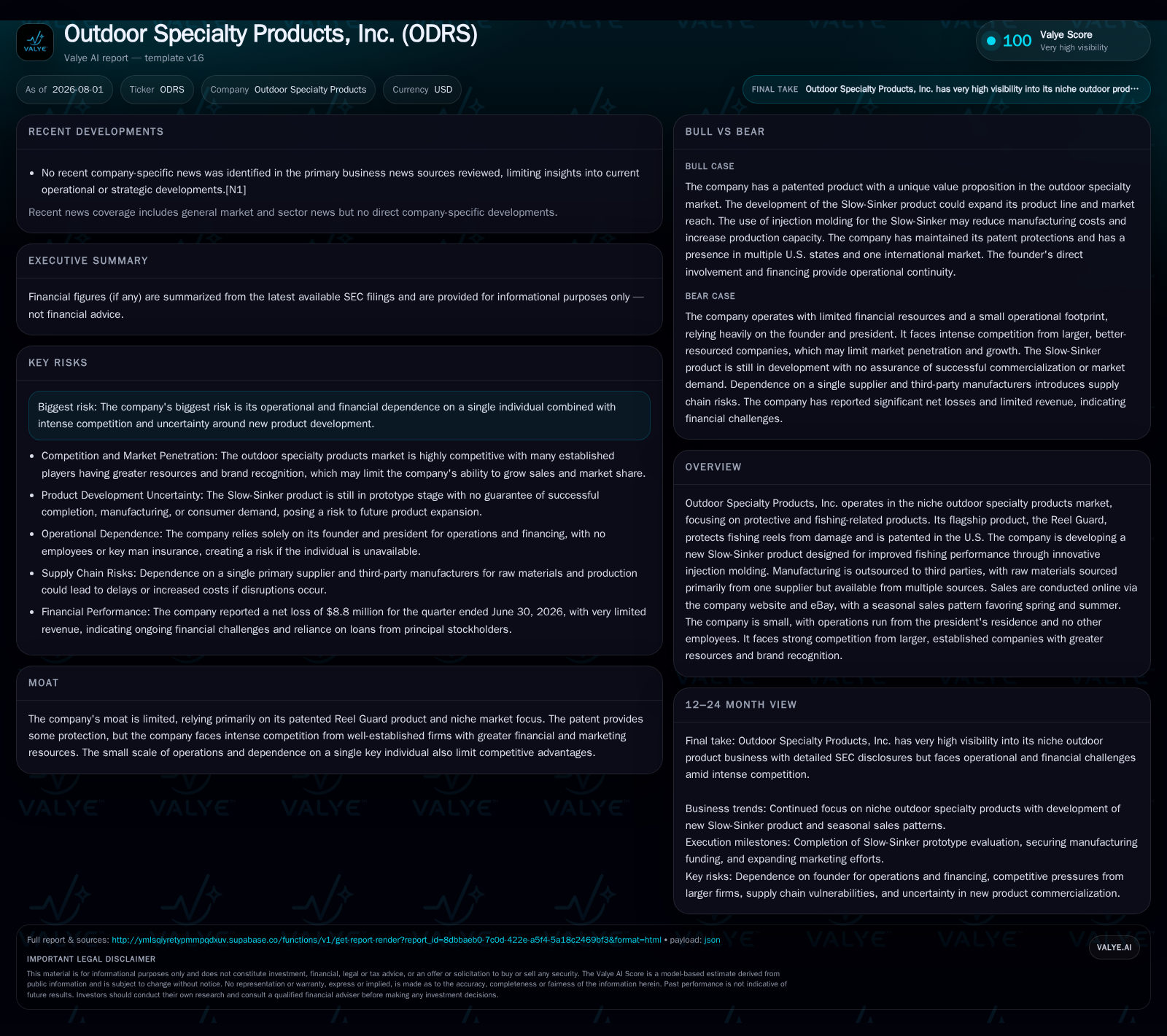
Outdoor Specialty Products, Inc.'s latest quarterly filing reveals continued operating losses and confirms focus on protecting its core patented product in a competitive niche. The business depends heavily on its Reel Guard fishing reel protector, manufactured through third-party injection molding with raw materials sourced mainly from one supplier. Seasonal sales volatility and single-operator management compound operational risks as the company advances prototype development of a Slow-Sinker product. Facing larger peers with stronger brand recognition, growth hinges on successful commercialization of new products and securing capital for manufacturing scale-up.
Latest Quarterly Operating Realities: Confirmation of Scale Constraints and Patent Status
Outdoor Specialty Products reported in its Q3 2026 filing a continuation of operating losses with operating income approximately negative $42,421 as of September 30, 2025, underscoring persistent challenges in scaling its niche fishing accessory business [S2],[F1]. This quarter’s disclosure reaffirms active patent fee payments that maintain exclusivity over the pivotal Reel Guard product — U.S. Patent No. 9,872,485 issued in 2018 — signaling management’s intent to defend its limited moat despite financial strain [S1],[S16]. Such patent maintenance is vital for protecting the company’s flagship asset against competitors but also highlights reliance on this single innovation amid intense market competition.
Niche Product Reliance: The Patented Reel Guard as Primary Revenue Driver
The company's revenue hinges primarily on the Reel Guard, a proprietary protective cover designed for fly fishing reels up to 4.25 inches diameter featuring a thin rubberized material adhered through custom pre-cut strips allowing easy removal without damage [S1]. Invented by founder Kirk Blosch in 2014 and patented nationally, this product is highly specialized with limited application beyond fly fishing reels but considered potentially useful for some deep-sea reels [S16]. The bespoke installation procedure supports a niche user base yet inherently limits broader brand recognition or mass market appeal compared to diversified peers who offer extensive fishing gear assortments backed by strong trademarks [S8]. Thus, while the patented design provides differentiation, it also constrains market penetration and revenue expansion.
Manufacturing Outsourcing Challenges within Specialized Injection Molding
Production is fully outsourced through third-party manufacturers employing injection molding technology using company-owned custom molds for both the Reel Guard and the early-stage Slow-Sinker prototype product lines [S1],[S15]. Critical supply inputs include adhesive strips sourced from a national manufacturer but purchased locally in minimum lot sizes of 1,000 units per order indicating inventory inflexibility at small volumes. This outsourcing model controls fixed costs but introduces supply chain dependency risks; any delays or vendor disruptions can impact fulfillment schedules given the company's limited internal buffer capacity [S10]. Additionally, injection molding specialized components demands upfront tooling investments that are currently constrained by capital availability—limiting rapid scale-up or introduction of new variants without secured funding [S16].
Seasonality’s Impact on Sales Volume and Inventory Management
Sales exhibit pronounced seasonality centered on spring and summer months aligning with peak outdoor fishing activity periods [S9]. This seasonality enforces episodic demand surges requiring prudent inventory forecasting to avoid stockouts during high-demand windows while minimizing capital locked in excess stock off-season given tight liquidity. The company maintains a modest inventory of raw adhesive materials and finished goods (each approximately $1,000-$2,500) reflecting conservative stocking practices suitable for its direct-to-consumer web-based distribution via its own site and eBay listing platforms [S9],[S10]. However, small scale amplifies risks of inaccurate demand estimation which could either erode reputation through unavailability or worsen cash flow through unsold inventory holding.
Competitive Landscape: Facing Larger Peers with Stronger Brand Recognition
ODRS confronts a highly competitive specialty outdoor products sector dominated by established firms possessing significant marketing budgets, broader product assortments, trademark protections, and loyal customer bases [S8]. Competitors typically benefit from vertical integration or extensive outsourcing chains supporting efficient cost structures and wider distribution reach. By contrast, Outdoor Specialty Products' narrow product focus coupled with minimal promotional spending limits its ability to capture meaningful share or exert pricing power. This dynamic restricts revenue growth potential absent successful new product commercialization or breakthrough marketing initiatives to increase brand awareness within the fishing accessories niche [S8].
Growth Initiatives Hinged on Innovation Pipeline and Funding
The company’s principal growth avenue lies in developing the innovative Slow-Sinker fishing sinker product designed as a single injection molded piece made from denser-than-water material to provide slow sinking rates optimized for long-distance casts [S1],[S16]. The design allows stacking multiple units to customize weight parameters, promising production efficiency gains relative to multi-component alternatives. A patent application was filed in 2024 demonstrating strategic IP protection efforts parallel to Ramp-Up plans. However, manufacturing commencement has been deferred pending prototype evaluation completion and securing sufficient capital to finance tooling and initial production runs highlighting ongoing funding constraints restricting expansion into complementary product lines presently [S1],[S16].
Key Individual Dependence: Operational Risks Amid Limited Resources
Operations remain tightly concentrated under founder and president Kirk Blosch who manages virtually all functional areas without additional employees or contractual key man insurance coverage [S6]. This operational centralization poses substantial execution risk; any absence or incapacity could materially disrupt production scheduling, order fulfillment, patent maintenance arrangements, or financial oversight. Unlike peer entities benefiting from specialized staff across R&D, marketing, supply chain management, this human resource bottleneck limits scalability directly tied to one individual’s capacities. Without structural scaling or delegation mechanisms implemented as resources allow, this risk represents a critical vulnerability to sustainable growth prospects.
What to Watch Next: Product Development Milestones and Demand Signals
Key internal milestones include finalizing Slow-Sinker prototype evaluation with acceptable performance metrics followed by tooling validation leading into low-volume production testing stages planned once additional funding is secured [S2],[S16]. External indicators such as initial customer feedback from test runs or pilot sales could serve as early demand signals influencing scale-up decisions. Likewise monitoring seasonal sales spikes for Reel Guard will validate resilience amidst competitive pressures while gauging any shifts in customer acquisition costs via e-commerce analytics could offer insights into marketing effectiveness. These metrics combined will be pivotal in assessing whether ODRS can leverage innovation beyond its sole existing protectant product toward meaningful revenue diversification.
Financial Profile Discussion: Liquidity Support and Funding Needs
As of June 30, 2026, Outdoor Specialty Products holds approximately $1,291 in cash and equivalents alongside total current assets near $7,998 indicating constrained liquidity reflective of ongoing operational expenditures exceeding top-line inflows [F1],[S2]. No recent disclosures indicate new debt issuances or refinancing activities since prior amendments extended revolving promissory note maturities into late 2026 under low-interest terms predominantly associated with loans from the president himself [S5],[S6]. This fragile cash position underscores an urgent necessity for fresh capital injections either via equity or lending instruments to fund planned Slow-Sinker manufacturing launches or bridge working capital gaps due to seasonal sales fluctuations. Without such funding access or meaningful revenue increases from existing products, sustaining day-to-day operations may prove challenging.
Outdoor Specialty Products occupies an intensely competitive niche bounded by dependence on a patented reel protector developed nearly a decade ago coupled with operational leverage resting on one individual managing all facets of the business out of his residence.
Its fundamental challenge revolves around breaking scale barriers through successful commercialization of new innovations like the Slow-Sinker while navigating seasonality-induced demand swings using lean inventory tactics supported by outsourced manufacturing specialists relying on third-party injection molding expertise.
Facing well-resourced incumbents able to offer diversified fishing accessory portfolios backed by recognizable branding places an added premium on securing consistent patent defense alongside innovation execution under tight capital constraints – all factors that collectively establish formidable barriers impacting growth trajectory absent further investment or strategic partnerships.
This analysis refrains from estimating market share or peer-specific financial ratios due to limited disclosures but situates ODRS clearly within patterns recognizable across specialty outdoor equipment startups struggling against entrenched majors' economies of scale alongside acute dependence on founder-driven execution models.
This report is prepared solely for information purposes based on public filings as of July 31, 2026. It does not constitute investment advice.
Disclaimer: This is research-only, informational analysis and not investment advice. It may include AI-generated interpretation and general industry context. Always verify important details using primary sources.

Comments