
AWARE Inc. Grapples with Revenue Decline While Eyeing Strategic SaaS Transition
Latest filings highlight AWARE’s operational challenges amid a shift to subscription-based biometric SaaS, alongside persistent net losses and liquidity resilience.
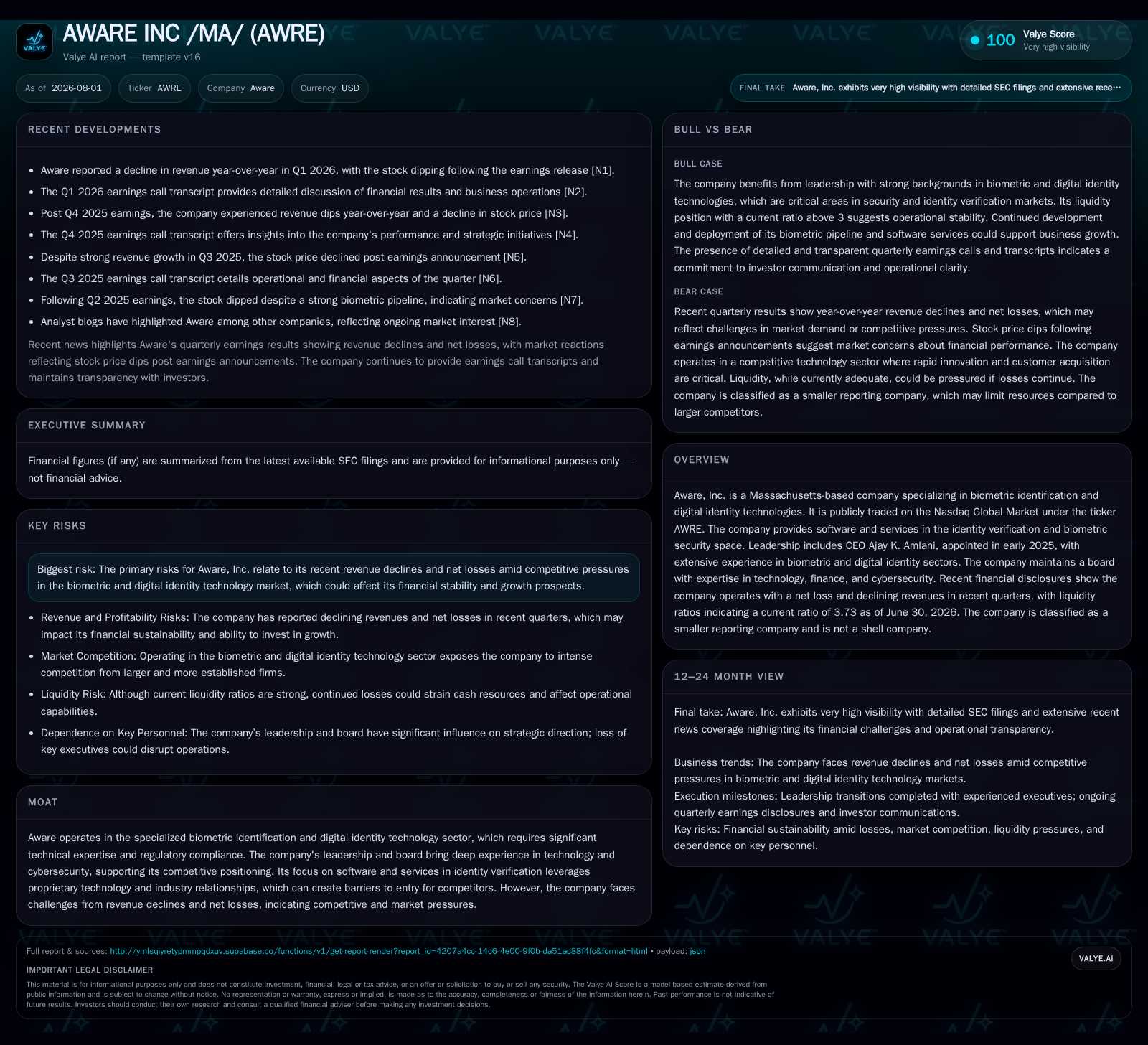
Aware, Inc.’s recent Q2 2026 filing reveals a continued downturn in revenue and an ongoing net loss trend, underscored by a reclassification of subscription-based service revenues. The company is navigating a critical transition from traditional license and maintenance revenue toward a subscription SaaS model for its biometric identity solutions. Despite financial pressures, AWARE maintains a solid liquidity position with a current ratio of 3.73. Its competitive standing reflects mid-tier scale amid larger biometric incumbents and more focused SaaS peers, while growth depends on execution against increasing regulatory demand and customer adoption of biometric authentication technologies.
Recent Quarterly Filing Update Discloses Subscription Revenue Reclassification Impact
In its Q2 2026 Form 10-Q filed July 31, Aware disclosed a significant reclassification of its subscription-based SaaS revenues [S2]. Beginning March 31, 2026, subscription revenues were moved from the "software maintenance revenue" line to "services and other revenue," impacting comparability with previous periods. This change reflects an increasing emphasis on recognizing SaaS revenues as service-oriented rather than traditional maintenance contracts. The reclassification affects historical figures modestly — $50 thousand for Q2 2025 and $98 thousand for H1 2025 have been reassigned to conform with the new presentation
This accounting adjustment signals an important internal shift aligning revenue recognition more closely with the company's strategic push towards a service-driven SaaS model. Recognizing subscription revenue as services rather than license or maintenance fees is crucial because it clarifies the recurring nature of income streams — a key valuation driver in biometric software sectors where annual recurring revenue (ARR) is pivotal. Moreover, the use of variable consideration estimates based on historical price concessions underscores cautious revenue recognition practices pertinent to contract complexity in identity verification implementations.
Transitioning Business Model: From License Sales to Biometric SaaS Services
Aware's business model historically combined one-time license fees for its biometric software platforms with ongoing maintenance contracts and professional integration services tailored to enterprise and government customers. The company's core offerings include biometric authentication technologies featuring fingerprint scanning, facial recognition, voice biometrics, and multi-factor authentication capabilities compliant with stringent regulatory data privacy standards [S1].
Recently, there has been a deliberate shift emphasizing subscription-based software-as-a-service (SaaS) delivery models. This move aligns with broader industry patterns where firms aim to monetize through predictable subscription revenues rather than volatile upfront license sales. Aware's revised revenue classification demonstrates this phase in its evolution — increasing subscription revenue share potentially offers improved gross margin stability and stronger customer retention due to embedded platform dependencies.
However, the visible downward press on overall revenues reported in intermediate filings hints at transitional execution challenges. Customers in sectors regulated heavily around digital identity verification often engage in prolonged sales cycles with rigorous integration demands affecting short-term sales pace [S1][S2]. Therefore, while the trajectory toward SaaS is strategically sound given sector norms emphasizing recurring ARR growth as a health marker, short-run drag from delayed adoption or contract timing remains evident
Competitive Position Amid Industry Leaders in Biometric Software Solutions
Aware operates within a competitive ecosystem populated by large integrated solution providers such as NEC Corporation and IDEMIA that boast extensive biometric hardware-software portfolios serving governments worldwide. These incumbents leverage scale advantages in R&D breadth and global deployment reach.
Conversely, niche SaaS-oriented providers like Veriff and Incode Technologies focus on cloud-native digital identity verification platforms prioritizing rapid scalability and streamlined integration. Aware sits between these poles: it offers robust biometric algorithms combined with tailored integration services but lacks the scale breadth of top-tier incumbents or pure-play rapid SaaS rollouts by newer entrants [S1]. This positioning demands prudent investment in innovation fuelled by sustained R&D expenditure while managing sales effectiveness to capture increasingly discerning enterprise customers balancing security needs against cost structures.
Regulatory compliance regimes (e.g., GDPR-like frameworks) further differentiate competitors based on certification status and data privacy controls embedded directly into biometric authentication products – areas where Aware’s leadership expertise contributes positively but requires continuous vigilance due to evolving legal landscapes.
Recurring Revenue Metrics and R&D Investment Cycle Considerations
Though Aware does not explicitly disclose Annual Recurring Revenue (ARR) figures or churn rates — KPIs critical in gauging sustainable SaaS health — indirect signals can be inferred [F1][S2]. The downward pressure on total reported revenues coupled with unchanged or rising research & development expenses suggests compression of margins typical when transitioning business models invest ahead of immediate payoff
R&D spending as a percentage of revenue remains elevated reflecting commitment to product enhancement crucial in maintaining competitive differentiation amid rapid technological change characteristic of biometrics and digital identity fields. Effective sustainment of innovation pipelines will be instrumental for Aware’s medium-term prospects as accuracy improvements in AI-driven facial recognition or voice biometrics can materially influence market acceptance.
Meanwhile, customer retention risk has likely increased given overall revenue declines; customer churn or slower renewal rates could emerge if competitive alternatives offer more attractive integration speed or pricing structures — especially relevant given industry peers emphasize cloud scalability paired with simplified user onboarding.
Growth Opportunities Aligned with Increasing Regulatory Identity Verification Demand
Macro industry drivers remain favorable: global tightening of regulatory mandates around digital identity verification continuously expands addressable markets for biometric solutions. Governments spearheading national ID programs integrate biometric authentication to enhance border security and citizen services while financial institutions elevate multi-factor authentication requirements amidst surging cybersecurity threats.
Digital transformation trends across enterprises stimulate investments into secure biometrics interfaces supporting online banking, e-commerce fraud prevention, and mobile device authentication—all growth sectors where Aware’s platform capabilities could gain traction if aligned with contemporary cloud delivery preferences.
The rise of AI-augmented biometrics further opens product upgrade pathways that enhance accuracy reducing false positives/negatives — essential for broader user acceptance beyond niche government verticals.
Key Risks: Market Adoption Headwinds and Competitive Pressures from Larger Peers
Despite promising growth tailwinds, significant risks temper optimism for Aware’s near-term progression. Persistently declining revenues highlight cyclical softness possibly linked to IT budget constraints or slower-than-expected uptake among targeted verticals wary of switching costs embedded within identity ecosystem integrations.
Intense innovation competition from larger biometric conglomerates backed by deep pockets creates continuous pressure necessitating heavy R&D spending which suppresses profitability metrics currently showing operating losses exceeding $5 million annually [F1]. The company must balance capital infusion against existential funding considerations given limited cash reserves.
Data privacy compliance adds another layer of cost complexity; failure to meet evolving legal standards risks penalties or reputational harm diminishing customer trust — especially impactful in biometrics where sensitive personal data processing integrity is paramount.
Finally, technology obsolescence risk looms larger as emergent authentication modalities (behavioral biometrics or decentralized ID frameworks) threaten legacy platforms not investing swiftly enough in R&D adaptation.
'What to Watch': Milestones in Customer Retention, ARR Growth, and Integration Successes
Investors should focus on signs that Aware stabilizes its subscription revenue reporting year-over-year following the recent reclassification which sets the baseline for credible ARR tracking—a vital metric underpinning valuation mechanics in recurring-revenue software models [S2]
Subsequent quarterly filings revealing trends around gross retention rates or declining customer churn would confirm strengthening unit economics supporting sustainable growth.
Additionally, announcements signaling meaningful new contract closures or expansion within existing accounts would provide tangible evidence countering recent cyclical softness.
Progress toward shortening sales cycle lengths via improved go-to-market effectiveness alongside demonstrated capability integrating complex client IT environments will also be key operational barometers monitoring transitioning pains versus normalized performance levels [S3]
Financial Profile Discussion: Liquidity Buffer Balances Against Operating Losses
As of June 30, 2026, Aware held approximately $2.9 million in cash and equivalents complemented by total current assets amounting to about $21.1 million against current liabilities near $5.7 million—yielding a robust current ratio of approximately 3.73 that mitigates near-term liquidity risks amid sustained net losses exceeding $5 million per annum according to trailing twelve months data available from prior filings [F1][S2]
This liquidity buffer provides operational runway allowing continued investment into R&D initiatives required for product competitiveness while addressing working capital needs related to relatively short payment terms (typically 30-60 days).
However, persistent operating deficits highlight the necessity either to accelerate top-line growth materially or revisit operating leverage deployment strategies before free-cash-flow generation becomes positive.
Disclaimer: This analysis is based solely on publicly available SEC filings as cited and industry knowledge layers without any form of investment advice or research view. It aims to provide an analytical perspective grounded in disclosed facts without forward-looking assertions unless explicitly stated.
Disclaimer: This is research-only, informational analysis and not investment advice. It may include AI-generated interpretation and general industry context. Always verify important details using primary sources.

Comments