
American Homes 4 Rent Advances Despite Regulatory Headwinds on Build-to-Rent Scale
AMH's Q2 results highlight resilient rental income growth backed by internal homebuilding amid emerging federal and local restrictions.
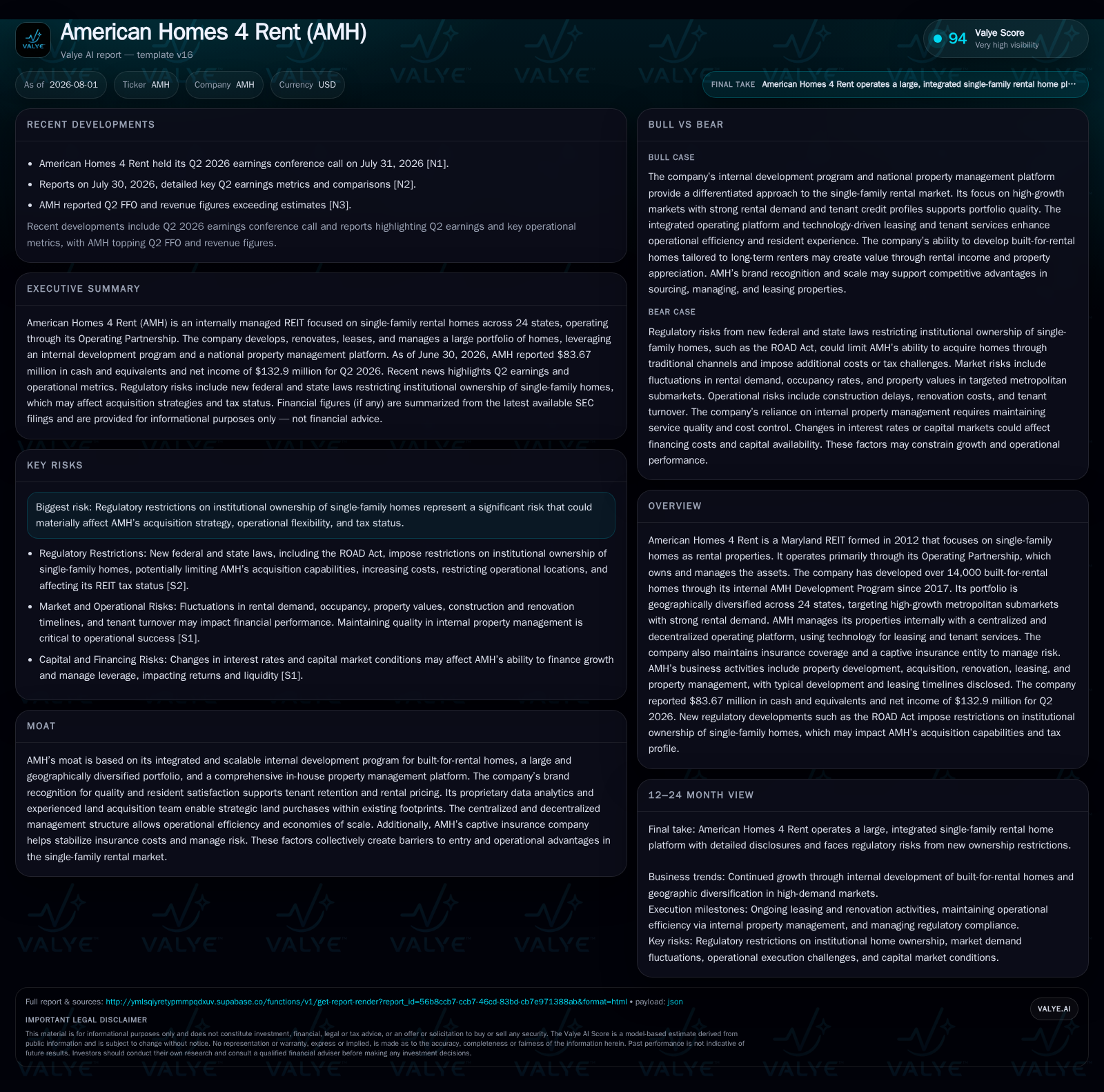
American Homes 4 Rent (AMH), a leading single-family rental REIT, reported solid second-quarter 2026 earnings driven by strong rental revenue and its integrated build-for-rent development program. However, new regulatory constraints such as the ROAD Act pose challenges to its acquisition strategy and geographic footprint expansion, potentially increasing costs and limiting flexibility. AMH’s vertically integrated operating partnership, spanning property development, leasing, and management across 24 states, supports tenant retention and operational efficiency but requires navigating inflationary pressures and fixed cost structures. Key metrics such as occupancy rate, rent growth, and NOI remain under pressure from inflation and local tax increases, while balance sheet leverage poses refinancing considerations in a rising-rate environment.
Recent Operating Update
American Homes 4 Rent (AMH) released its Q2 2026 results via Form 10-Q dated July 31, 2026 [S2], continuing to demonstrate resilient operational performance despite growing regulatory headwinds. Rental revenue growth remains supported by a large and geographically diversified portfolio of over 61,000 single-family homes operated through its subsidiary Operating Partnership. The filing also outlines newly effective federal legislation—specifically the Residential Ownership and Acquisition Disclosure (ROAD) Act enacted July 11, 2026—which restricts institutional acquisitions of single-family homes starting January 7, 2027. While exemptions apply for build-to-rent developments or purchases from other large institutional owners, the Act caps access to traditional multiple listing service (MLS) acquisitions that AMH historically used less but still valued in portfolio expansion [S2].
This creates a near-term constraint on acquisition strategies outside of internal development or joint venture arrangements, potentially shifting capital toward more costly or slower land acquisition pipelines. Moreover, several states and local jurisdictions have also introduced or proposed complementary regulatory frameworks limiting corporate ownership or taxing ownership heavily, adding complexity to AMH’s ability to maintain its REIT status or efficient tax profiles [S2]. Such policies increase compliance costs and may reduce access to capital markets for future financing.
Business Model
AMH operates as an internally managed Maryland real estate investment trust (REIT) formed in 2012 with all business conducted predominantly via its Delaware limited partnership Operating Partnership [S1]. This structure centralizes asset ownership while allowing tax transparency benefits intrinsic to partnerships. Its core business is acquiring, developing "built-for-rent" single-family homes targeted at high-demand metropolitan submarkets across 24 states (about 61k properties held at fiscal year-end) [S1][F1].
Revenue is generated primarily through monthly rental income paid by tenants residing in these homes. Leasing rates are set centrally using data-driven pricing models incorporating local market competitiveness along with property-specific factors such as size, age, neighborhood quality, school access, and transportation links [S7]. Tenant screening processes standardize income verification and credit criteria to mitigate default risks.
Unlike many residential REITs that rely heavily on multifamily apartments or manufactured housing segments (e.g., AvalonBay Communities or Equity Residential), AMH specializes in the single-family segment with a unique vertical integration advantage via its AMH Development Program launched in 2017 [S1][S8]. This program facilitates an internal build-to-rent pipeline yielding over 14,000 homes developed since inception — a scale allowing optimized construction costs leveraging existing local land acquisition expertise
Once built-occupancy certificates are received (typically taking four to seven months post-land development), these units are quickly leased within approximately 10–50 days driven by targeted marketing campaigns including self-guided showings enabled by proprietary technology platforms [S8].
Property management is conducted primarily in-house with a mix of centralized corporate-level functions handling accounting, legal compliance, marketing campaigns, call center operations for tenant services alongside locally deployed leasing agents and property managers maintaining direct relationships with residents for rapid responsiveness [S19]. This hybrid centralized/decentralized model sustains brand consistency while harnessing regional market knowledge essential for sustaining occupancy rates above peer averages.
Additionally, AMH operates a captive insurance company which buffers volatility in insurance premiums—a material expense line—and reduces exposure to third-party carrier fluctuations common in property portfolios spanning multiple jurisdictions [S1].
Industry Structure & Competitive Position
The residential REIT industry broadly consists of apartment-focused entities (Equity Residential - EQR; AvalonBay - AVB), manufactured housing REITs, mortgage REITs focused on financing residential properties rather than ownership, homebuilders dabbling in rentals via build-to-rent programs, plus specialized single-family rental operators like Invitation Homes (INVH). AMH aligns most closely with INVH but differentiates via scale of internal development capability combined with geographic diversification into select high-growth metropolitan submarkets nationwide.
Its operating partnership ownership model consolidates control over assets while offering flexibility in capital markets transactions through issuance of OP units convertible into shares. This confers agility absent in wholly corporate-owned REIT structures.
Operational efficiency gains stem from managing nearly all aspects internally from land acquisition through leasing which yields higher margin capture potential versus outsourcing heavy third-party property management fees common among smaller or less integrated competitors. The branded "AMH" reputation on quality rentals fosters tenant retention—a key driver since tenant turnover directly impacts leasing velocity and cost per unit absorbed during vacancy transition periods.
Growth Drivers
Housing supply shortages combined with affordability challenges favor renting over homeownership for a significant segment of households (~one-third nationally). AMH addresses this structural demand by expanding the supply via its built-for-rent homes designed expressly for long-term leasing.
Expansion of AMH’s internal development pipeline allows greater control over product specification matching market demands while accelerating pace compared to conventional third-party acquisitions or scattered remodels. Geographic diversification into submarkets characterized by rising population densities underpins sustained rent growth potential insulated from localized economic downturns.
Technological enhancements supporting self-showings streamline leasing processes reducing time-to-occupy metrics while data analytics optimize pricing responsiveness ensuring competitive rents without sacrificing yield.
Institutional capital interest inflows support balance sheet flexibility enabling continued investment even amid macroeconomic uncertainties including interest rate hikes.
Brand recognition cultivated over years aids resident satisfaction which improves tenant retention rates—critical given associated costs linked to resident turnover impact net operating income (NOI).
Risks & Watchpoints
Foremost are regulatory risks highlighted by recent enactment of the ROAD Act federally plus state/local measures targeting institutional ownership concentration particularly in single-family rental housing stocks [S14][S2]. These could curtail acquisition channels forcing reliance on slower development cycles or selective joint ventures.
Inflation remains persistent elevating direct operating expenses—labor wages across property management and construction sectors as well as material costs—challenging margin maintenance since fixed nature of many expenses limits swift cost pulling during slower rent cycles. Property tax hikes exacerbate these burdens given their material share of total operating expenses.
Tenant default risk may rise under worsening macroeconomic consumer conditions though standardized screening practices mitigate this somewhat.
Interest rate volatility affects cost of capital access: AMH’s total debt stood near $5.19 billion with cash and equivalents of approximately $83.7 million as of June 30, 2026, resulting in net debt around $5.11 billion [F1]
Balancing centralized controls with localized operational autonomy presents ongoing managerial execution risk especially when scaling into new markets or integrating newly developed homes swiftly without brand dilution.
What To Watch Next
Key indicators will include monitoring post-January 2027 effects from ROAD Act implementation on acquisition volumes including any changes to mix between internal build versus purchase activity. Lease-up velocity following new home deliveries will reveal whether resident demand remains robust amid broader inflationary pressures.
Tracking vacancy trends geographically can illuminate local market supply-demand imbalances impacting rents. Also worth scrutiny is progress within the AMH Development Program pipeline relative to prior years’ milestone deliveries indicating capacity sustainability.
Financially, debt servicing capacity amidst interest rate dynamics plus incremental use of equity issuance mechanisms will signal balance sheet health tied closely to ongoing growth investments.
Management communications on navigating evolving regulatory landscape including advocacy efforts or adaptation strategies will further clarify outlook trajectory.
Financial Profile Discussion
As of June 30, 2026, American Homes 4 Rent reported cash & equivalents totaling approximately $83.7 million juxtaposed against total debt outstanding near $5.19 billion resulting in net debt around $5.11 billion [F1]
Revenue metrics have shown steady upward trends reflective of expanded portfolio size but remain exposed to inflationary cost pressures detailed above that could compress net operating income margins if rent escalations lag cost increases [N3][S2]. Maintaining dividend distributions typical for REITs depends on sustained funds from operations (FFO), which hinge critically on occupancy rates and rent growth stability highlighted previously.
Capital expenditures related primarily to constructing new built-for-rent homes constitute material cash outflows; efficient milestone delivery schedules linked to land availability remain pivotal for maintaining positive adjusted FFO generation enabling shareholder return continuity without excessive dilution or debt load increase [S8][S4]
In sum, financial policy appears balanced with emphasis on conservative leverage yet calibrated growth support but requires close monitoring given external macro-regulatory shocks introduction recently.
Disclaimer: This is research-only, informational analysis and not investment advice. It may include AI-generated interpretation and general industry context. Always verify important details using primary sources.

Comments