
WESCO International Leverages Distribution Scale Amid Industrial Sector Opportunities
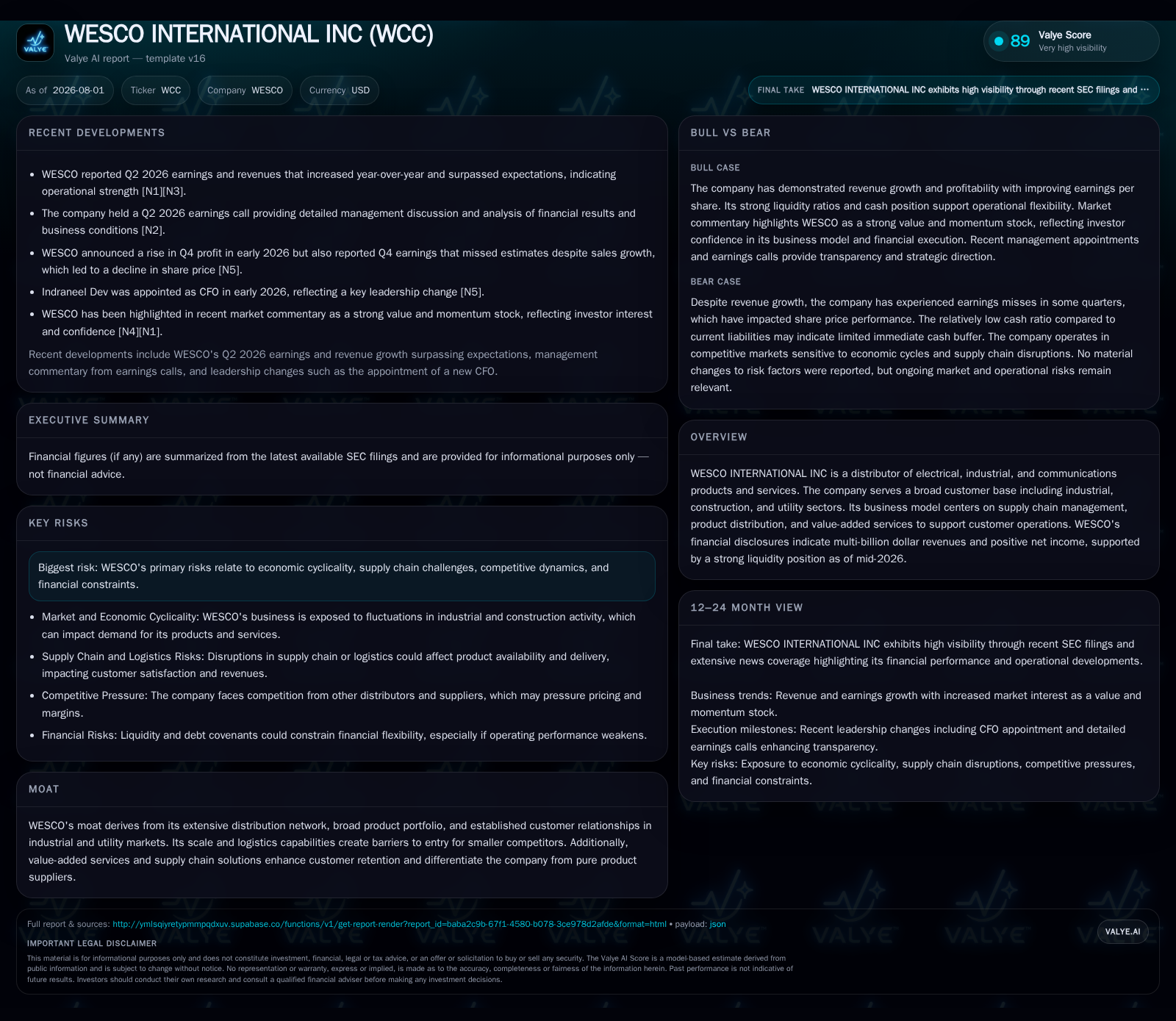
WESCO’s Q2 2026 results reveal robust revenue growth and operational execution underpinning competitive strength in a cyclical industrial distribution market.
WESCO International delivered stronger-than-expected performance in Q2 2026, driven by effective supply chain management and a broad logistics network supporting customer retention across industrial, construction, and utility sectors. The company’s business model integrates wide-ranging product distribution with value-added services that boost switching costs and operational efficiency. Despite cyclical demand variability and margin pressure risks inherent to the sector, WESCO’s scale and service capabilities position it well against peers in industrial distribution. Key growth drivers include infrastructure spending and increased outsourcing of supply chain functions. Ongoing monitoring of execution on supply chain efficiencies and working capital management will be critical to sustaining momentum.
Stronger-than-Expected Q2 Performance Anchored in Supply Chain Excellence
WESCO International’s second quarter filing for 2026 showcased revenue growth surpassing analyst expectations during ongoing macroeconomic uncertainty [S2][N1][N3]. Management cited gains primarily driven by optimized supply chain processes and enhanced logistics capabilities that improved order fulfillment rates—a crucial operating KPI in industrial distribution where lead times directly impact customer satisfaction. This operational success counterbalanced typical cyclicality seen in sectors WESCO serves such as construction and utilities where capital spending can be lumpy.
Evidence from the recent earnings call confirmed that focused initiatives on inventory turnover enhancements contributed to reduced working capital intensity despite broader market headwinds. These improvements not only support margin stability but also bolster cash flow conversion—an important financial efficiency metric for distributors handling large physical goods inventories [S2][N2]
From Product Distribution to Supply Chain Partner: WESCO’s Business Model Strengths
WESCO effectively operates as an intermediary bridging manufacturers of electrical components, industrial supplies, and communications products with end-user customers spanning industrial production facilities, construction projects, and utility operators [S1]. The company’s core monetization comes from physical product sales; however, a distinctive element is its integration of value-added services such as technical expertise, bulk purchasing agreements, demand forecasting support, service contracts, and logistical solutions.
These services create switching costs that improve customer retention rates—a vital KPI given the competitive nature of industrial distribution—and provide incremental margin beyond product markups. By blending broad product depth with embedded supply chain management capabilities encompassing inventory control and order fulfillment speed through an extensive logistics network, WESCO positions itself closer to a partner than a simple supplier within clients’ procurement ecosystems [S1]. This multi-dimensional relationship helps offset pricing pressures common among distributors.
Distribution Industry Dynamics Affecting Competitive Positioning for WESCO
Within the broader industrial distribution landscape populated by peers like Fastenal (industrial focus), Graybar (electrical distribution), and Rexel (communications/electrical specialization), WESCO’s advantage lies in its multi-sector breadth combined with scale. The industry is characterized by low differentiation on product alone due to commoditization of core goods; hence logistics network scale and quality of value-added services become primary competitive levers.
WESCO’s broad geographic footprint supports lower lead times and higher order fulfillment rates than smaller or more specialized competitors. While this scale is difficult to replicate quickly due to capital intensity of warehousing infrastructure and vendor relationships, economic cyclicality impacts volume fluctuations across all players causing intermittent margin pressure. Additionally, supply chain disruptions—such as component shortages or transportation delays—can erode gross margins unless effectively managed through demand forecasting and inventory strategies.
Growth Catalysts in Infrastructure Spending and Supply Chain Outsourcing Trends
Several secular tailwinds underpin potential volumetric growth for WESCO. Increasing government-funded infrastructure projects spur demand for electrical components and construction materials distributed by the company. Simultaneously, ongoing industrial automation trends drive adoption of more sophisticated electrical systems requiring technical supplier support.
Utility grids expansion alongside rapid deployment of renewables also fuels demand for new communications products and electrical supplies suited to complex installation environments. Moreover, customers increasingly outsource non-core supply chain functions seeking integrated logistics providers like WESCO that reduce procurement complexity while improving responsiveness through comprehensive service contracts.
Collectively, these drivers translate into rising order volumes backed by expanding client budgets over medium-to-long term horizons even as short-term economic cycles cause some variability [S1].
Risk Factors Impeding Margin Expansion in a Cyclical Industry Environment
WESCO faces several challenges typical for distributors operating at scale within cyclical industries. Demand sensitivity to construction slowdowns or manufacturing cutbacks can compress order books suddenly. Heightened competition exerts downward pressure on pricing power since many customers have alternative suppliers.
Supply chain constraints—ranging from raw material cost inflation to transportation bottlenecks—pose risks to gross margin stability if not swiftly mitigated through sourcing flexibility or price adjustments. Inventory obsolescence risk adds carrying cost liabilities if demand forecasting misses pace with rapid technology changes in electrical or communications segments.
Financial risks include credit exposure when customers delay payments during downturns. Despite mitigating these through disciplined underwriting practices, such risks require ongoing vigilance grounded in robust days sales outstanding metrics [S1][S2]
"What to Watch": Execution Milestones and Market Signals Monitorables for WCC Performance
Following Q2 results release, critical near-term benchmarks include sustained improvements in customer retention rates which reflect success maintaining long-term contracts anchored by value-added services [N2][S3]. Monitoring changes in inventory turnover ratio will indicate operational leverage on working capital management efficiency.
Executives’ ability to continue refining order fulfillment capabilities—reducing lead times via expanded logistics capacity or technological upgrades —will be telling for maintaining competitive advantage amid peers with aggressive network investments. Given underlying cyclicality in large client sectors such as utilities or construction markets, tracking backlog trends or order intake velocity also provides early visibility into demand sustainability post-quarter.
Financial Profile Discussion: Balance Sheet Health Supports Strategic Flexibility
WESCO enters the back half of 2026 with a solid liquidity position evidenced by a current ratio above 2.09 calculated at June-end 2026 [F1], suggesting ample short-term asset coverage against liabilities which underpins resilience during economic downturns or supply chain shocks. Debt remains significant but manageable relative to operating income—a multi-hundred-million-dollar scale metric reported as positive net income affirming profitability profile [F1].
This financial foundation supports continued investment into expanding logistics infrastructure or acquiring complementary businesses to broaden service portfolios without imposing undue refinancing risk. It provides an industry-informed interpretation of operating results without investment advice.*
Disclaimer: This is research-only, informational analysis and not investment advice. It may include AI-generated interpretation and general industry context. Always verify important details using primary sources.

Comments