
BJ's Restaurants Advances Menu Innovation and Off-Premise Sales Amid Liquidity Challenges
BJ’s Restaurants reports Q2 2026 results highlighting operational momentum but underscores liquidity constraints amid competitive pressures.
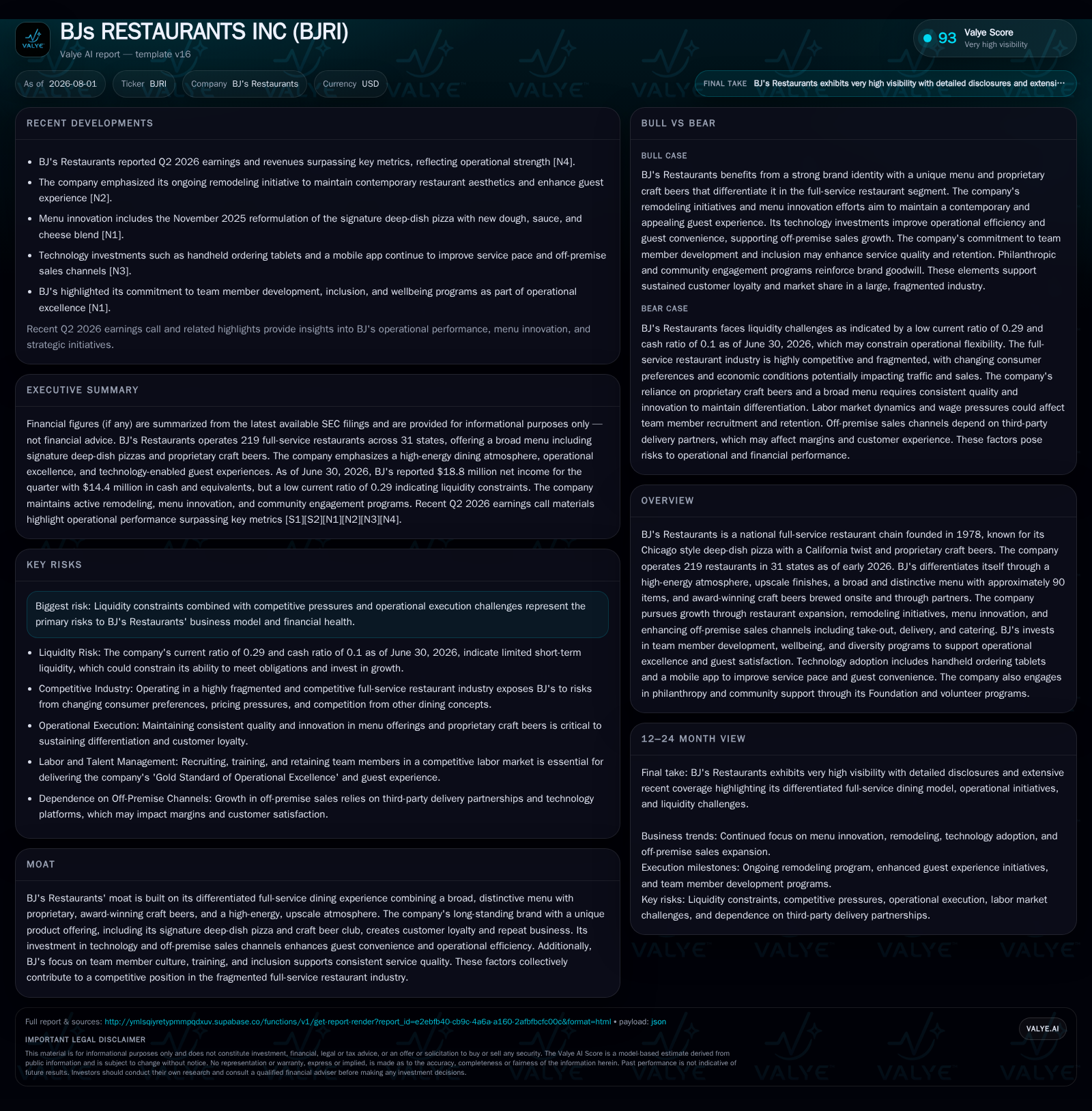
In Q2 2026, BJ’s Restaurants maintained growth efforts through menu innovation, remodeling, and expanded off-premise channels, supported by technology adoption to enhance guest experience and operational efficiency. Despite these advances, the company's balance sheet reveals significant liquidity pressure with a current ratio of 0.29 and net debt near $30 million as of June 2026. In the fragmented full-service dining segment, BJ’s distinctive craft beers and upscale environment offer differentiation, though rising operating costs and regulatory risks pose ongoing challenges. Monitoring same-store sales trends, remodeling effectiveness, and leverage management will be critical in assessing execution and financial resilience.
Latest Operating Update
BJ's Restaurants released its Q2 2026 financial results on July 30, reaffirming its strategic emphasis on menu innovation and expansion of off-premise sales avenues including take-out, delivery, and catering services [S3],[N2]. The company's ongoing investments in restaurant remodeling aim to refresh its portfolio of 219 locations across 31 states as of early 2026 [S1]. These efforts combine to enhance the overall guest experience by reinforcing the chain’s positioning as an upscale full-service dining destination with a vibrant atmosphere.
Operationally, BJ's leverages technology adoption such as handheld ordering systems for servers and mobile app capabilities to streamline ordering processes and increase customer convenience—both vital in maintaining service levels during peak demand periods [S1],[N1].
Business Model Overview
BJ's operates within the full-service casual dining sector of the U.S. restaurant industry—a space known for extensive competition from established chains like The Cheesecake Factory or Yard House but differentiated by BJ's integration of proprietary craft beer offerings brewed onsite or by select partners,[S1]. The company's core revenue drivers stem from food and beverage sales generated primarily through table service complemented by off-premise channels which have grown increasingly important post-pandemic.
Its broad menu encompasses roughly 90 items ranging from Chicago-style deep-dish pizzas with a California twist—the original brand hallmark—to slow-roasted entrees and signature desserts like the Pizookie® [S1]. Craft beer brewing forms a central element of the brand’s competitive moat; BJ's holds several brewing facilities alongside brewpubs ensuring quality control while appealing to evolving consumer preferences for craft beverages.
Monetization is transaction-based at the point-of-sale in each restaurant location. Volume growth hinges on opening new units successfully alongside same-store-sales improvements driven by increased guest frequency or higher average checks. Price adjustments are calibrated carefully given intense competition yet bolstered by proprietary offerings that create compelling differentiation.
Remodeling initiatives focus on enhancing ambiance with upscale finishes such as linen napkins, distinctive glassware corresponding to different beer styles, high ceilings combined with large TVs for sports-viewing energy—all reinforcing the "high-energy atmosphere" experience BJ's emphasizes in marketing [S1]. Concurrently, technological tools enable operational excellence elements that improve table turnover rates without compromising the relaxed, social ambiance critical for guest retention.
Industry Structure and Competitive Position
The full-service restaurant industry is notably fragmented with over $100 billion in annual sales driven largely by discretionary consumer spending patterns influenced by broader economic cycles. Operators compete intensely on menu innovation, quality of guest experience including decor and service level, pricing strategy, labor cost efficiency, regulatory compliance adherence, and ability to adapt sales channels toward growing off-premise demand.
Peers like The Cheesecake Factory share similarities in menu breadth but often differ in regional penetration or emphasis on alcoholic beverage programs. Fast-casual operators such as Chipotle or Panera Bread contrast significantly through faster service models but represent indirect competition by capturing share from consumer food budgets focused on convenience.
Within beverage offerings specifically, brewpubs and independent craft beer brewers represent niche competitors particularly appealing to younger demographics seeking unique consumption experiences—an arena where BJ's proprietary brewing capability enhances brand loyalty while protecting margins via controlled production costs, [S1]
Growth Drivers
BJ's growth agenda involves multi-pronged levers: expanding restaurant count cautiously but consistently; remodeling existing units to maintain contemporaneous appeal; innovating menus including new craft beverages; scaling off-premise delivery/take-out capabilities supported by digital platform investments; strengthening team member culture with training focusing on operational excellence; and leveraging marketing programs aimed at increasing frequency among core guests [S1],[N2].
Notably, off-premise sales continue gaining traction as consumer behavior normalizes toward hybrid dine-in/delivery habits seen throughout the restaurant industry post-pandemic. This channel offers margin benefits if effectively integrated due to lower labor intensity per transaction yet requires upfront technology investment alongside partnerships with delivery platforms when used externally.
Menu innovation plays a dual role—both attracting new guests looking for fresh options while driving incremental visits from existing customers seeking variety. Proprietary recipes protected through trademarks fortify entry barriers against copycats while fueling merchandise opportunities beyond restaurants [S21],[S22].
Risks and Growth Constraints
Labor costs continue to pressure margins given prevailing tight wage markets typical across hospitality sectors; managing labor efficiency while sustaining delivery standards is an ongoing challenge given rising minimum wages and turnover concerns. Food input cost volatility also weighs on profitability particularly when price increases cannot be fully passed through due to competitive sensitivities.
The regulatory landscape imposes layered risks including stringent alcoholic beverage sales licensing subject to state-by-state variations restricting market entry strategies; evolving food safety laws mandating rigorous audits increasing compliance expenditures; data privacy regulations like California’s CPRA requiring costly cybersecurity frameworks alongside potential liabilities for breaches; environmental regulations impacting waste management at brewery operations; plus liability claims tied to "dram-shop" laws or employment practices all pose variables that could adversely impact operations unexpectedly if controls falter or external conditions shift abruptly [S4],[S27],[S28].
Additionally, new restaurants usually require up to three years post-opening before achieving target stable operating margins (15%–20% four-wall margin net of occupancy expenses), meaning near-term expansion carries risk of diluting profitability if units underperform or preopening expenses escalate disproportionately [S19]. Remodeling programs similarly demand capital investment upfront without guaranteed uplift in guest traffic.
What To Watch Next
Key metrics that will indicate trajectory include same-store sales growth revealing guest traffic gains or price/mix improvement; average check size trends signaling pricing power or favorable product mix shifts; incremental contribution from off-premise channels reflecting successful digital/operational integration; labor cost percentage relative to sales illustrating efficiency versus inflation pressures; customer satisfaction scores potentially correlating with repeat visitation rates; overall restaurant unit growth validating expansion scalability balanced against preopening costs.
Financially monitoring quarterly cash flow adequacy relative to debt service obligations will assess whether tightening liquidity requires refinancing measures or capital raising efforts. Current assets stood at about $53.9 million while current liabilities were significantly higher at $186.3 million, yielding a current ratio of roughly 0.29, which indicates tight short-term liquidity and working capital constraints [F1]. This financial position underscores the need for vigilant cash flow management amid ongoing investments and operational initiatives.
In summary, BJ's financial profile illustrates an entity investing deliberately into differentiated experiential dining anchored by proprietary craft beers but operating within a capital-intensive segment facing structural headwinds from rising costs and fragmented competitive dynamics necessitating careful stewardship to sustain margins while pursuing measured growth.
Disclaimer: This is research-only, informational analysis and not investment advice. It may include AI-generated interpretation and general industry context. Always verify important details using primary sources.

Comments