
Integrated Supply Chain Challenges Temper Pilgrim’s Pride Earnings Growth
Pilgrim’s Pride faced significant margin pressure in Q2 2026 as rising commodity feed costs and restructuring expenses compressed profitability despite stable net sales, highlighting the challenges of managing input volatility within a diversified integrated protein business.
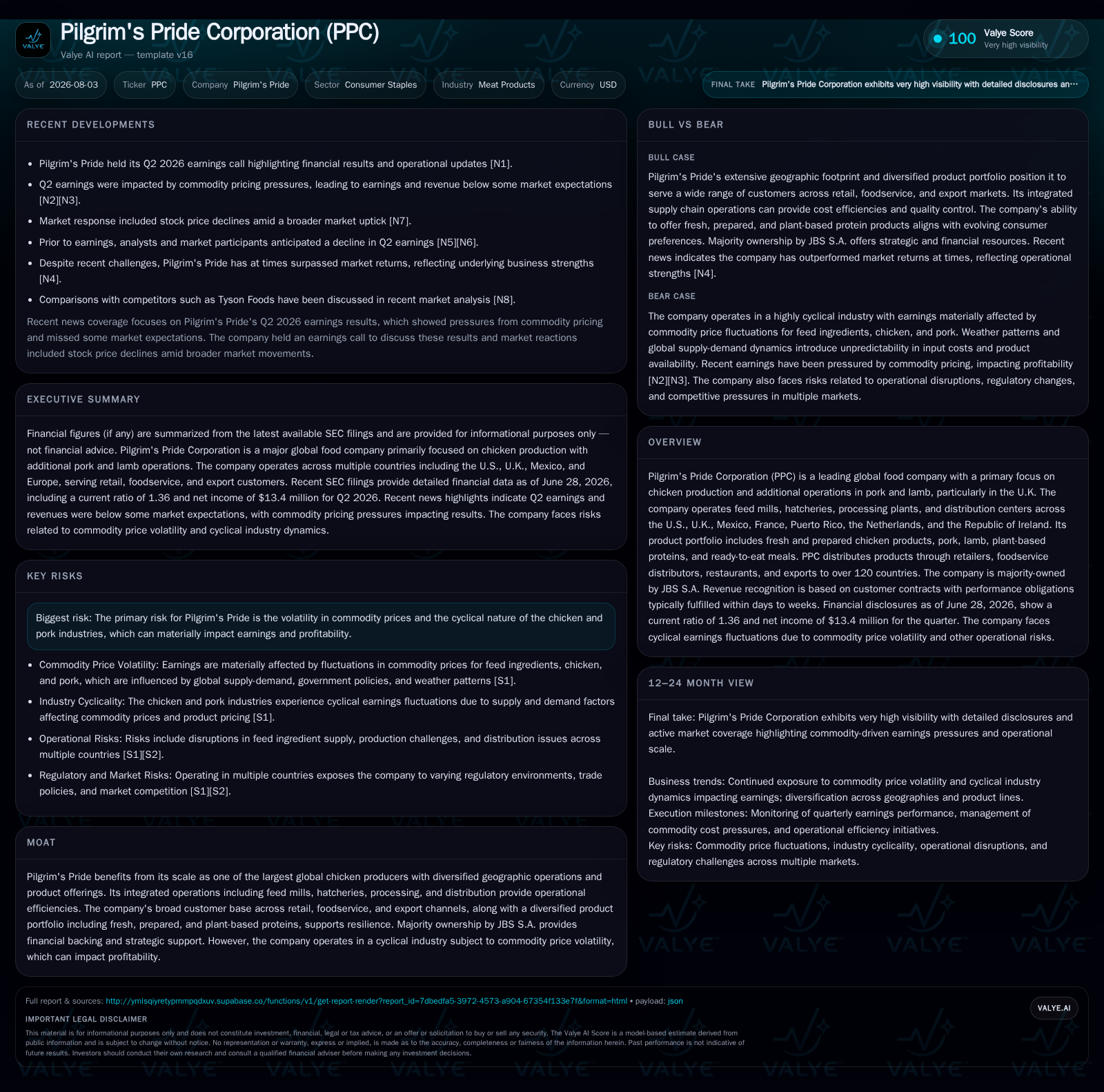
In Q2 2026, Pilgrim's Pride Corporation reported steady net sales near $4.63 billion but saw gross profit nearly halved to $340 million, driven by elevated feed ingredient prices and increased operational costs. Net income contracted sharply to $13.4 million amid restructuring charges and higher SG&A expenses. The company’s vertically integrated supply chain, spanning feed mills to processing plants across North America and Europe, provides operational control but exposes it to commodity-driven cost swings. While diversification into pork, lamb, and plant-based proteins offers some revenue resilience, persistent inflationary pressures and cyclical commodity volatility remain key challenges. Monitoring feed price trends, processing capacity utilization, and expansion in value-added product segments will be critical for assessing recovery prospects.
Q2 Operating Performance Reflects Margin Pressure from Commodity Inflation
Concurrently, selling, general and administrative expenses rose by over 30%, partly driven by restructuring charges totaling nearly $8.7 million during the quarter. These factors combined resulted in net income dropping dramatically from more than half a billion dollars last year to approximately $13.4 million this quarter — highlighting the vulnerability of margins in volatile commodity environments even for vertically integrated producers [S2], [N1], [N2].
Vertical Integration: Operational Control Meets Commodity Cost Exposure
Pilgrim’s Pride operates a comprehensive vertically integrated supply chain encompassing feed mills producing animal feed formulations, hatcheries supplying chicks, extensive processing plants converting live animals into fresh and prepared meat products, along with distribution centers servicing diverse customer channels across North America and Europe [S1], [S3]. This integration enables better control of input quality and yield optimization metrics such as feed conversion ratios — critical for operational efficiency.
However, feed ingredients remain the largest single component of production costs. Global agricultural market conditions driven by weather variability or biofuel policy can sharply increase these input prices before selling prices adjust fully or promptly. Although Pilgrim's employs derivative contracts and advance purchase commitments as partial hedges against feed price volatility, these are not accounted for as cash flow hedges; therefore unrealized valuation fluctuations impact earnings directly through noncash gains or losses [S1], [S2]. Additionally, perishability risks constrain inventory flexibility.
Diversified Protein Portfolio Provides Revenue Stability Amid Cyclical Pressures
While fresh chicken represents Pilgrim's core revenue driver within its poultry-dominant portfolio, the company also offers pork products alongside lamb (notably strong in U.K. markets) and emerging plant-based protein alternatives aimed at evolving consumer preferences towards blended diets. This product breadth helps distribute exposure across different protein categories with varying supply-demand dynamics.
Pilgrim's serves multiple customer segments including retail grocery chains, foodservice distributors, restaurants, and export markets spanning over 120 countries. Revenue recognition occurs upon order acceptance with performance obligations typically fulfilled within days or weeks — enabling relatively high demand visibility despite macroeconomic uncertainties [S3]
Nonetheless, margin sensitivity persists due to competitive pricing pressures combined with inflationary cost drivers including energy, labor wages, transportation expenses, and pandemic-era operational disruptions amplifying overheads [N1]
Industry Context: Scale Benefits Offset by Raw Material Inflation Across Peers
Within the global meat production sector Pilgrim’s Pride operates alongside major integrated peers like Tyson Foods (TSN) and JBS S.A., all leveraging vertical integration from feed procurement through final product distribution. These peers similarly balance scale-enabled sourcing advantages against cyclical commodity input cost volatility.
Smaller poultry-focused competitors such as Perdue Farms or Sanderson Farms concentrate more narrowly but face analogous commodity risks without comparable geographic diversification benefits. Hormel Foods exemplifies successful expansion into prepared foods offering more stable margins yet remains exposed to raw material inflation.
Pilgrim's ownership by JBS S.A. provides strategic sourcing depth but does not eliminate exposure to cyclical cost shocks affecting industry-wide profitability.
Growth Outlook Focused on Value-Added Products and Export Expansion
Long-term growth opportunities for Pilgrim’s Pride center on expanding its prepared meat product lines—including ready-to-eat meals and plant-based blends—that carry premium pricing relative to commoditized fresh cuts. Rising urbanization globally fuels demand for convenient protein solutions.
Increasing export penetration beyond established markets presents volume growth potential particularly in emerging economies where per-capita protein consumption is rising.
Monitoring investments in processing capacity upgrades or new facilities will be important indicators of management confidence in sustained demand supporting operating leverage gains.
Risks: Commodity Price Volatility, Livestock Disease Outbreaks & Contract Terms
Pilgrim’s explicitly cites risks from extreme fluctuations in feed grain prices driven by unpredictable weather or changing agricultural policies which materially affect earnings during cost surges that cannot be immediately recouped via pricing adjustments [S1]
Livestock diseases such as avian influenza or African swine fever pose operational hazards including mandatory culling or export restrictions that can disrupt supply chains and damage reputation.
Short contract fulfillment cycles tied mainly to point-of-sale transfers limit longer-term fixed-price contract coverage; this structure heightens earnings volatility amid seasonal or episodic demand shocks.
Key Metrics To Monitor: Feed Costs, Capacity Utilization & Product Mix Trends
Near-term monitoring should focus on global corn and soybean meal price trajectories given their outsized impact on PPC’s cost base. Stabilization or declines would support margin recovery while continued inflation signals persistent headwinds.
Operational KPIs such as live weight processed volumes and processing plant capacity utilization will provide evidence on demand health post recent inflationary sell-through pressures.
Expansion or launches of value-added prepared meat products and broadened exports into growth markets would validate strategic execution diversifying revenue away from volume-dependent segments vulnerable to cyclicality.
Subsequent quarterly guidance updates will offer important insight into management’s outlook balancing external cost pressures against internal efficiency initiatives.
Financial Profile Discussion: Adequate Liquidity Amid Elevated Short-Term Expenses
Despite significant margin compression reflected in Q2 results—including net income falling to roughly $13 million—the balance sheet maintains sufficient liquidity with a current ratio of approximately 1.36 at June 28, 2026 [F1], [S2].
Elevated SG&A spending related to restructuring efforts adds near-term expense pressure aimed at long-term structural improvements but temporarily dampens cash generation under prevailing market dynamics [S2]
Overall financial position supports ongoing operations though cash flow softness warrants attentive monitoring going forward.
Disclosure: This analysis is based solely on publicly available information from company filings dated through July 30, 2026 ([S1], [S2], [S3]) and recent news articles ([N1], [N2]). It does not constitute investment advice but aims to provide informed insight into Pilgrim's Pride Corporation’s operating trends within its sector context.
Disclaimer: This is research-only, informational analysis and not investment advice. It may include AI-generated interpretation and general industry context. Always verify important details using primary sources.

Comments