
Mexco Energy Strengthens Financial Position and Governance Amid Stable Upstream Operations
Mexco Energy reports solid profitability and liquidity driven by disciplined upstream oil and gas production.
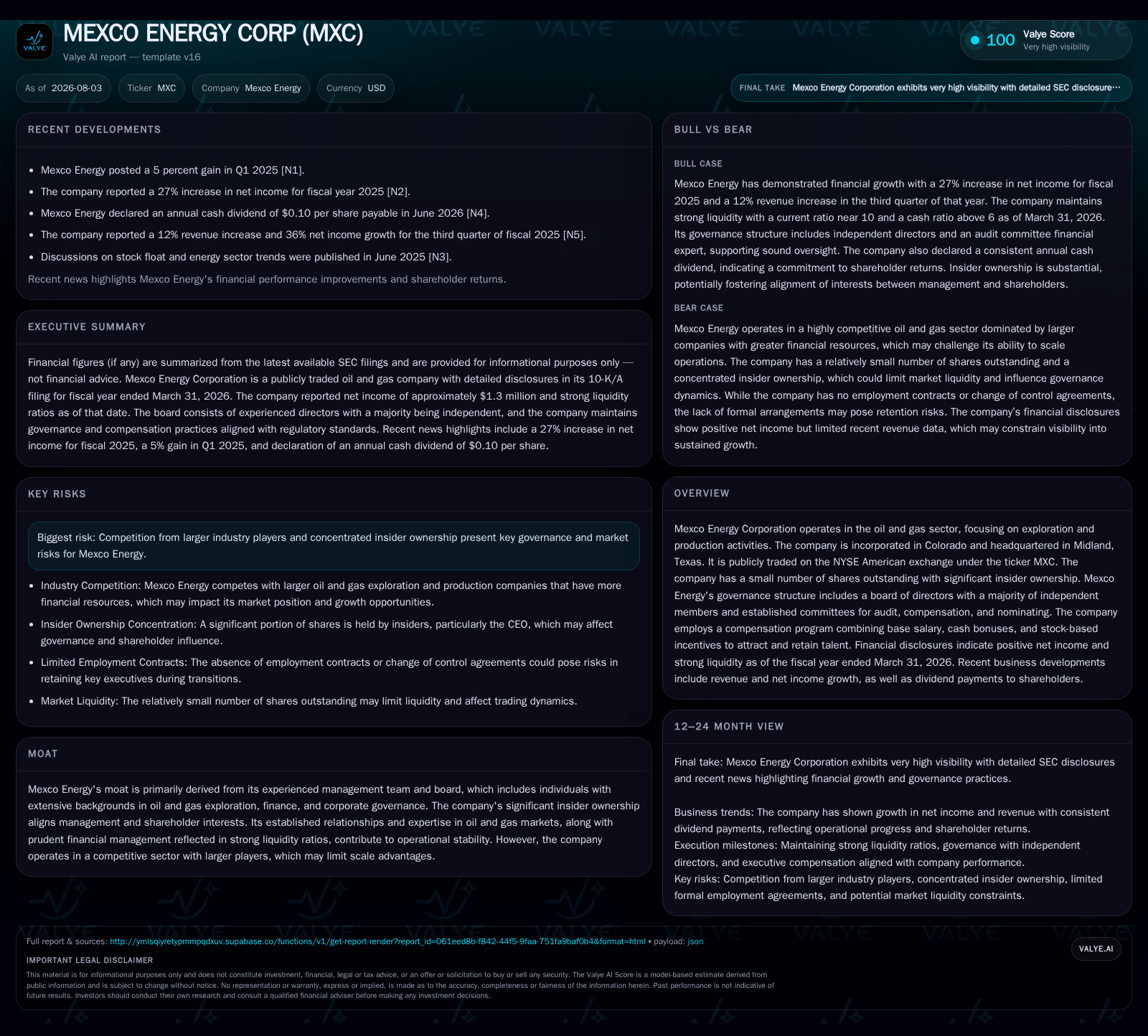
Mexco Energy Corporation continues to operate efficiently in the upstream oil and gas sector, maintaining strong financial health with positive net income and liquidity as of March 2026. The company's small scale is offset by experienced leadership, concentrated insider ownership, and rigorous governance practices. While commodity price exposure and industry competition remain key risks, Mexco's focused capital allocation and dividend payments reflect stable operational execution. Future growth hinges on reserve replacement, cost control, and market conditions.
Recent Operating Update: Fiscal Year 2026 Results and Developments
Mexco Energy's latest quarterly filing from February 10, 2026, confirmed no material changes to previously disclosed risk factors, underlining steady operational conditions without emerging threats [S2]. Subsequently, in a June 29, 2026 event filing tied to the fiscal year ended March 31, 2026, the company announced solid financial performance alongside further development activities on its properties [S3][S4]. This disclosure signifies ongoing investment in resource development consistent with its exploration & production focus.
A noteworthy June announcement also detailed the declaration of an annual cash dividend of $0.10 per share payable at month-end June 2026—a tangible return signal for shareholders reflecting confidence in free cash flow generation despite the capital-intensive nature of upstream oil and gas operations [S6]
Business Model: Niche Upstream Oil & Gas Operator with Focused Production
Mexco Energy operates strictly within the upstream segment of the oil and gas value chain: the exploration, acquisition, development, and production of crude oil and natural gas reserves within the United States [S1]. Revenue derives primarily from selling produced hydrocarbons either through spot sales or existing contracts. Given its smaller scale relative to major integrated peers, Mexco lacks significant commodity hedging sophistication or broad geographic diversification.
Capital expenditures are regularly targeted towards drilling new wells, enhancing well productivity, and sustaining reserve life. Control of operating costs per barrel is critical due to limited scale economies compared with larger independents or majors. As such, Mexco emphasizes operational efficiency while managing exploration risk inherent to upstream.
Revenue flow is volume- and price-sensitive: higher production volumes directly boost sales but depend on successful reserve replacement; realized commodity prices fluctuate with market dynamics beyond company control [F1]. Profitability thus hinges on balancing production uptime with market pricing trends while maintaining cost discipline.
Industry Structure and Competitive Positioning
Within the broader upstream oil & gas industry featuring large integrated majors (e.g., ExxonMobil), independents (e.g., Devon Energy), oilfield services providers (Schlumberger), midstream operators (Kinder Morgan), and traders/investors, Mexco occupies a niche as a smaller independent E&P player focusing on modest geographic assets.
Competition for acreage acquisition, drilling rig capacity, and skilled personnel intensifies from larger firms with deeper balance sheets; this creates a structural challenge for scale expansion but also opportunities to exploit niche reservoirs overlooked by giants [S13][F1]. Insiders' concentrated ownership (over 46% held by CEO Nicholas C. Taylor) aligns strategic decisions but may elevate governance risk if oversight weakens
Governance robustness partly mitigates this: the board comprises five non-employee directors with four classified as independent; committees governing audit, compensation, and nominations are chaired by independent directors ensuring checks-and-balances consistent with NYSE American rules [S1][S16][S26]. This governance structure is vital given industry volatility.
Growth Drivers
Mexco's growth prospects depend on several intertwined factors:
- Reserve Replacement: Sustained investment in exploration and property development is critical to offset natural depletion of producing wells. Notably, recent filings cite ongoing property development efforts indicative of active reserve management [S3][S4].
- Commodity Prices: Higher realized prices per barrel or MMBtu enhance revenue visibility; however, Mexco’s filings do not disclose specific hedging coverage suggesting full exposure to market fluctuations which can be both opportunity and risk.
- Operational Efficiency: Maintaining low operating costs per barrel through optimization increases free cash flow available for dividends or reinvestment.
- Dividend Policy: The declared annual dividend signals financial discipline while potentially enhancing investor appeal.
Expansion potential is constrained by capital intensity inherent to drilling operations but could be incrementally improved via selective acquisitions or partnerships if pursued prudently.
Risks and Watchpoints
Key risk layers include:
- Commodity Price Volatility: Mexco's revenues directly track oil & gas prices; downturns compress margins absent hedging strategies [S2].
- Exploration Risk: Reserve shortfalls from unsuccessful drilling can limit production volumes leading to revenue erosion.
- Scale Disadvantages: Smaller asset base limits bargaining power on service contracts or equipment costs relative to larger peers.
- Governance Concentration: Insider control enhances alignment but concentrates strategic authority—active board independence will be crucial.
- Regulatory/Environmental Compliance: Upstream operators face tightening environmental standards requiring potential incremental capex.
- Market Demand Shifts: Longer-term energy transition trends could shift demand away from hydrocarbons affecting valuation.
Monitoring monthly production volumes alongside quarterly realized prices would provide vital markers for operational vitality.
What to Watch Next
Investors should prioritize:
- Updates on reserve replacement ratios from drilling activities indicating sustainable production lifecycles.
- Quarterly disclosures around production volumes, operating costs per BOE (barrel of oil equivalent), and realized commodity prices for trends in profitability drivers.
- Any announcements regarding capital expenditure plans or potential asset acquisitions that might accelerate growth.
- Changes in governance structure or insider ownership concentration signaling shifts in strategic control.
- Dividend announcements reflecting cash flow health under varied market conditions.
Continued transparency via SEC filings combined with earnings press releases will illuminate performance trends against cyclical industry backdrop.
Financial Profile Discussion
Disclaimer: This is research-only, informational analysis and not investment advice. It may include AI-generated interpretation and general industry context. Always verify important details using primary sources.

Comments