
GoDaddy’s Q2 2026 Growth: AI-Driven Platform Strengthens Domain and Commerce Expansion
GoDaddy’s Q2 2026 results highlight revenue growth fueled by domain registration gains and AI-enhanced commerce solutions, reinforcing its integrated platform strategy.
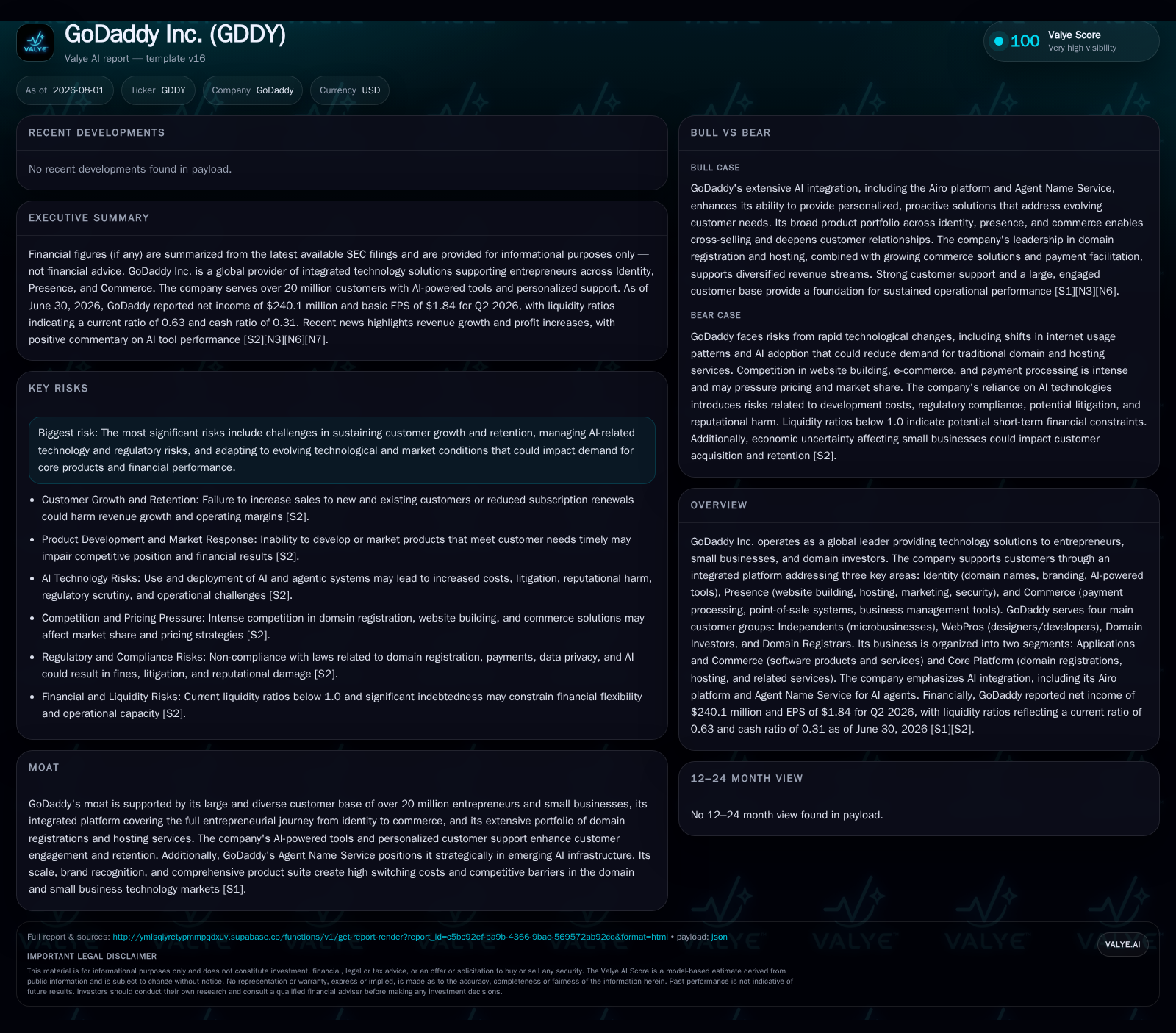
In Q2 2026, GoDaddy reported total revenue of $1.298 billion, up 6.6% year-over-year, led by growth in its Core Platform segment driven by domain registrations and aftermarket sales. The company’s AI-powered Airo platform contributes to higher customer engagement and improved average revenue per user (ARPU), reflecting enhanced monetization through bundling across identity, presence, and commerce offerings. While benefiting from scale and integrated product suites, GoDaddy faces risks from customer churn, regulatory complexities, and technological evolution but continues to invest in cloud infrastructure efficiencies and international expansion. Operational momentum is underscored by rising normalized EBITDA and bookings growth supporting a resilient recurring revenue base.
Q2 Revenue Momentum Fueled by Domain Registrations and Aftermarket Growth
Aftermarket sales additionally contribute meaningful incremental revenue above standard renewals, reflecting GoDaddy’s extensive portfolio management capabilities that distinguish it from smaller registrars like Namecheap or Tucows. This segment's recurring nature combined with value-added services such as domain protection reinforces switching costs for customers, helping mitigate churn pressures common in a fragmented registrar market.
Meanwhile, the Applications & Commerce segment registered stronger expansion with revenues of approximately $515 million (+11%), showcasing demand for proprietary website building tools and innovative commerce solutions including payment processing and point-of-sale systems which address increasing merchant needs for omnichannel sales [S2]. This diversification into SaaS-based presence and commerce offerings complements core domain services by capitalizing on cross-sell opportunities within GoDaddy’s entrepreneurial customer base.
Platform Integration with AI Tools Enhances Customer Retention and ARPU
A notable driver behind the reported financial progress is GoDaddy’s strategic deployment of its Airo platform—an AI-powered suite facilitating domain search, logo generation, website customization, email set-up, and ongoing business marketing assistance [S1,S2]. The infusion of generative and agentic AI technologies helps reduce onboarding friction while delivering personalized research views that simplify purchasing decisions across Identity (domain), Presence (website), and Commerce (payment) offerings.
This AI integration has contributed to a lift in average revenue per user (ARPU), rising to $250 in Q2 2026 from $230 a year earlier [S2], signaling more effective monetization through deeper customer engagement with bundled solutions rather than standalone products alone. By increasing wallet share per customer via AI-augmented upsells—such as embedding premium website features or commerce functionalities—GoDaddy improves both lifetime value and retention rates.
The seamless technology approach underpinned by cloud infrastructure migration also optimizes operational efficiency while enabling agile enhancements driven by AI innovation. Continuous evolution of Airo tools will be pivotal for sustaining differentiation against SaaS competitors like Wix or Squarespace that offer website builders but may lack GoDaddy’s breadth across identity-to-commerce spectrum.
Competitive Advantages in a Fragmented Internet Infrastructure Landscape
With over 20 million customers comprising independents (microbusinesses), WebPros (creators/developers), domain investors, and registrars [S1], GoDaddy leverages substantial scale that confers advantages difficult for peers to replicate easily. Its integrated platform strategy spanning Identity (domains/branding), Presence (website/hosting/marketing), and Commerce (payment/management tools) creates high switching costs through bundled offerings fostering customer stickiness.
Competitors like Namecheap focus primarily on competitively priced domain services but lack comparable commerce integration; Wix/Squarespace excel at website design but have narrower scope outside presence management; Shopify dominates commerce enablement but does not offer domains or hosting at scale. Thus, GoDaddy’s end-to-end entrepreneurial journey coverage provides a unique ecosystem beneficial to customers seeking simplicity without juggling multiple vendors.
The brand recognition combined with personalized customer care delivered by GoDaddy Guides enhances trust—a key intangible asset reducing churn risk amid intensified competition.
Bundling Strategies Deepen Engagement but Face Market Maturity Headwinds
GoDaddy’s pricing and bundling initiatives aim to simplify buying through tailored packages combining multiple products across segments to deliver perceived value enhancements that encourage attachment of additional services [S1]. While this strategy deepens engagement helping increase lifetime values per customer as evidenced by ARPU trends, it requires delicate calibration given market saturation among existing small business users.
There is inherent tradeoff potential as aggressive bundling might complicate pricing transparency or provoke competitive discounting pressures if rival players respond forcefully on standalone product pricing.
Nonetheless, these integrated offers enabled by backend technology improvements contribute positively towards reducing churn rates—a critical KPI given recurring subscription dependence—and mitigate acquisition cost inflation through more efficient product cross-selling.
Growth Levers: International Expansion, Commerce Upsell, and Operational Efficiencies
International revenue rose robustly by 7.9% in Q2 to $427 million (approximate) underlying double-digit growth trends in selected regions where internet penetration fuels new entrepreneurship waves [S2]. Geographic diversification mitigates U.S.-centric macroeconomic risks while tapping expanding markets demanding digital presence SaaS solutions.
Expansion into omnichannel commerce via point-of-sale systems, financial offerings such as GoDaddy Capital loans, instant payouts to merchants, along with inventory/order dashboards represent rising avenues for monetization beyond domains or hosting alone [S1]. These features address small businesses increasingly seeking unified offline-online management platforms.
Cost efficiencies gained from ongoing cloud infrastructure migration are reflected in technology & development expenses falling as a percentage of revenue despite nominal increases in absolute terms due to scale-driven amortization benefits [S2]. This operational leverage supports margin enhancement evidenced by normalized EBITDA increasing 13.7% year-over-year to $434 million with corresponding operating income growth of 28.6%, confirming structural profitability improvements amid revenue growth [S2].
Risks: Customer Churn, Regulatory Complexity, and Rapid Technological Evolution
Key risks confronting GoDaddy include sustaining customer acquisition momentum given competitive intensity from specialized domain registrars (Namecheap), SaaS website builders (Wix/Squarespace), commerce platforms (Shopify), and payment processors (Stripe/PayPal) who may erode share or pressure pricing [S1,S17]. Effective retention remains critical considering annual retention rates hover around 85%, consistent but vulnerable if bundling fails to offset price sensitivity or market fatigue.
Additionally, the rapid pace of AI innovation entails cost uncertainties alongside evolving regulatory scrutiny related to data privacy or intellectual property associated with generative AI services embedded within Airo tools creating potential legal/execution risks [S1,S17].
Dependence on third-party registry agreements introduces variability due to fluctuating domain registration fees impacting cost structures directly correlated with gross margin performance on Core Platform products [S1]. Unexpected technical disruptions or cybersecurity incidents could impair service reliability provoking reputational harm limiting adoption.[S17]
The firm carries significant leverage — total debt stands near $3.82 billion balanced against cash equivalents last recorded at approximately $967 million—resulting in net debt around $2.85 billion,[F1] which constrains flexibility for opportunistic investments requiring disciplined capital allocation especially under volatile macroeconomic conditions.[F1,S2]
"What to Watch"—Next Milestones in Booking Trends and AI Feature Deployment
Future updates on total bookings trajectory will serve as an early indicator of demand sustainability given its predictive value on subsequent recognized revenue streams.[S2] The pace and adoption rate of new agentic AI innovations introduced via the Agent Name Service or expanded Airo functionalities will mark differentiation success against peer SaaS providers.
Monitoring aftermarket domain sales volumes remains imperative due to their outsized contribution margin profile influencing overall profitability [S2]
Market conditions impacting global small business formation rates will affect pipeline length while execution on cloud infrastructure consolidation potentially unlocks further cost savings enhancing operating leverage over ensuing quarters.
Financial Profile Discussion: Profitability, Cost Optimization, and Leverage Position
Q2 operating income surged by 28.6% illustrating effective operational scaling supported by technology cost containment initiatives aligned with cloud migration efforts helping flatten technology & development spending as a percentage of revenue despite absolute growth.[S2] The normalized EBITDA uplift (+13.7%) complements this profitability enhancement underlining margin durability amid reinvestment cycles.[S2]
General & administrative expenses decreased modestly (-6.6%) benefiting from headcount control without impairing capacity for strategic acquisition diligence.[S2] Cash flow generation remains robust—net cash provided by operating activities improved 16.5% sequentially evidencing strong booking-to-cash conversion.[S2]
Balance sheet liquidity is adequate albeit tight current ratio (~0.63) due to elevated current liabilities exceeding current assets,[F1] reflecting working capital dynamics typical for SaaS firms managing deferred revenues alongside timing differences in payments to registries.[F1,S2]
However, GDDY carries substantial gross debt near $3.82 billion measured against cash reserves posing leverage risk that could limit financial flexibility particularly if macroeconomic headwinds intensify or interest rate volatility escalates financing costs [F1]
Hence prudent capital allocation balancing growth initiatives against deleveraging priorities remains essential going forward.
Disclaimer: This report is for informational purposes only and does not constitute investment advice or research views regarding GoDaddy Inc.'s securities. Analysis herein is based solely on publicly available filings as of the stated dates without speculation beyond supported facts.
Disclaimer: This is research-only, informational analysis and not investment advice. It may include AI-generated interpretation and general industry context. Always verify important details using primary sources.

Comments