
Camping World Advances Membership and Service Mix to Offset Seasonal RV Sales Volatility
Q2 2026 results reveal that Camping World’s expanding membership and service operations help mitigate the effects of seasonal declines in RV sales.
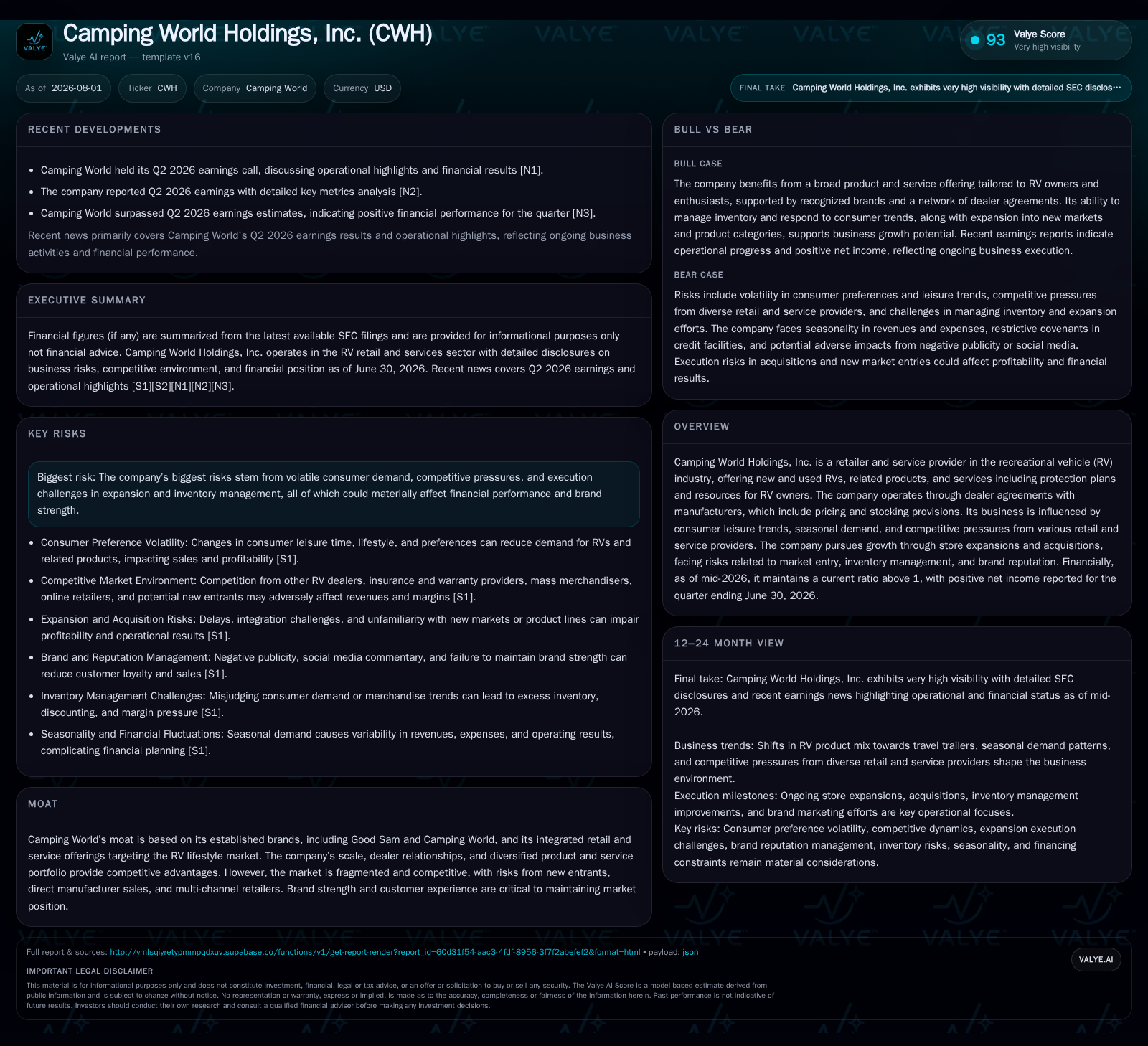
Camping World Holdings reported Q2 2026 results reflecting typical seasonal softness in new and used recreational vehicle (RV) sales offset by growth in recurring revenue streams such as protection plans, aftermarket product sales, and service offerings. The company continues leveraging dealer agreements to manage inventory effectively amid pricing pressures caused by shifts toward lower-priced travel trailers. Active membership expansion through Good Sam reinforces customer retention and smooths revenue variability. However, execution risks surrounding store expansion and competitive pressures from direct-to-consumer manufacturer channels remain key challenges. Financially, Camping World maintains a solid liquidity position with a current ratio above 1, while carrying notable leverage tied to ongoing growth investments.
Q2 Operating Highlights Illustrate Seasonal Demand Impact Balanced by Service Growth
Integrated Dealer Agreements Shape Inventory Control and Pricing Opportunities
Central to Camping World's operational control is its network of dealer agreements with RV manufacturers that specify stocking levels and minimum advertised price (MAP) provisions for new model year units [S1]. These contractual constraints limit the company's ability to aggressively discount inventory but simultaneously instill discipline in managing high-cost vehicle stock. This framework helps moderate inventory turns and aligns supply more closely with demand forecasts. However, the rigidity also restricts dynamic price adjustments which could be a drawback when consumer preferences shift unexpectedly or competitor pricing changes. The company must balance adhering to these provisions while tuning its merchandising strategy to optimize average selling prices (ASP) across variable market conditions.
Evolving Product Mix: Ascent of Travel Trailers Shifts Average Selling Prices
The product mix evolution toward travel trailers — generally lower-priced than motorhomes — has been a long-term structural trend at Camping World. Between 2015 and 2025, travel trailers rose from 62% to nearly 79% of total new vehicle unit sales [S1]. This shift mechanically compresses ASPs since travel trailers carry a lower price point than other RV classes despite partial compensation from inflationary increases. Recent quarters have seen continued modest declines in ASPs reflecting both consumer preference shifts and supply chain normalization after prior pandemic-induced shortages [S1]. Sustaining gross margins amid this trend requires operational efficiency gains or enhanced higher-margin service revenues.
Active Membership Expansion Underpins Customer Retention Amid Competitive Pressure
Camping World's demographic moat is significantly strengthened by its Good Sam membership program and related active customer base expansion [N1][N2]. Increasing active customers provides a steady stream of recurring revenues via protection plans and member-exclusive services that exhibit greater resistance to discretionary spending variability than upfront RV purchases. This loyalty-driven approach fosters better customer lifetime value through retention benefits and cross-selling opportunities across aftermarket products and service maintenance offerings. With fragmented competition across specialty outdoor retailers and emerging e-commerce channels vying for similar consumer segments, maintaining brand strength via membership engagement is crucial for revenue diversification.
Competitive Dynamic: Dealer Relationships Versus Manufacturer Direct Sales
The expanding prevalence of direct-to-consumer manufacturer sales challenges Camping World's traditional intermediary role between OEMs and end customers [S1]. Automakers have increasingly adopted online platforms that reduce reliance on dealer networks while enhancing price transparency for consumers. This trend limits dealership pricing power due to potential undercutting or bypassing altogether; it also places pressure on inventory acquisition economics given manufacturer-controlled wholesale pricing [S1]. To stay competitive, Camping World leverages scale advantages but must innovate around service quality, customer experience, and integrated offering breadth to differentiate itself from pure-play digital competitors.
Growth Vectors Through Store Footprint Expansion Face Execution Risks
Retail store expansion remains a key strategic pillar for geographic coverage growth at Camping World [S3][S1]. New locations—both greenfield openings and acquisitions—enable access to untapped markets thus increasing local customer penetration. However, execution complexity arises from integration costs, local market nuances regarding consumer preferences, lease negotiations, construction delays, staffing requirements, and regulatory approvals [S16][S17]. Additionally, macroeconomic cycles influence store profitability as discretionary spending contracts during downturns impacting store transaction volumes. Success hinges on prudent site selection supported by reliable demographic data analysis alongside efficient on-boarding protocols.
Risks Highlighted: Consumer Spending Volatility, Inventory Challenges, Brand Reputation
Several risks have heightened prominence amid prevailing economic uncertainty. As a discretionary spend-dependent business exposed to leisure activity preferences and employment dynamics, any reduction in consumer confidence can materially depress demand for expensive RV purchases as well as renewal rates for ancillary services [S1]. Inventory management challenges persist due to bulky high-value product nature compounded by forecast errors leading to excess stock or stockouts impacting margins [S27]. Brand reputation is equally vital; poor customer experiences across any touchpoint threaten erosion of loyalty-based revenue streams critical for stability in a highly fragmented competitive landscape [S1]. Cost inflation pressures in labor or energy further complicate operating margin preservation.
Upcoming Milestones: Monitoring Same-Store Sales, Protection Plan Uptake, New Store Openings
Key operating signals warrant close monitoring in succeeding quarters: same-store sales growth will reveal underlying organic health excluding new store effects; protection plan attachment rates exemplify success scaling recurring revenue; active customer count trends gauge loyalty program effectiveness; finally, successful ramp-up of recently announced store locations will indicate execution capability against identified integration risks [S2][N3]. Positive trajectories on these fronts would underscore durability of Camping World's diversified revenue base beyond cyclically sensitive unit sales.
Financial Profile Discussion: Liquidity Stands at a Secure Current Ratio Amid Debt Leverage
As of June 30, 2026, Camping World held $224 million in cash and equivalents against $2.45 billion in current assets and $2.01 billion in current liabilities, resulting in a current ratio of approximately 1.22 [F1]. This liquidity position supports near-term operational needs including inventory financing through floor plan credit facilities tied closely to vehicle stock levels. Total debt was approximately $1.48 billion as of December 31, 2025, with net debt near $1.26 billion after accounting for cash balances [F1]. The company's capital structure includes senior secured credit facilities with covenants that may limit additional indebtedness or liens, potentially affecting financial flexibility under economic stress [S4][S5][S6]. Current free cash flow generation appears sufficient to meet obligations while funding ongoing expansions, subject to macroeconomic conditions.
This analysis consolidates recent quantitative disclosures from Camping World Holdings’ latest SEC filings alongside thematic industry context specific to the recreational vehicle retail sector emphasizing cyclical demand patterns tempered by growing service-oriented revenue streams. The company’s strategy pivots heavily on leveraging its dual retail-service platform plus membership program strengths — essential tools for counterbalancing inherent seasonality and competitive channel shifts. Awareness of operational execution risks around inventory management and store rollouts comprise critical lenses through which ongoing performance should be evaluated.
This report adheres strictly to publicly filed information without investment advice or speculative forecasts.
Disclaimer: This is research-only, informational analysis and not investment advice. It may include AI-generated interpretation and general industry context. Always verify important details using primary sources.

Comments