
PTC Strengthens AI-Led Lifecycle Management Amid Mixed Q3 Execution and Robust Cybersecurity Governance
PTC's latest quarterly update highlights AI integration in product lifecycle solutions, ongoing share repurchases, and a stringent cybersecurity framework reinforcing its industrial SaaS positioning.
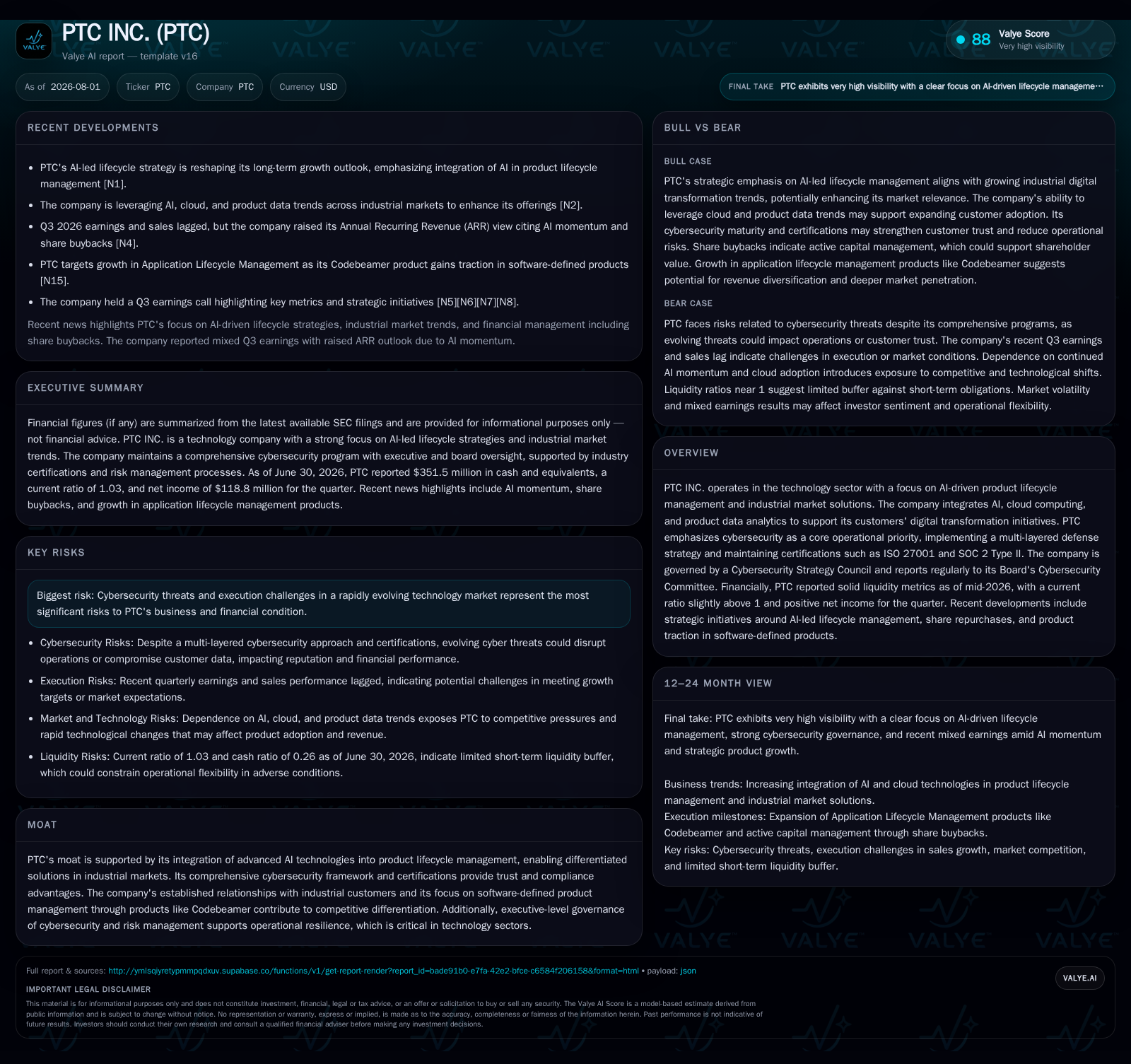
In its fiscal Q3 2026 filing, PTC Inc. reported mixed operational results with some sales headwinds but raised its ARR outlook driven by momentum in AI-powered product lifecycle management. The company continues to sharpen focus on software-defined products and industrial digital transformation, supported by a strong cybersecurity posture with ISO 27001 and SOC 2 certifications. While share repurchase programs signal capital discipline, growth execution challenges and long enterprise sales cycles remain key watchpoints. Overall, PTC maintains a differentiated position among SaaS PLM peers through integration of AI and advanced analytics within a secure, cloud-based platform framework.
Recent Operating Update: Q3 Ebb With Strategic Momentum
The quarter also featured ongoing share repurchase activity authorized out to late 2028 totaling $2 billion following prior repurchase programs’ expiration. This capital return strategy suggests management’s confidence in future free cash flow generation despite cyclical softness often seen in industrial tech budgets [S4][N8]. Meanwhile, the successful divestiture of legacy IoT assets like Kepware and ThingWorx earlier in the year refocuses PTC on its core software platforms with sharper enterprise value propositions.
Business Model: Recurring Revenue With Multi-Modal SaaS Offering
PTC operates primarily as a subscription-based SaaS provider targeting industrial enterprises demanding sophisticated PLM capabilities encompassing design-through-manufacturing lifecycle control. Its revenues derive from licenses (seats), usage-based modules including advanced analytics powered by AI/ML algorithms, and professional services for implementation/support.
A critical emerging segment is Application Lifecycle Management (ALM), exemplified by Codebeamer which caters specifically to managing software development cycles for software-defined products—a fast-growing niche reflecting industry digitalization trends [S1][N12]. Seat expansion within existing accounts along with upselling higher-margin feature sets is central to scaling ARR sustainably.
Recurring revenues provide visibility while additional professional services add upfront revenue spikes but at lower margins. Pricing power stems from deeply embedded workflow integration into customers’ R&D pipelines and regulatory compliance requirements essential for industrial clients.
Industry Structure and Competitive Position
PTC competes within the enterprise SaaS PLM space alongside incumbents such as Siemens Digital Industries Software, Autodesk’s PLM offerings, and Dassault Systèmes. These peers similarly pursue cloud transformation while emphasizing digital twin technology and data-driven product innovation platforms.
What differentiates PTC is the depth of integrated AI applied across product data analytics combined with rigorous cybersecurity governance that addresses heightened industrial security concerns—certifications like ISO 27001 & SOC 2 elevate trust in sectors where IP protection is paramount [S1][S19].
Moreover, PTC’s ability to pivot toward software-defined products reflects keen industry insight aligning product portfolio evolution toward emerging industrial digitization needs. However, it faces long sales cycles typical of large manufacturing enterprises requiring bespoke integrations alongside competitive pressures from both legacy on-premise providers transitioning to SaaS models and newer cloud-native entrants.
Growth Drivers
Several secular trends underpin PTC’s growth thesis:
- AI Adoption in PLM: Embedding artificial intelligence speeds design iterations and predictive maintenance schedules enhancing efficiency across product lifecycles.
- Cloud Shift: Migration from legacy on-premise PLM suites to cloud-first architectures fosters incremental customer acquisition/climbs through subscription upgrades.
- Digital Twin Demand: Increasing use of digital replicas for simulation directly ties into PTC’s platforms providing richer operational insights.
- Software-Defined Products: Expansion into ALM with Codebeamer signals strategic penetration into hybrid hardware-software ecosystems growing rapidly in industrial markets.
- Regulatory Compliance Drivers: Customers’ escalating needs around data privacy/security stimulate purchases of certified secure platforms.
- Cross-Sell Upsell Within Large Accounts: Established client footprint opens doors for expanding seat counts and introducing advanced modules.
- Geographic Market Expansion: Emerging market industrial modernization presents fresh opportunity windows beyond traditional developed economies.
These factors should collectively propel ARR growth provided PTC can continue demonstrating robust net retention rates and manage churn effectively.
Risks and Growth Constraints
Despite a solid foundation, PTC confronts meaningful obstacles:
- Execution Risk: Integration of AI initiatives demands sustained innovation velocity; delays or technical missteps could undermine competitive advantage.
- Lengthy Sales Cycles: Complex procurement processes slow new customer wins especially given bespoke solution tailoring at scale.
- Cybersecurity Threats: Even with strong governance frameworks there remains exposure to sophisticated cyberattacks potentially disrupting operations or eroding client trust.
- Competitive Pricing Pressure: Market entrants offering modular/cloud-only alternatives may force price concessions impacting margin profiles.
- Dependence on Third Parties: Reliance on external cloud infrastructure vendors introduces operational risk in service continuity or cost inflation.
- Customer Vendor Lock-In Apprehension: Industrial clients wary of switching costs may delay license renewals impacting retention metrics.
- Macroeconomic Sensitivity: Capital expenditure variances by manufacturing customers pose cyclicality risk to bookings/revenue pacing.
Careful monitoring of these risks along with adherence to best practices in R&D investment balance will be vital to sustaining growth trajectories [S11][S16].
What To Watch Next
Key milestones to monitor include:
- Quarterly updates on ARR growth rate versus guidance to validate AI-enabled growth acceleration claims.
- Net retention rate metrics signaling customer loyalty amid expansion or contraction dynamics.
- Cloud gross margin trends reflecting operational leverage amid ongoing platform enhancement investments.
- Progress on sales cycle efficiency initiatives aimed at compressing deal closure timelines within large industrial enterprises.
- Expansion in ALM product adoption particularly Codebeamer licensing reflecting traction in software-defined product space.
- Updates from Cybersecurity Strategy Council indicating continued risk mitigation effectiveness or new certification attainments strengthening competitive barriers.
- Adjustments to share repurchase pacing that may reveal shifts in capital allocation priorities post-divestiture proceeds deployment.
Positive signals across these vectors would support sustainability of recent strategic pivots while any degradation may warrant re-evaluation of market stance.
Financial Profile Discussion
As of June 30, 2026, PTC exhibited solid liquidity with current assets slightly exceeding current liabilities producing a current ratio near 1.03—indicative of balanced working capital management though minimal excess cushion [F1]. Cash & equivalents stood at approximately $351 million supporting operational flexibility amid investments. Historical debt and net debt figures are not updated in recent filings, so current leverage and refinancing status cannot be precisely assessed [F1].
Disclaimer: This is research-only, informational analysis and not investment advice. It may include AI-generated interpretation and general industry context. Always verify important details using primary sources.

Comments