
La Rosa Holdings Advances AI Infrastructure Amid Real Estate Brokerage Challenges
The latest quarterly filing reveals La Rosa Holdings grappling with Nasdaq compliance risks and losses while pursuing growth through its integrated real estate services and new AI infrastructure initiatives.
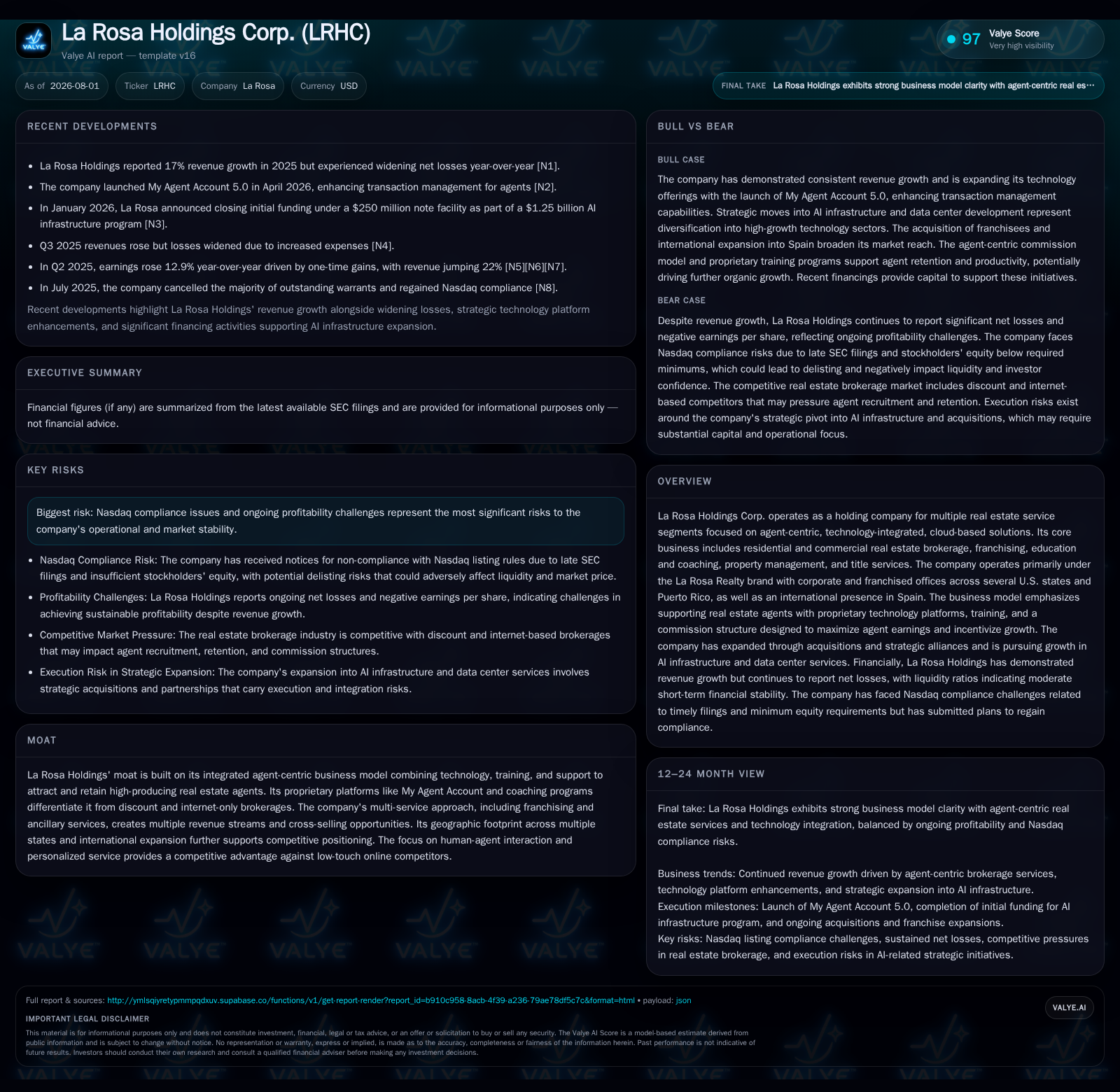
La Rosa Holdings Corp., a real estate services holding company, faces significant near-term risks tied to potential Nasdaq delisting due to late filings and share price volatility. Despite recurring operating losses raising going concern doubts, the company is advancing its agent-centric brokerage and franchising business model, bolstered by proprietary technology platforms and diversified ancillary services. Additionally, La Rosa is making strategic moves into the AI data center space through acquisitions and infrastructure development leveraging its real estate assets. Monitoring progress on compliance, acquisition integration, and agent growth will be critical markers of the company’s turnaround trajectory.
Nasdaq Compliance Risks: Immediate Market Implications from Latest Filing
io would materially impair trading liquidity and investor confidence while restricting access to capital markets during a critical refinancing horizon.
These compliance uncertainties cast a shadow over operational continuity since equity funding has been a key financial lifeline during recurring losses. The volatility in public market status could exacerbate volatility in share value and diminish attractiveness for new institutional investors or strategic partners.
Integrated Agent-Centric Model Driving Revenue Mix and Differentiated Offerings
La Rosa’s business foundation rests on an integrated multi-service model centered around a sizable network of licensed agents—approximately 2,842 active brokers and sales associates as of May 31, 2026—dispersed across primarily Florida but also California, Texas, Georgia, Puerto Rico, and Spain under both corporate (23 offices) and franchised/licensed arrangements (at least five franchise offices) [S1]. The firm operates predominantly under its flagship La Rosa Realty brand alongside ancillary units delivering property management and title services.
Revenue generation hinges on traditional brokerage commissions from residential and commercial real estate transactions complemented by franchise fees paid by independently operated branch franchises which leverage the parent company’s brand strength and technology.
Central to sustaining agent engagement is La Rosa’s proprietary platform “My Agent Account” (MAA), recently upgraded with a fully integrated Transaction Management module designed to streamline workflow and reduce reliance on costly third-party systems. Agents pay annual subscription fees granting them comprehensive toolsets aimed at enhancing lead conversion rates and efficiency within competitive local markets [S1]. This digital infrastructure coupled with robust coaching programs aligns closely with the well-documented impactful role that technology integration plays in agent retention—one of the most critical KPIs in real estate brokerage—by boosting agents’ net commission potential through reduced administrative burdens.
Franchising Strategy Anchors Geographic Reach and Recurring Income Streams
Franchising provides La Rosa with scaled geographic reach beyond wholly-owned branches, expanding its footprint particularly in high-growth Florida submarkets where five franchised offices contribute stable licensing revenues along with associated fees tied to local transaction volumes. This model enables the firm to capitalize on regional market dynamics without incurring full operational costs per location. The network effect generated aids recruitment of higher-producing agents attracted by brand recognition combined with localized autonomy.
Moreover, franchising diversifies revenue streams away from cyclical transaction-dependent commissions toward more predictable franchise fee income that contributes positively during soft real estate market phases [S1]. Controlling trademark licensing agreements further injects recurrent cash flow irrespective of immediate transaction activity.
Consolidating Brokerage, Education, Property Management, and Title Service Synergies
La Rosa broadens client engagement across multiple touchpoints through cross-segment synergy among brokerage sales, education/coaching programs aimed at agent skill enhancement, property management services managing rental portfolios on behalf of owners or investors, as well as title and escrow operations primarily based in Florida [S1]. This diversified service suite enhances lifetime customer value beyond one-off transaction commissions.
Property management complements brokerage by offering recurring fee-based income streams linked to portfolio size growth—a vital KPI reflecting scaling potential independent of volatile home sales cycles. Ancillary offerings like commission advancement programs provide agents with financial liquidity solutions that strengthen affiliation loyalty while generating fee income for the firm.
Collectively these multi-channel revenues help stabilize overall margins by reducing dependency solely on fluctuating market-driven commission splits typical in residential brokerage models prevalent among peers such as Keller Williams or Realogy.
Pioneering AI Infrastructure: Real Estate Assets Fuel Next-Generation Data Center Expansion
Recognizing structural vulnerability inherent in residential real estate’s cyclical nature—exacerbated recently by antitrust litigation uncertainties—the company announced a strategic pivot towards artificial intelligence (AI) infrastructure markets leveraging its real estate holdings [S1]. In early 2026 La Rosa entered into non-binding agreements to acquire Consensus Core Technologies Inc., an AI/high-performance computing infrastructure provider targeting Tier III data center facilities capable of supporting workloads upwards of 1,500 kW IT load within approximately 10,000 square feet [S4], representing scalable capacity attuned to enterprise-grade cloud computing demand.
This initiative involves acquiring land in fast-growing Central Florida regions suitable for developing AI-specific data centers designed for high reliability standards. Structurally this investment diversifies La Rosa’s earnings base beyond brokerage-derived commissions which remain sensitive to economic downturns while positioning it within a growing but capital-intensive tech infrastructure segment distinct from traditional competitors primarily focused on brokerage/franchise operations [S5].
While still nascent without guaranteed closure or definitive integration terms forthcoming, this directional shift carries material upside potential if successfully capitalized but also entails elevated execution risk given regulatory hurdles and financing strains inherent in high-capital facility development stages.
Risks: Cyclical Market Pressures, Profitability Challenges, Litigation Exposure, and Technology Adoption Barriers
The company's operating environment remains challenging reflecting several intertwined risks. Foremost are persistence of substantial net losses exceeding $30 million annually driving auditor going concern disclaimers that underscore precarious financial footing contingent upon successful capital raises or profitable turnaround efforts [S1]. Cash flow deficits impede self-funded expansion while increasing reliance on dilution-prone equity financing methods or complex preferred stock issuances observed recently [S4], potentially straining shareholder returns.
Legal proceedings span employment-related disputes with former executives pending resolution before trial dates late 2026/early 2027 that may trigger material settlement outflows or legal expenses constraining liquidity further [S12]. Meanwhile intensified regulatory scrutiny linked to Nasdaq listing standards demands accelerated remediation plans under tight timelines with uncertain outcomes jeopardizing public market access essential for equity capital availability [S2].
Competitive headwinds also stem from discount internet brokerages which leverage low-cost structures eroding commission bases; La Rosa seeks differentiation via specialized agent support ecosystems.
Finally adoption risks related to proprietary platforms persist: incremental upgrades like MAA version improvements promise cost savings but require consistent user uptake amid competing SaaS solutions employed industry-wide requiring constant investment to sustain relevance.
What’s Next: Milestones on Compliance, Acquisition Closures, Agent Growth Metrics
Critical near-term events will revolve around meeting Nasdaq compliance deadlines this fall with plan acceptances or filings conceivably forestalling delisting actions. Parallelly consummation or termination decisions regarding Consensus Core Technologies’ acquisition will signal commitment scope toward AI infrastructure diversification strategy [S3].
On operational performance dynamics monitoring licensed agent numbers beyond the current nearly 2,850 figure will serve as an early proxy for demand strength given direct correlation between active agents driving transaction volumes directly impacting topline growth prospects [S1]. Franchise expansions adding new regional offices or renegotiating fee structures could enhance recurring revenue visibility.
Investor focus should also track progress against cost containment measures internally manifested via executive salary reductions implemented earlier this year alongside any forthcoming restructuring announcements designed to arrest cash burn trends [S6]
Financial Profile Discussion: Recent Losses Amid Capital Structure Constraints
Recent preferred stock financings expanding issuance capacity reflect strategic attempts to bolster capital accessibility though they introduce dilution concerns requiring future earnings improvement justification to restore investor confidence [S4], highlighting delicate trade-offs between sustaining operations amidst losses versus shareholder value preservation.
Disclaimer: This analysis synthesizes publicly filed regulatory disclosures without offering investment advice or forecasts concerning securities performance.
Disclaimer: This is research-only, informational analysis and not investment advice. It may include AI-generated interpretation and general industry context. Always verify important details using primary sources.

Comments