
PTC Therapeutics Strengthens Rare Disease Franchise with Milestones Driving Revenue
PTC Therapeutics’ latest quarterly report highlights milestone-driven revenue growth amid a strong cash position, underscoring its rare disease commercial strategy and regulatory dependencies.
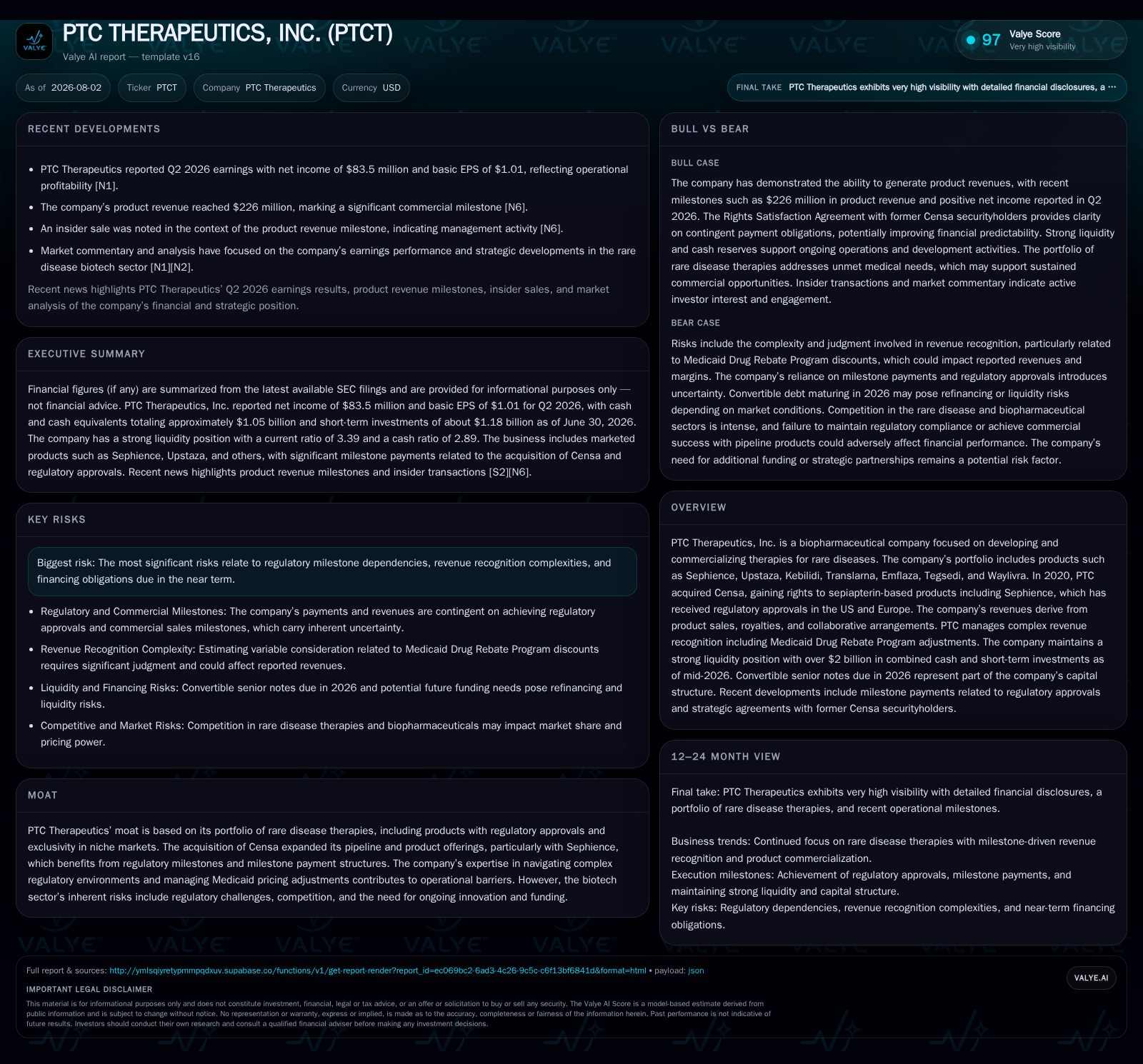
In Q2 2026, PTC Therapeutics recognized significant milestone payments tied to regulatory approvals for its rare disease portfolio, notably Sephience, reflecting the company’s success in expanding patient access and product commercialization. This milestone-driven revenue recognition introduces timing variability but affirms the value of recent pipeline expansions stemming from strategic acquisitions like Censa. PTC’s management continues to navigate complex Medicaid Drug Rebate Program adjustments that materially impact net sales and revenue recognition. The company’s liquidity remains robust with over $2 billion in combined cash and investments, though near-term refinancing of $93 million in convertible senior notes due September 2026 demands attention. Peers such as BioMarin similarly balance milestone-dependent revenues with ongoing clinical development, positioning PTC competitively within the niche rare disease biotech landscape.
Quarterly Milestones Accelerate Revenue Recognition but Add Complexity
PTC Therapeutics’ Q2 2026 filing reveals accelerated revenue recognition driven by milestone payments linked to regulatory approvals for Sephience in both US and European markets. These payments reflect achievement of specific development and sales milestones under the Censa acquisition agreements, a substantial driver given both operational validation and cash inflow timing [S2], [S3]. While these milestones underpin short-term revenue growth, they introduce variability and complexity in forecasting due to dependency on regulatory events and market penetration assumptions.
The quarterly update also revised estimates for eligible patient populations and intensified efforts around identification campaigns for rare disorders addressed by their portfolio. These dynamics influence volume-based sales expectations alongside fixed contractual milestones, heightening the intricacy of revenue recognition across product sales versus contingent payments [S2]. Such multi-factor revenue mechanics necessitate sophisticated forecasting models that incorporate regulatory timelines, patient diagnosis rates, and payer program participation.
Rare Disease Portfolio Monetization: Multifaceted Revenues from Sales to Royalties
PTC’s monetization architecture combines direct product sales with royalties from licensing agreements and structured milestone payments associated particularly with the Censa merger assets. Beyond upfront acquisition costs, milestone obligations include up to $217.5 million for developmental milestones on advanced sepiapterin programs plus additional triggers tied to net sales thresholds reaching $250 million, $500 million, and $1 billion over consecutive quarters [S1], [S5]. The company has already disbursed over $150 million in milestones linked to Sephience’s FDA approval and European Commission marketing authorization.
This layered revenue model benefits from market exclusivities often granted under orphan drug designations but also complicates net revenue calculation since royalty percentages escalate alongside higher sales tiers ranging from 8% to 12% [S1]. Moreover, Medicaid Drug Rebate Program liabilities reduce gross receipts through mandated price concessions impacting realized margins. PTC’s transparent acknowledgment of these pricing pressures confirms they remain material factors shaping profitability despite regulatory protections [S1], [S2]. Integrating these elements reflects a strategically broad but financially nuanced approach common among specialized rare disease biopharma firms.
Price and Policy Pressures: Navigating Medicaid Rebate Impact on Revenues
Government pricing programs like the Medicaid Drug Rebate Program impose significant operating leverage risks for PTC. Rebates mandated under this program require adjustments that affect net product revenue after gross sales recognition [S1]. Changes in enrollment or reimbursement policies can alter rebate liabilities unpredictably, pressing PTC to continuously refine its pricing strategies and financial provisions.
This dynamic is emblematic of broader sector challenges faced by biopharmaceutical companies reliant on government payors where policy shifts can compress margins or delay cash collections. Effective navigation entails not only compliance disciplines but also proactive payer engagement to sustain access programs at favorable terms—critical for maintaining volume growth in ultra-niche patient populations typical of rare diseases.
Industry Peers Provide Context on Competitive Position and Revenue Model Nuances
Within the rare disease biotech cohort—members like BioMarin Pharmaceutical serve as relevant comparators exhibiting similarly complex revenue mixes including milestone-triggered income streams combined with royalties and direct sales. Such peers typically balance clinical innovation pipelines aligned with regulatory protections granting market exclusivity spanning years post-launch.
PTC’s strong liquidity profile exceeding $2 billion in cash plus marketable securities provides strategic flexibility exceeding many smaller peers who face tighter financing constraints during development cycles or pre-commercial phases. This financial cushion enables sustained investment into commercialization capacity tailored to reach limited but high-specialty patient cohorts globally—a distinct competitive strength against less capitalized entrants in this domain.
Pipeline Prospects and Regulatory Routes Frame Future Growth Potential
PTC maintains an active pipeline targeting additional rare genetic disorders leveraging proprietary platforms enhanced through acquisitions like Censa. Its portfolio expansion is supported by orphan drug designations underpinning expedited regulatory pathways offering reduced time-to-market compared with traditional pharmaceuticals [S1]. Clinical trial advancements across key programs remain critical KPIs while label expansions offer incremental addressable markets beyond initial approved indications.
Future growth prospects hinge on such regulatory achievements combined with strategic partnerships driving collaboration-based milestone payments. Patient identification improvements further complement commercial opportunities by enlarging diagnosed pools eligible for treatment—an essential step given inherent rarity limiting total market sizes.
Risks from Milestone Dependencies, Market Access Challenges, and Financing Refinement Needs
PTC faces concentration risk owing to operational reliance on achieving specific developmental or commercial milestones which manifest as lumpy revenue recognition points subject to regulatory agency decisions beyond firm control [S1], [S2]. Delays or adverse outcomes impair near-term cash flow predictability.
Reimbursement volatility introduced by government payer dynamics such as Medicaid rebate policy modifications adds further uncertainty affecting net realized prices. The highly specialized nature of treatments also confines patient volumes imposing limitations on rapid scale benefits common in broader pharma segments.
Finance-wise, approximately $93 million of convertible senior notes mature in September 2026 requiring refinancing or repayment action imminently—a juncture demanding careful capital structure management amid evolving operating conditions [S2]. Failure or suboptimal refinancing may constrain flexibility despite a strong liquidity base.
"What’s Next" — Monitoring Product Launches, Milestone Triggers, and Financial Stability Signals
Investors should prioritize upcoming catalyst events including anticipated milestone payments linked to new indication authorizations or expanded market entries providing tangible validation of pipeline progressions within approved platforms [N1], [N2], [S3]. Monitoring royalty income streams vis-à-vis reported sales metrics will also illuminate realization quality amidst payout obligations arising from legacy collaborations.
Financial updates addressing management’s approach towards the upcoming convertible note maturity deadline will reveal capital access health key for sustaining R&D momentum. Additional guidance or third-party analyst assessments around evolving patient identification efficacy may further refine near-term demand forecasts informing commercial scalability judgments.
Financial Profile Discussion: Cash Position Supports Growth but Convertible Notes Require Vigilance
As reported at June 30, 2026, PTC Therapeutics holds approximately $1.05 billion in cash plus an additional $1.18 billion in marketable securities totaling around $2.23 billion in liquid assets—one of the more robust liquidity positions relative to biotech peers specializing in rare diseases where capital intensiveness often pressures available cash [F1], [S2]. The company’s current assets of approximately $2.62 billion and current liabilities near $771 million imply a current ratio of about 3.4x, indicating strong short-term liquidity coverage [F1].
Conversely, total debt includes nearly $93 million due imminently via convertible senior notes maturing September 2026 representing a refinancing need shortly ahead that injects some near-term financial uncertainty despite existing strength [S2]. This calls for close observance of debt capital markets conditions alongside management disclosures concerning refinancing plans or covenant negotiations essential for maintaining credit health without operational disruption
In aggregate, PTC’s financial structure appears aligned with sustaining its specialized commercial footprint while navigating inherent biotech-sector volatility tied to regulatory timing and milestone income dependencies.
Disclaimer: This is research-only, informational analysis and not investment advice. It may include AI-generated interpretation and general industry context. Always verify important details using primary sources.

Comments