
Alcoa's Acquisition Gamble Shapes Aluminum Industry Outlook
Alcoa’s pursuit of South32’s equity interests adds strategic growth potential but also increases near-term operational and financial uncertainties.
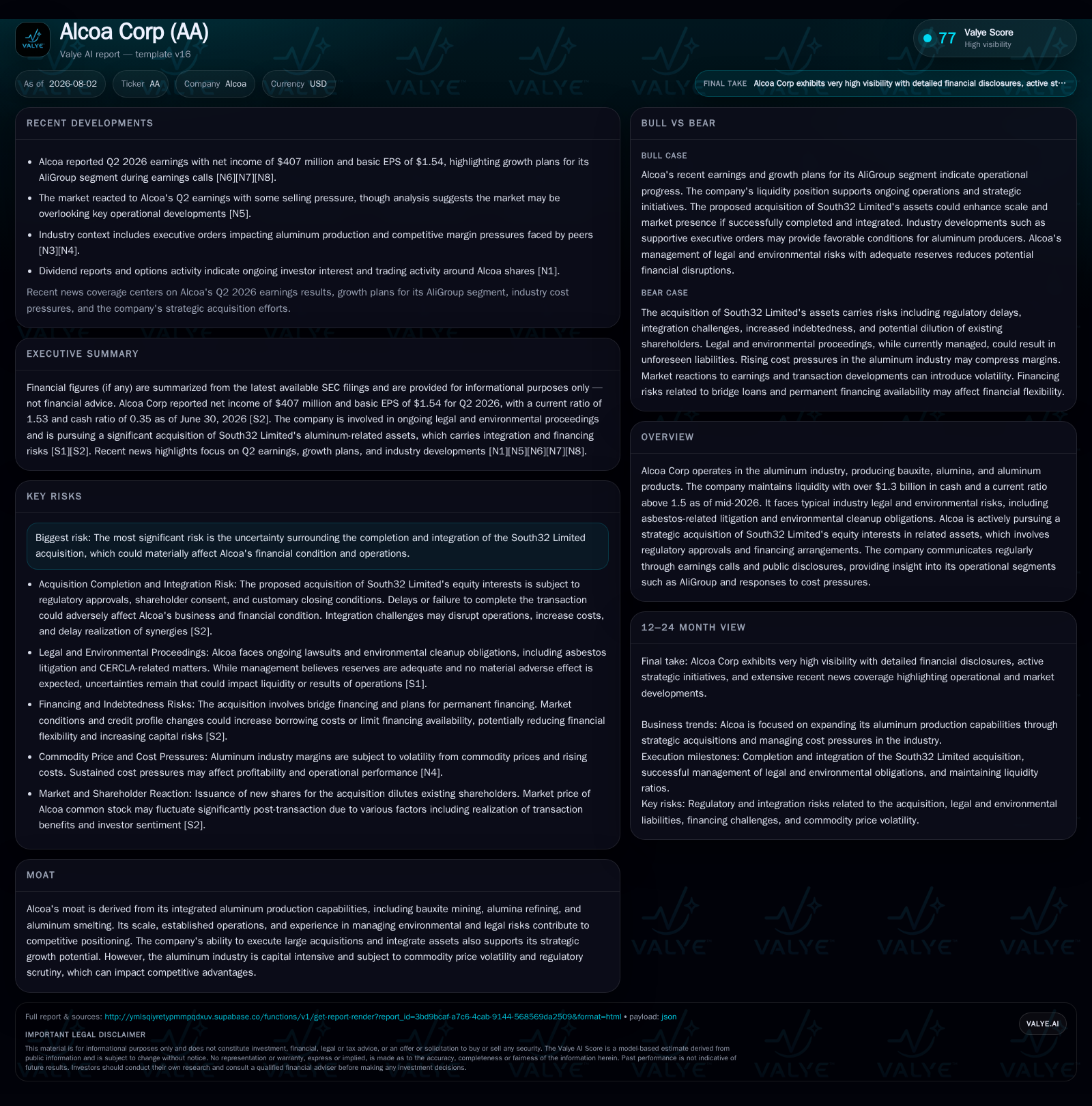
In its 2026 Q2 SEC filings, Alcoa Corp updated on its ongoing strategic acquisition of South32 Limited's bauxite, alumina, and aluminum assets, highlighting transaction-related costs and regulatory approval risks that cloud near-term operational clarity. The company continues to leverage its integrated production model spanning bauxite mining through aluminum smelting to sustain pricing and margin discipline amid commodity market volatility. While Alcoa maintains a solid liquidity position with over $1.3 billion cash and a healthy current ratio, the completion and integration of the South32 transaction remain critical growth catalysts shadowed by execution risks. Operational performance shows mixed cost and capacity utilization pressures reflecting broader sector dynamics including energy intensity and environmental compliance demands.
Post-Quarterly Update: Acquisition Risks Shadow Operational Momentum
Alcoa’s most recent quarterly filing dated July 30, 2026, underscores the material near-term uncertainty tied to its planned acquisition of South32 Limited's equity interests in complementary bauxite mining, alumina refining, and aluminum smelting assets [S2]. This transaction remains subject to multiple closing conditions—including South32 shareholder approval, regulatory clearances across jurisdictions, and listing approvals for new shares to be issued—that have yet to be satisfied or waived. Notably, Alcoa disclosed the incurrence of considerable transaction-related costs such as advisory fees and legal expenses irrespective of deal completion [S2]. These fixed costs weigh on near-term profitability metrics while imposing execution timing risk. Importantly, the share issuance accompanying the transaction would dilute existing stockholders by approximately six percent post-close [S2], potentially exerting downward pressure on market valuations especially if South32 shareholders sell newly acquired stock.
This juncture represents a volatile inflection point; delays or failure to close could disrupt operational planning and capital allocation decisions while dampening market confidence. The company’s filings indicate that termination rights exist under the Deed should closing conditions fail to materialize within reasonable timeframes [S2], emphasizing that the acquisition's strategic benefits hinge not just on completion but also effective integration post-close.
Integrated Production Model: Capturing Value From Bauxite to Aluminum Metal
Alcoa operates a vertically integrated business model spanning upstream bauxite mining through midstream alumina refining to downstream aluminum smelting and fabrication—a structure reaffirmed in its February 2026 annual report [S1]. This comprehensive footprint affords Alcoa enhanced control over input sourcing amid global supply chain complexity and fluctuating raw material prices. By internalizing production stages traditionally held by separate entities, the company can mitigate margin squeeze effects common in highly commoditized metal markets where price volatility is endemic.
Customers primarily comprise industrial manufacturers in sectors such as automotive lightweighting solutions, aerospace components, packaging materials, and construction alloys. Alcoa’s ability to supply both basic raw materials (like bauxite and alumina) as well as value-added fabricated products strengthens customer retention through diversified product offerings. Key performance indicators in this model include capacity utilization rates across all production segments—essential for absorbing fixed costs in energy-intensive electrolysis processes—and cost per ton produced that reflects energy input efficiencies.
While cyclical demand influences volume shipped and average realized prices fluctuate with global metal markets, integrated producers like Alcoa leverage their scale to sustain operating margins through coordinated production scheduling and upstream cost management [S1]
Industry Dynamics: Balancing Scale, Capital Intensity, and Pricing Power
The aluminum industry is capital-intensive with long asset lifecycles necessitating sustained capital expenditures for maintenance and modernization of mines, refineries, and smelters. Energy consumption per ton produced remains a critical cost driver given electrolysis processes comprise the bulk of smelting operations' energy use. Commodity price cycles tightly correlate with revenue variability as aluminum spot prices react swiftly to macroeconomic demand shifts.
Peers such as Aluminium Corporation of China (Chalco), Rio Tinto, Norsk Hydro, and Rusal face similar pressures though vary in geographic exposure and product breadth. Alcoa’s ability to strategically deploy capital expenditure under these conditions directly impacts its return on capital employed (ROCE) and free cash flow generation capacity—a vital determinant of financial flexibility in an industry prone to commodity-driven margin compression.
Operating margins reported in filings reflect this tension: gains from higher prices may be offset partially by rising input costs including energy price inflation or logistics constraints [S1]. Continuous productivity improvements and efficiency initiatives are critical to sustaining competitive advantage against lower-cost producers internationally.
Acquisition Impact: Strategic Growth vs Integration Uncertainty from South32 Deal
The strategic rationale driving Alcoa’s pursuit of South32’s equity interests focuses on consolidating resource ownership across bauxite deposits, alumina refineries, and smelters thereby expanding scale synergies that could enhance competitive positioning globally [S2,S3]. Integration would expand Alcoa’s resource base potentially reducing cost per ton through optimized asset utilization.
However, updated disclosures reveal increasing caution around timing risks tied to requisite regulatory clearances which remain pending well into mid-2026 [S2]. Expenses already incurred despite uncertain closing timelines add financial burden. Market reception post-announcement has been mixed due to dilution concerns alongside uncertainty over the immediate accretive impact on earnings per share or free cash flow generation.
Transaction delays or failure could stymie projected benefits including anticipated synergies or earnings accretion cited at announcement. Additionally, integration challenges often feature unforeseen execution risks ranging from cultural misalignment to operational disruptions thus increasing contingent liabilities during transition phases.
Operational Performance: Cost Controls and Capacity Utilization Under Pressure
While detailed quarterly production volumes or exact utilization rates are not explicitly itemized in filings reviewed here, narrative updates emphasize continued pressure on aluminum segment costs partially driven by global energy inflation pressures inherent in electrolysis-intensive smelting operations [N3,S2]
Notably, discussions during Q2 earnings calls spotlight AliGroup—the downstream cast products segment—as a focal point for growth investments aimed at niche value-added markets with higher margins compared to commodity-grade metal sales [N3]. This segment's expansion underscores a strategic pivot towards differentiated products offsetting commodity cycle sensitivities.
Energy intensity management remains paramount; ongoing initiatives intended to improve process efficiency will be pivotal indicators moving forward alongside shipment volumes monitoring capacity responsiveness to fluctuating demand signals.
Sector Risks: Commodity Cycles, Energy Costs, Legal Exposure, and Regulatory Compliance
Alcoa faces persistent sector-native risks highlighted extensively in its annual SEC disclosures including exposure to volatile LME aluminum prices impacting revenue realization volatility [S1,S2]. High capital expenditure demands coupled with long-lived assets constrain operational agility.
Environmental compliance obligations—especially related to hazardous substance handling at former sites—and substantial asbestos-related litigation remain material although management reports adequate insurance coverage mitigating direct financial jeopardy presently [S1,S17]. Regulatory scrutiny over emissions controls or permitting also bear future cost implications.
Energy supply disruptions or abrupt price spikes pose additional operational risks given the electricity dependence of electrolysis-based smelting technologies common industry-wide. Global geopolitical shifts affecting trade flows similarly affect market balance.
Monitoring Points: Transaction Milestones, Production Metrics, Market Signals Ahead
Key near-term developments warrant close attention notably regulatory approvals from relevant antitrust bodies for completion of the South32 asset purchase agreement—any delays here would extend acquisition uncertainty significantly weighing on stock price dynamics [S2,N2].
Operational KPIs such as changes in production volumes across bauxite mining units or alumina refining output could signal successful asset integration later. Capacity utilization rates when disclosed will illuminate how effectively combined operations leverage scale advantages under evolving market conditions.
Watch also for commodity price momentum shifts serving as leading indicators for revenue trajectory—persistent downward pressure would strain margins further; conversely strength provides upside levers for profitability [N2]
Financial Profile Discussion: Liquidity Cushion Amid Capital Commitments
As of June 30, 2026 balance sheet data shows Alcoa holding $1.35 billion in cash equivalents backed by current assets totaling $5.885 billion versus current liabilities of $3.834 billion yielding a current ratio of approximately 1.53—a comfortable liquidity position sufficient for near-term operational needs plus ongoing acquisition-related spend commitments [F1]
Total debt stood at about $2.22 billion resulting in net debt around $872 million after cash offsets—a moderate leverage level manageable given expected free cash flow generation from core integrated operations barring adverse cycle swings or protracted deal delays [F1]
Maintaining robust liquidity amidst expensive strategic transactions is essential; this buffer provides optionality against potential contingencies such as extended regulatory review or unforeseen integration expenses documented in filings [S2,S3]
This analysis synthesizes Alcoa Corp’s latest quarterly disclosures within a detailed aluminum industry context emphasizing structural experiential factors specific to integrated producers managing high capital intensity amid volatile market dynamics. It incorporates explicit operating insights tied directly from SEC submissions without extrapolating unsupported forward outlooks or proprietary metrics.
The views expressed herein do not constitute investment advice or research views.
Disclaimer: This is research-only, informational analysis and not investment advice. It may include AI-generated interpretation and general industry context. Always verify important details using primary sources.

Comments