
Regeneron Advances Biologics Sales and Pipeline Development While Managing Biosimilar Pressure
Q2 2026 results show Regeneron’s growth driven by EYLEA and Dupixent amid biosimilar competition and sustained R&D investment in late-stage drug candidates.
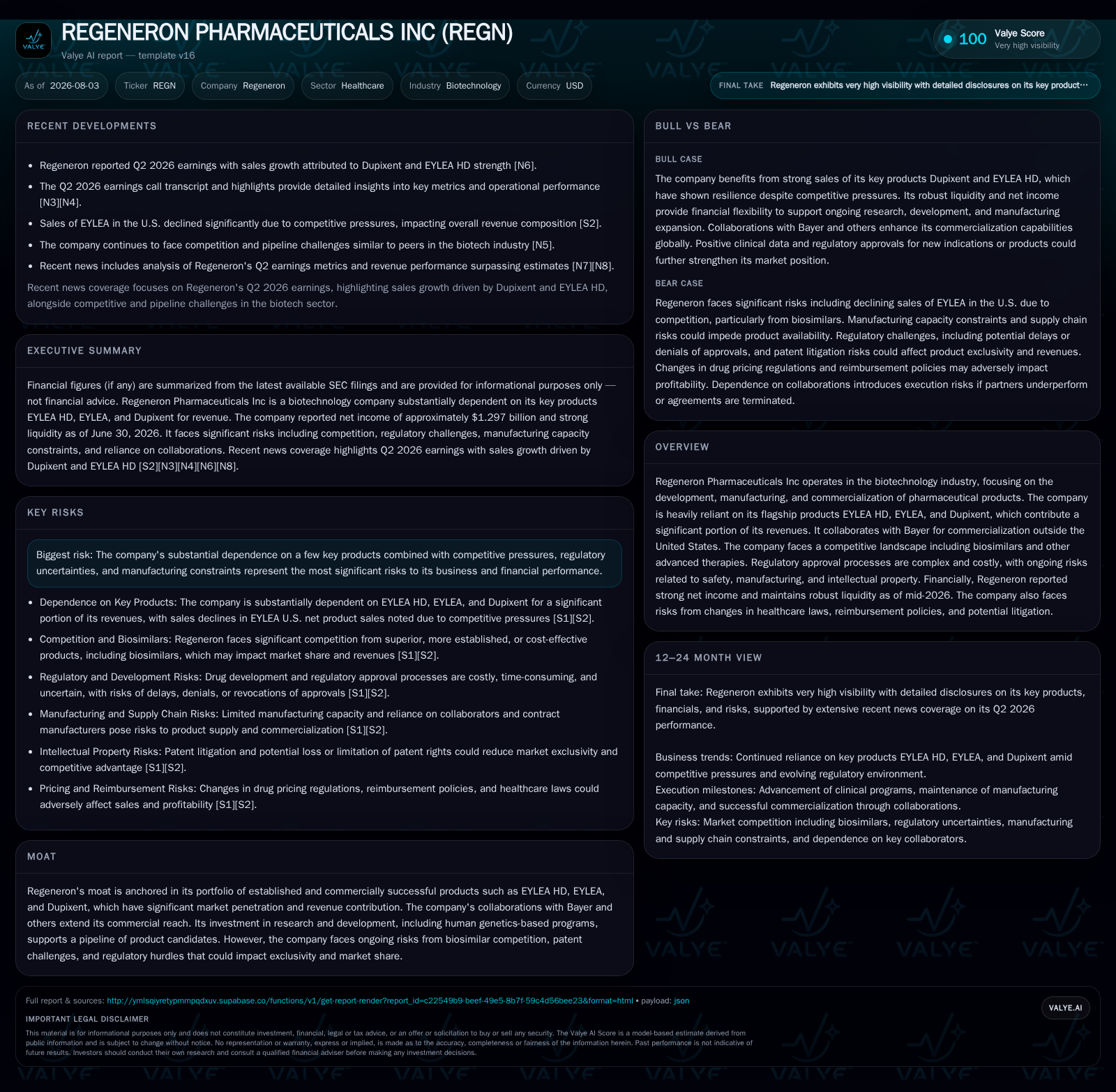
In the latest quarter ending June 30, 2026, Regeneron Pharmaceuticals reported sustained revenue strength powered by its core products EYLEA HD, EYLEA, and Dupixent, reflecting ongoing market penetration and collaboration benefits. While these biologics underpin the company's commercial engine, competitive pressures from biosimilars and regulatory complexities remain significant hurdles. Regeneron's integrated biotech model, combining R&D innovation with manufacturing scale and strategic collaborations, supports a sizable late-stage pipeline to offset patent expirations. Financially, the company maintains robust liquidity and manageable leverage to fund growth and acquisitions.
Recent Operating Update
Regeneron Pharmaceuticals’ Q2 2026 disclosures reveal continued revenue strength primarily driven by its flagship biologic products: EYLEA HD, EYLEA, and Dupixent [S2][S3]. These therapies not only contribute substantially to top-line but also demonstrate durability through extended label expansions and strong patient adoption globally. The company’s collaboration arrangements notably with Bayer bolster its non-US commercialization footprint providing a distinct channel advantage in international markets [S1]. However, the latest filings also caution that biosimilar introductions represent an escalating competitive threat that could erode future sales [S10][S19]. Acquired in-process research and development (IPR&D) charges relating to collaboration deals were noted at $127 million pre-tax in Q2 2026 [S6], pointing to active investment in bolstering the product pipeline through external partnerships.
Business Model Analysis
Regeneron operates as a fully integrated biotechnology firm executing across the entire value chain from early discovery through clinical development to manufacturing and commercialization [S1]. Revenue is principally generated through net product sales of biologic agents that target high-value therapeutic areas such as ophthalmology (EYLEA) and immunology (Dupixent). Monetization hinges on selling directly or via collaborators to healthcare providers, hospitals, specialty pharmacies, and government payors. Third-party reimbursement is crucial; thus, coverage policies from Medicare/Medicaid alongside private insurers substantially influence uptake [S10][S19].
Strategically, Regeneron offsets high fixed costs inherent in R&D and manufacturing by leveraging collaborations for co-development risk-sharing (Sanofi for Dupixent) and widening distribution channels (Bayer partnership). These alliances provide milestone payments, royalties, and shared profits which supplement direct product sales revenues [S1]. However, this model requires precise coordination to avoid margin dilution.
The company’s investment in genetics-based R&D platforms underpins a pipeline of roughly 45 clinical candidates [S1], positioning it to refresh revenues as frontline products face patent cliffs or biosimilar incursion. Manufacturing represents another critical node; internal capacity augmentation is essential to meet volume ramp-ups post-approval but also introduces timing and cost risks given the complexity of biologics production [S10][S21].
Industry Structure and Competitive Position
The biotechnology industry is characterized by intensive capital deployment into long-cycle research followed by regulatory approvals that dictate market access timelines. Within this ecosystem, Regeneron enjoys a moat through proprietary monoclonal antibodies protected by patents that have garnered significant market share in their categories [S1]. Peers like Amgen similarly balance internal innovation with partnerships to optimize lifecycle management.
Nonetheless, the sector faces a bifurcation where rising biosimilar competitors challenge incumbent biologics’ exclusivity duration—directly impacting revenue predictability. Regulatory pathways enabling biosimilar entry shorten effective patent protections compelling incumbents toward continuous innovation or label diversification [S10][S19]. Reimbursement pressures further complicate pricing strategies particularly under evolving US healthcare legislative measures aiming at curbing drug cost inflation [S23]. In this context, Regeneron's mix of blockbuster products with collaborative commercialization is well-aligned but requires vigilant pipeline progression to sustain competitive defenses.
Growth Drivers
Growth levers include ongoing approvals of new indications for existing biologics which can meaningfully expand patient populations served—this has been evidenced by multiple label expansions for Dupixent across inflammatory diseases [S1]. Additionally, product innovations enhancing delivery mechanisms or dosing convenience can improve adherence thereby increasing lifetime sales per patient.
Further pipeline evolution fueled by advances in human genetics enhances discovery success rates; Regeneron's robust candidate count at various clinical phases signals breadth sufficient to deliver next-generation therapies [S1]. Strategic acquisitions and licensing agreements complement internal programs enabling rapid portfolio diversification.
Global market penetration remains vital as emerging geographies adopt specialty biologics with increasing purchasing power supported by expanding healthcare infrastructure. Collaborative ties facilitate expedited regional launches beyond US-centric commercialization capabilities [S1][S3]. Lastly, timely regulatory approvals serve as pivotal inflection points underpinning valuation uplift and eventual revenue realization.
Risks and Constraints
Substantial dependency on a limited suite of high-revenue products presents concentration risk; any erosion caused by unforeseen safety events or competitor displacements could materially impair financial performance [S10][S19]. Fluctuations in reimbursement policies or government pricing mandates pose ongoing threats to margins particularly under heightened scrutiny over drug pricing frameworks.
Manufacturing capacity remains constrained by technical complexity inherent in biologic production. Failures or delays at either proprietary or contract manufacturing sites risk supply shortages impacting commercial commitments [S10][S21]. Intellectual property litigations complexity adds legal uncertainty potentially diverting resources toward defense rather than innovation.
Collaborator reliance inherently risks misaligned incentives or operational failures outside Regeneron’s direct control which could delay launches or reduce marketing effectiveness [S14][S19]. The volatile geopolitical landscape combined with regulations across multiple jurisdictions introduces compliance burdens.
Financially, acquired IPR&D charges introduce earnings variability signaling acquisition-driven expansion but also short-term profit pressures [S6]. Maintaining talent required for advanced R&D programs amidst strong industry competition is also crucial yet challenging.
What to Watch Next
Upcoming milestones include FDA decisions on several late-stage pipeline assets which will clarify near-term growth runway. Market uptake data on extended indications for Dupixent and performance sustainability for EYLEA HD amid biosimilar entry will be key demand markers. Monitoring collaboration renewal terms or new alliance formations will reveal strategic alignment continuity.
On execution fronts, tracking manufacturing capacity expansion progress alongside inventory management provides insight into readiness for anticipated launches. Regulatory environment updates influencing US drug pricing policy require scrutiny given their direct margin implications. Quarterly updates on acquired IPR&D expense trends may indicate acquisition pacing.
Financial Profile Discussion
As of June 30, 2026, Regeneron held approximately $2.46 billion in cash and cash equivalents against total debt estimated at $3.49 billion yielding net debt near $1.03 billion—reflecting balanced leverage supporting both organic growth investments and strategic transactions [F1]. The current ratio stands at a robust 3.34 showcasing ample liquidity coverage over short-term liabilities providing operational resilience during pipeline investments or market uncertainties [F1].
The company’s financial structure underpins sustained R&D expenditures critical for its discovery-to-commercialization model while managing collaborations requiring upfront milestone payments evidenced by recent IPR&D charges impacting quarterly earnings non-GAAP adjustments [S6][S7]. This financial flexibility aligns well with sector expectations where capital availability directly correlates with long-cycle biotech innovation embodied by companies such as Amgen.
This analysis synthesizes recent regulatory disclosures alongside established industry knowledge to illustrate Regeneron's current operating profile within global biotech dynamics without extrapolating forward-looking statements or unverifiable claims. readers may want to monitor further due diligence especially regarding regulatory outcomes and reimbursement trends that materially influence biotech firm valuations.
Disclaimer: This is research-only, informational analysis and not investment advice. It may include AI-generated interpretation and general industry context. Always verify important details using primary sources.

Comments