
PSQ Holdings Nears NYSE Delisting Threshold While Pursuing $5.5 Million EveryLife Sale Amid Losses
PSQ’s market cap hovers just above NYSE minimums, with the pending EveryLife divestiture facing execution and tax risks alongside ongoing significant operating losses.
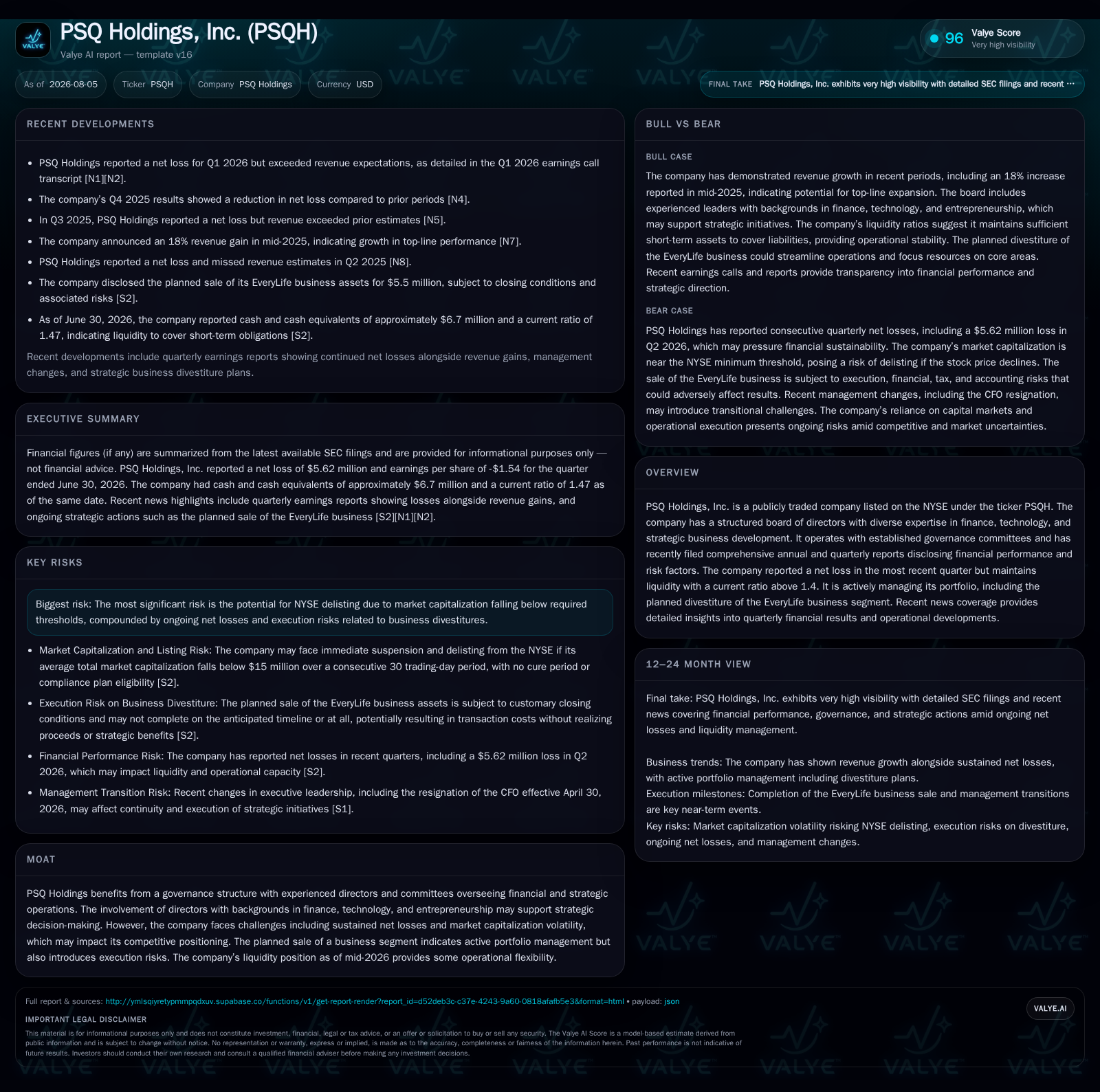
In its Q2 2026 filing, PSQ Holdings reported an average market capitalization of $17.3 million as of July 31, narrowly above the NYSE's $15 million minimum for listing, exposing the company to immediate suspension risk without remedial options. The firm is pursuing the sale of its EveryLife business for $5.5 million, a transaction carrying customary closing contingencies, potential purchase price adjustments, indemnification holdbacks, and complex tax implications that could affect net proceeds and liquidity. Despite a significant net loss of approximately $36.6 million in 2025, PSQ maintains a current ratio of 1.47 and cash reserves of $6.7 million at quarter-end, providing limited operational flexibility. The company’s investment holding model relies heavily on successful portfolio management and transaction execution to stabilize financial performance and enhance shareholder value.
Latest Quarterly Update Highlights Critical Market Cap Thresholds and Divestiture Execution Risks
PSQ Holdings’ Q2 2026 filing underscores significant near-term operational challenges driven by its precarious market capitalization positioning and ongoing portfolio restructuring efforts. As of July 31, 2026, the company's average total market capitalization was approximately $17.3 million—marginally above the New York Stock Exchange’s strict $15 million minimum required over any trailing 30 trading-day period [S2]. This regulatory standard entails immediate suspension and delisting without any cure period if breached, posing a material risk that can abruptly impact investor confidence and access to public capital markets.
Concurrently, PSQ is progressing with the divestiture of its EveryLife business segment under a definitive agreement valued at $5.5 million [S2]. Although strategically aimed at portfolio optimization and liquidity enhancement, this transaction carries typical closing contingencies that introduce execution risk including potential delays or failure that would result in incurred transaction costs without corresponding proceeds—an acute concern given existing financial pressures.
Tax complexities further complicate this sale; under Internal Revenue Code Section 1060, the purchase price allocation will determine both timing and characterization of any taxable gain recognized by PSQ post-closing [S2]. Additionally, post-closing purchase price adjustments and indemnification holdbacks may reduce net cash inflows realized by the company, directly influencing available liquidity for operational needs or debt servicing.
Business Model Anchored in Investment Holding and Portfolio Management
PSQ Holdings functions primarily as an investment holding company overseeing a portfolio from which it derives revenue through investment income streams such as dividends and interest alongside capital gains upon asset sales [S1]. Unlike traditional operating companies that generate revenue from products or services, PSQ’s value creation depends heavily on astute capital allocation decisions including acquisitions and divestitures aligned with long-term profitability goals.
The company’s governance framework supports these activities via committees tasked with overseeing financial reporting integrity and strategic investments including asset disposals like EveryLife [S1]. Such governance is crucial in managing transaction complexities while balancing short-term liquidity demands against longer-term portfolio reshaping objectives.
Industry Context: Managing Market Volatility and Transaction Complexity Among Financial Holding Peers
Within the financial services sector—encompassing investment holding companies and alternative asset managers such as Brookfield Asset Management or Apollo Global Management—firms routinely navigate valuation volatility tied to macroeconomic conditions alongside regulatory listing requirements.
NYSE-imposed market capitalization thresholds represent a stringent compliance hurdle unlike more flexible private equity or diversified asset management peers who typically enjoy broader fee-based revenue streams insulating them from pure valuation shocks. For PSQ Holdings, falling below these floors triggers abrupt delisting risks that compound cost-of-capital pressures by signaling elevated investment risk.
Moreover, executing large-scale asset dispositions involves extensive due diligence, tax planning considerations, post-closing adjustments, and indemnity arrangements common across industry peers—factors requiring robust governance capabilities amidst balancing liquidity needs versus strategic repositioning imperatives.
Growth Drivers: Portfolio Optimization via Strategic Divestiture and Expense Discipline
The imminent completion of the EveryLife business sale represents a pivotal growth catalyst by unlocking estimated proceeds intended to bolster liquidity or facilitate deleveraging initiatives [S2][S1]
Beyond one-off divestiture gains, sustainable growth depends on disciplined portfolio turnover combined with prudent cost controls aimed at reducing operating deficits evident in persistent negative operating income trends. Capitalizing on market cycles through timely asset disposition execution may improve earnings quality while enabling expansion opportunities within complementary financial sectors.
Key Constraints: Market Capitalization Vulnerability and Execution Risk on Asset Sales
Two primary constraints temper PSQ Holdings’ outlook:
First is the immediate threat of NYSE delisting triggered by average market capitalization falling below $15 million—with no cure period amplifying volatility risk exposure post-reporting periods [S2]. Such an event would disrupt public trading status potentially restricting capital access.
Second is execution risk surrounding consummation of the EveryLife sale; delays or failure would not only forfeit expected cash inflows but also incur sunk transaction expenses exacerbating operational cash burn [S2]. Uncertainty related to tax liabilities stemming from purchase price allocation could further diminish net realized benefits post-sale.
These factors collectively highlight the delicate balance between external valuation-driven risks and internal execution capabilities shaping PSQ’s near-term trajectory.
Monitoring Priorities: Market Capitalization Trends, Divestiture Progress, Liquidity Health, Governance Oversight
Critical near-term indicators include continuous tracking of PSQ’s average market capitalization relative to NYSE minimums—persistent proximity demands readiness for prompt corrective actions if declines occur post-quarter [S2].
Equally important is scrutiny over milestones associated with EveryLife transaction such as satisfaction of closing conditions, adherence to timelines, finalization of purchase price allocations, indemnity disclosures—all serving as proxies for anticipated liquidity stabilization [S2][S3]
Liquidity metrics including maintenance or deterioration of current ratio (reported at 1.47) provide insight into operational resilience absent additional financing sources [F1]. Governance developments affecting decision-making frameworks warrant attention given their critical role steering portfolio restructuring amid volatile conditions.
Financial Profile Discussion: Sustained Operating Losses Amid Moderate Liquidity Cushion
PSQ Holdings maintains a moderate liquidity position with approximately $6.7 million in cash and equivalents and a current ratio of 1.47 as of June 30, 2026, supporting near-term working capital requirements [F1]
However, this buffer remains limited considering impending transaction costs related to the EveryLife divestiture which are expensed regardless of deal closure success. Any delays or failures in closing would strain cash resources since anticipated proceeds fueling turnaround efforts might not materialize timely [S2]
Additionally, tax implications tied to purchase price allocation under IRC Section 1060 introduce variability in net gain realization potentially affecting reinvestment capacity or debt servicing ability vital for restoring fiscal health [S2]
It situates operational updates within sector norms for financial holding companies emphasizing structural risks around listing eligibility thresholds and portfolio execution dependencies without conjecture beyond provided evidentiary sources.
Disclaimer: This is research-only, informational analysis and not investment advice. It may include AI-generated interpretation and general industry context. Always verify important details using primary sources.

Comments