
Integer Holdings Advances Through Strategic Merger and Operational Resilience
The company reports solid Q2 2026 financials alongside a pivotal merger agreement with KKR, balancing operational discipline and strategic uncertainties.
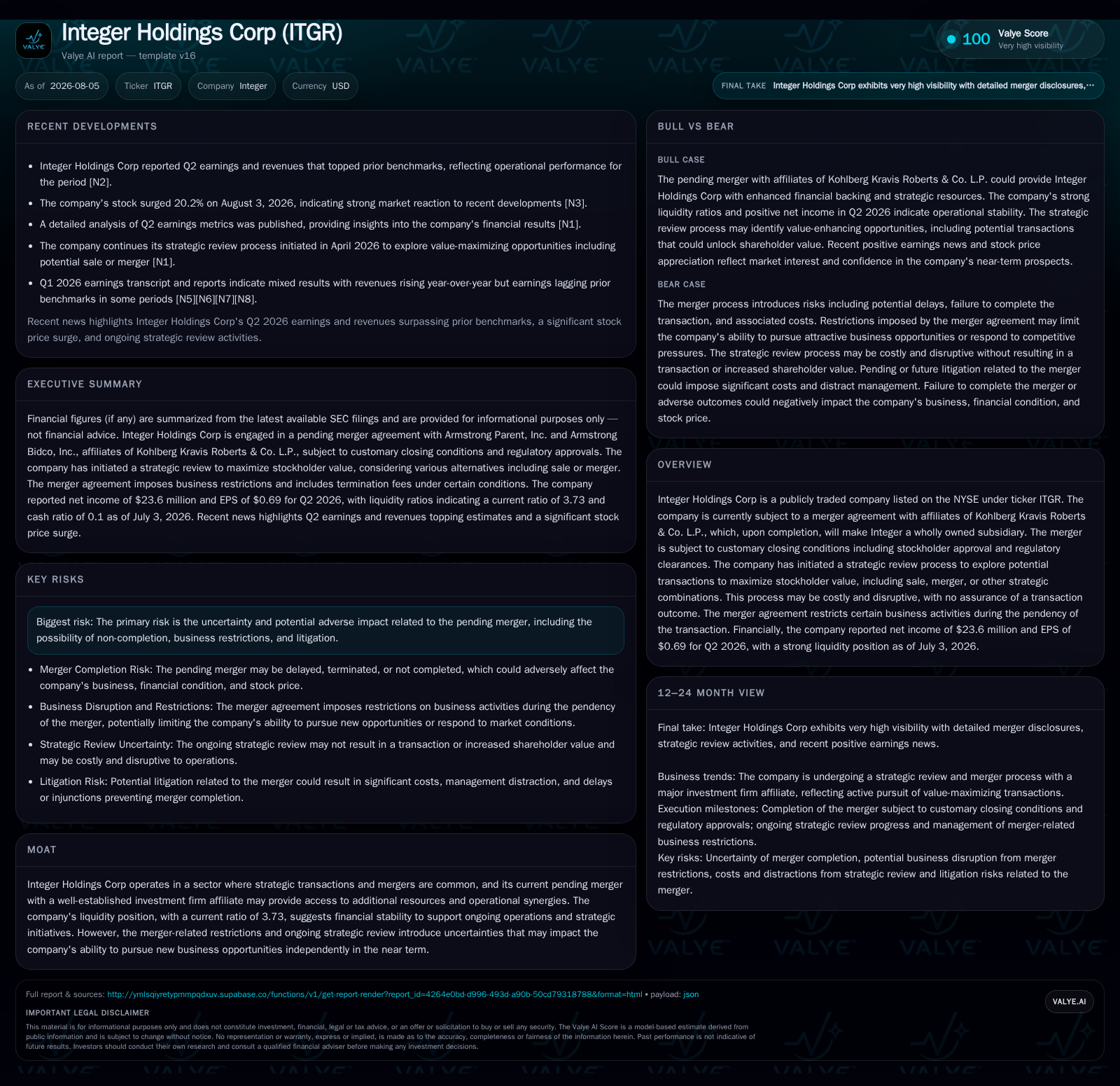
Integer Holdings Corporation reported a net income of $23.6 million and EPS of $0.69 for Q2 2026, exceeding revenue estimates despite ongoing merger-related operational constraints. The company entered into a definitive merger agreement with KKR affiliates under customary closing conditions, triggering strategic review efforts while limiting operational flexibility. Integer continues to focus on manufacturing excellence in medical device components, sustaining high quality control and long-term OEM contracts. Key risks include merger completion uncertainty, regulatory approval timelines, and supply chain dynamics affecting capacity utilization.
Q2 2026 Operating Update Highlights Merger Milestone and Business Steadiness
In its latest quarterly filing for Q2 2026 dated August 4, Integer Holdings Corp reported net income of $23.6 million with an earnings per share (EPS) of $0.69, surpassing revenue expectations according to market sources [S2],[N1],[N2]. This performance underscores the company's operational resilience even amidst the significant strategic event announced concurrently — a definitive merger agreement with affiliates of Kohlberg Kravis Roberts & Co (KKR) executed on August 2, 2026 [S3]. The merger agreement outlines customary closing conditions including majority stockholder approval, absence of prohibitive governmental orders, expiration of antitrust waiting periods under Hart-Scott-Rodino regulations, compliance with covenants during the interim period, and no material adverse effects since signing [S28]. Notably, both the company and KKR retain rights to terminate under certain scenarios including unmet conditions by May 2, 2027 or superior proposals arising [S28]. These developments introduce immediate strategic constraints as Integer is required to adhere to conduct covenants restricting certain business actions during the pendency of the transaction—a factor that tempers management’s flexibility but safeguards deal integrity [S2]. Despite this backdrop, the firm’s continued profitability indicates an effective balancing act between maintaining daily operations and managing transaction-related complexities.
Manufacturing Core: Operational Quality Controls Amid Strategic Constraints
Integer operates primarily as a manufacturer of specialized medical device components and implantable devices that are supplied largely to original equipment manufacturers (OEMs) and healthcare providers under long-term contracts [S1]. This business model hinges heavily on disciplined manufacturing yield rates and defect tracking systems aligned with stringent FDA regulatory approvals and quality control standards. These factors directly influence customer contract renewal rates critical for revenue stability. The firm's detailed product lifecycle management necessitates adherence to exacting production protocols amid its complex supply chain management environment [S1],[S2]. However, the merger agreement's business conduct covenants potentially restrict enhancing manufacturing capacity or pursuing aggressive expansion initiatives temporarily—delaying investments that could improve capacity utilization or broaden product lines at a time when OEM demands are evolving rapidly [S28]. Thus, maintaining manufacturing yield rates without sacrificing quality becomes essential not only for client retention but also to uphold brand equity within a sector where recalls or defects severely damage reputations.
Competitive Positioning: Navigating Contract Manufacturing within Medical Components Ecosystem
Within the competitive landscape of medical device manufacturing, Integer occupies a critical role as a specialized supplier focusing on implantable device components rather than serving as a full-scale diversified medical device OEM akin to Medtronic or Boston Scientific. As such, Integer tends to face pricing pressure characteristic of component contract manufacturers but offsets this through complex product specialization that creates switching costs for customers reliant on highly regulated supply chains. Compared with peers like Teleflex Incorporated—another prominent medical component contract manufacturer—Integer's engagement in long-term supply arrangements provides revenue visibility but demands rigorous compliance with regulatory approval timelines such as FDA clearances that extend product time-to-market cycles [S1]. This positioning necessitates continuous innovation in manufacturing practices alongside robust quality assurance frameworks to maintain competitiveness within established OEM ecosystems.
Growth Drivers: Regulatory Approval Pipelines, OEM Relationships, and Demographic Tailwinds
Structural growth within Integer’s domain benefits from several enduring healthcare trends. The aging global population drives increased prevalence of chronic diseases requiring implantable therapies—a demand vector supporting volume growth for many medical device manufacturers including Integer’s implantable components segment. Additionally, ongoing pipelines through regulatory bodies such as FDA enable periodic new product launches once authorization is granted; these milestones serve as key catalysts for enlarging addressable markets and renewing OEM partnerships which often hinge on innovation capability alongside proven manufacturing reliability. Expanding healthcare infrastructure in emerging markets may further amplify demand long term though execution remains tempered by current strategic focus limitations due to merger-related restrictions. Overall, these drivers support underlying growth prospects contingent upon successful navigation of approval timelines and sustaining OEM trust via contract renewals.
Risks Ahead: Merger Uncertainties, Regulatory Hurdles, and Supply Chain Considerations
Despite promising fundamentals, Integer faces significant risk exposures predominantly tied to its pending merger transaction. The company discloses multiple contingencies including possibility that the deal may be delayed or fail entirely due to unmet closing conditions such as shareholder votes or antitrust interventions [S28],[S12]. Failure to complete the transaction could materially affect market pricing for common shares along with business continuity given management distraction and potential supplier/customer disruptions outlined in risk disclosures. Additionally, operating under merger-imposed business conduct restrictions curtails strategic agility possibly delaying capital expenditures needed for manufacturing capacity optimization or supply chain resilience improvements—a vital consideration given global supply chain volatility common in medical device sectors today,[S12]. Moreover, risks related to regulatory delays in FDA clearances impact time-to-market metrics which can depress revenues from new products affecting longer-term growth sustainability.
Key Milestones to Monitor: Merger Approvals, Quarterly Revenue Signals, Capacity Utilization Trends
Looking forward into late 2026 and early 2027 several milestones will critically shape Integer’s trajectory. The timely outcome of requisite stockholder voting on the merger agreement will be determinative alongside completion of regulatory reviews under U.S. antitrust law frameworks particularly the Hart-Scott-Rodino Act conditional periods [S3].[N1] Subsequent quarterly earnings releases will serve as leading indicators for whether demand patterns or margin structures shift materially during this transition period. Tracking operating KPIs such as capacity utilization rates will reveal if manufacturing operations maintain efficiency amid possible interim investment deferrals. Similarly monitoring customer contract renewal progress provides insight into how well client relationships weather period uncertainty framed by deal execution risk.
Financial Profile Discussion: Liquidity Strength Versus High Leverage in Midst of Transaction
From a financial standpoint Integer displays notable liquidity strength with current assets totaling approximately $810.6 million compared against current liabilities near $217.1 million resulting in a healthy current ratio of about 3.73 as of July 3, 2026—a marker indicating adequate short-term funding capacity during transactional inactivity phases [F1]. Cash reserves amount to roughly $21 million while total debt stands substantially higher at approximately $1.26 billion resulting in net leverage exceeding $1.23 billion; thus financial flexibility is constrained though mitigated by existing equity commitments from the KKR buying party ensuring transaction financing sufficiency at close [F1],[S3]. This leverage profile underscores the premium accorded by KKR’s commitment letters which enhance confidence regarding deal completion feasibility albeit carrying associated refinancing risk post-merger closure should operational cash flow not improve sufficiently.
This analysis contextualizes Integer Holdings Corp’s recent performance within its ongoing strategic transformation prompted by a significant private equity acquisition offer from KKR affiliates. It balances detailed examination of operational strengths amid stringent quality controls required in medical device manufacturing alongside cautious recognition of risks tied primarily to transaction execution complexities and regulatory uncertainties inherent in healthcare verticals. Stakeholders should closely monitor near-term proof points around meritorious deal approvals alongside core financial health signals reflective of operational steadiness through this transitional chapter.
Disclaimer: This report is prepared solely for informational purposes without any research view regarding securities purchase or sale. readers may want to monitor all publicly available information before making investment decisions.
Disclaimer: This is research-only, informational analysis and not investment advice. It may include AI-generated interpretation and general industry context. Always verify important details using primary sources.

Comments