
First Watch’s Daytime Dining Focus Drives Operational Efficiency but Faces Liquidity Challenges
The company’s concentrated breakfast and lunch model supports high unit volumes and employee satisfaction but necessitates careful management of growth and leverage.
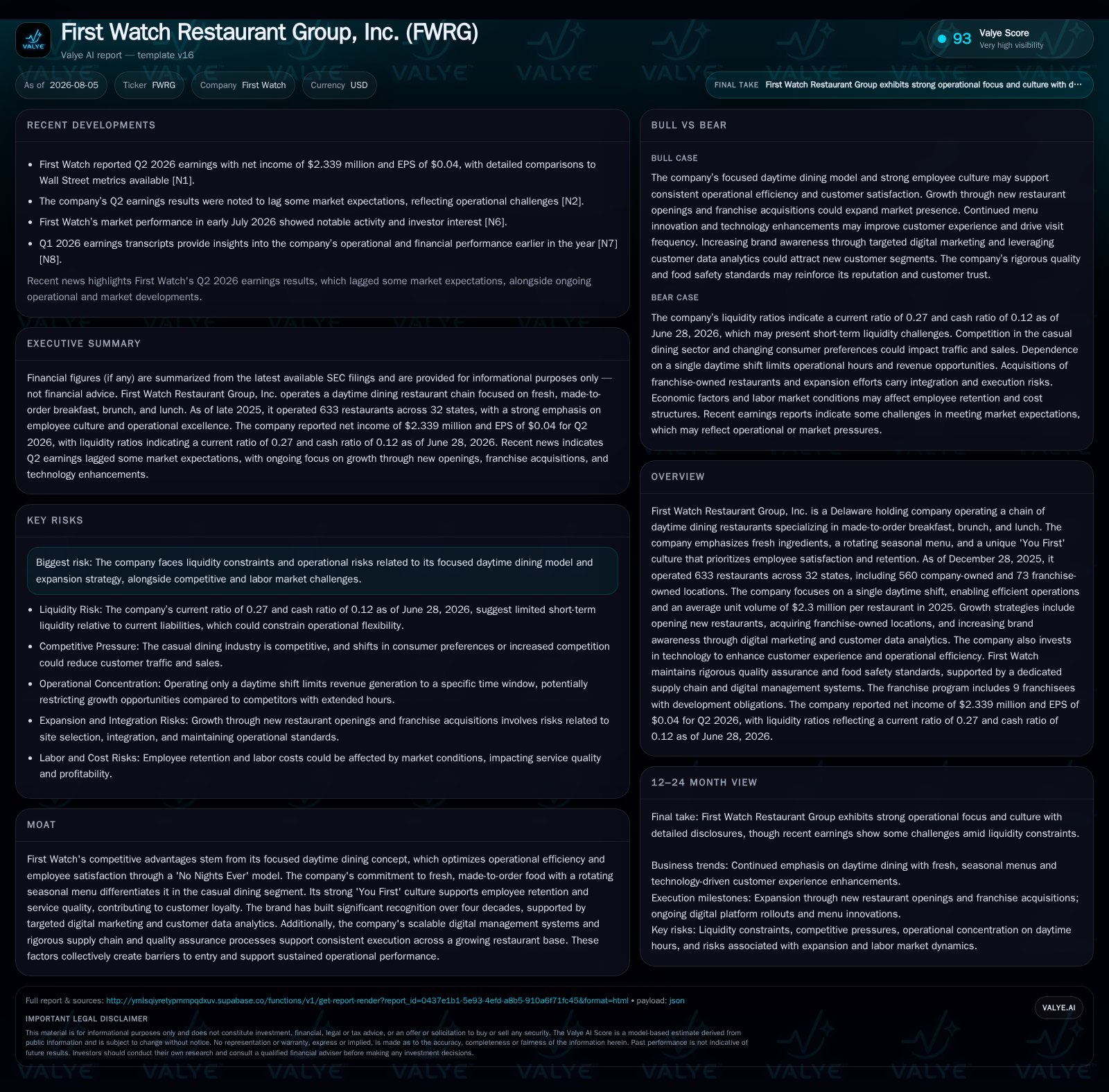
First Watch Restaurant Group, Inc. operates a large chain of daytime-only casual dining restaurants specializing in made-to-order breakfast, brunch, and lunch with a strong focus on fresh ingredients and seasonal menu innovation. The company’s unique operational model—serving only during daytime hours—enables operational efficiencies and high average unit volumes but inherently limits hours of operation, which pressures expansion-focused growth to achieve scale. Recent quarterly disclosures reveal stable core demand yet highlight ongoing liquidity constraints tied to elevated debt and a low current ratio. Growth is being pursued through opening new units, franchise acquisitions, and technology investments to enhance customer experience, though labor market pressures and supply chain risks remain notable headwinds.
Recent Operating Update
First Watch Restaurant Group’s latest quarterly filing for the period ended June 28, 2026, reveals continuity in its core operating model while underscoring liquidity pressures that warrant close monitoring [S2]. The company emphasized stable in-restaurant demand with continued strengthening same-store sales indicative of sustained consumer appetite for experiential daytime dining. This aligns with broader industry trends favoring quality experiences over mere convenience [N1][S2]. Technological advancements such as full deployment of pay-at-the-table systems across all company-owned outlets reflect management’s commitment to operational excellence and customer convenience enhancements.
Despite this positive top-line traction, the company's financial snapshot signals some caution. Current assets of approximately $47.5 million compared to current liabilities of about $177.9 million yield a current ratio near 0.27, indicating potential strain on working capital liquidity requiring vigilant cash flow management particularly amidst ongoing restaurant openings and remodel investments [F1].[S2]
Business Model Specifics
First Watch operates primarily in the U.S. casual dining segment, uniquely concentrating exclusively on daytime dining periods focusing on made-to-order breakfast, brunch, and lunch menus that leverage fresh ingredients with frequent seasonal updates [S1]. This "No Nights Ever" strategy compresses operations into roughly a 7.5-hour daily shift per location—a point that optimizes labor scheduling efficiency while catering to consumer demands typically underserved by multi-shift competitors.
Revenue streams derive mainly from food and beverage sales in-company owned restaurants complemented by franchised outlets spanning about 11% of the system-wide counting around 73 franchises out of total 633 stores [S1]. The monetization model includes direct in-restaurant dining revenue augmented by off-premises sales channels such as digital ordering for takeout and third-party delivery integrations. Off-premises sales increased from 17.5% of total restaurant sales in 2024 to approximately 19% in 2025—an evolving component that strengthens the brand's accessibility amid changing consumer habits without diluting its experiential core offering substantially [S1].
Unit economics are favorable driven by an average unit volume (AUV) near $2.3 million per store annually as of year-end 2025—a figure above many casual dining peers largely due to focused daypart specialization facilitating higher traffic concentration during operational hours [S1]. This concentration enables relatively stable table turnover rates backed by superior guest experience powered by chef-driven menus including items like Breakfast Quinoa Bowl or Chimichurri Steak Hash. Seasonality also plays a role with menus rotating four to five times annually bolstering customer trial frequency.
Employee retention is another pivotal dimension of First Watch’s business model [S1][S20]. The "You First" culture enhances employee satisfaction via predictable schedules avoiding evening/night shifts common elsewhere in dining hospitality jobs. This strategic focus likely reduces turnover-related costs—a critical factor given widespread labor shortages affecting industry peers—while also contributing positively to customer service consistency
Industry Structure & Competitive Position
Peers that have diversified into fast casual or implemented omni-channel ordering platforms at scale (e.g., Shake Shack) illustrate growing competitive pressure on technological fronts; however, First Watch's adoption of digital ordering for takeout plus pay-at-the-table tech deployment places it firmly within contemporary standards necessary for sustaining customer loyalty and efficiency gains [S1].
The blend of company-owned versus franchise outlets positions the company for tighter brand control relative to heavily franchised chains such as Yum Brands but requires more capital investment up front—a tradeoff that appears carefully managed given recent strategic acquisitions of franchise units totaling at least 19 restaurants in two deals during 2025 to consolidate ownership footprint [S18]
Growth Drivers
First Watch's growth engine revolves around three interlinked pillars: opening new restaurants primarily company-owned; selectively acquiring franchise-operated stores; and intensifying marketing efforts underpinned by sophisticated customer data analytics aiming to boost visitation frequency and average check size [S1]. These acquisitions serve dual purposes: expanding store count while enhancing uniformity across the system which improves margin scalability.
Menu innovation remains an ongoing priority featuring seasonal rotations that keep offerings fresh without alienating loyal customers reliant on flagship dishes such as their Brooklyn Breakfast Sandwich or freshly juiced beverages batched daily at each location—a rarity among casual dining peers adding differentiation advantage.
On the technology frontier, investments target improving guest-facing experiences alongside streamlining back-of-house operations enabling better labor cost management—a crucial margin lever amid rising wage inflation impacting the whole sector [S1]. The steady march toward greater off-premises contribution represents an adaptive response to evolving consumer behavior accentuated post-pandemic although still a minority revenue slice.
Risks and Constraints
Operationally, First Watch confronts several headwinds emblematic of broader foodservice industry dynamics compounded by its unique model constraints. Foremost among these are:
- Labor market tightness heightening wage pressure despite cultural efforts aimed at retention; inability to attract qualified staff may constrain pace of new restaurant openings or degrade service quality [S20].
- Continued supply chain vulnerabilities affecting key fresh ingredient sourcing potentially elevating food costs or causing sporadic shortages given reliance on a limited number of suppliers for foodstuffs including coffee beans sourced via Project Sunrise initiative supporting women-owned farms—reflecting both reputational benefits but sourcing concentration risks [S29][S1].
- Regulatory complexity spanning food safety mandates such as HACCP compliance evolution plus employment law shifts increasing legal scrutiny burden associated with wage/hour claims or safety-related litigations typical within the restaurant sector potentially adding unforeseen compliance costs or settlements [S26][S27][S20].
- High leverage position limits financial flexibility when confronted with macroeconomic slowdowns or credit market volatility essentials since debt service consumes significant cash flows limiting scope for opportunistic expansions or capital expenditures beyond baseline maintenance capex levels [F1][S4][S5].
- Single-daypart focus directs growth reliance almost exclusively toward geographic expansion rather than maximizing daytime throughput within existing units thereby increasing acquisition/real estate risk exposure.
What To Watch Next
Key upcoming milestones include assessing same-store sales trends through subsequent quarters: sustained positive guest traffic growth versus any signs of deceleration will signal robustness or softening demand patterns respectively [N1]. Monitoring progress converting additional franchise locations will illuminate management's ability to grow control while validating acquisition economics.
Advances in technology rollouts—particularly enhancements in mobile/digital ordering interfaces or labor scheduling tools—will reveal how inclined consumers are toward deeper engagement while enabling staff productivity gains underpinning future margin improvement potential.
From financing perspective, updates regarding potential refinancing activity or amendments related to debt covenants would be critical given historically thin liquidity buffers evidenced recently by the low current ratio metric derived from Q2 data [F1].[N2]
Finally, regulatory developments around wage laws or food safety compliance impacting either direct operations or franchise partners may require swift adaptations; their handling could affect reputation noticeably given First Watch’s brand positioning tied closely with quality assurance commitments.
Financial Profile Discussion
Recent financial data portrays a classic maturity-phase restaurant operator contending with capital intensity balanced against solid operating income generation capacity. Operating income stood near $27.5 million at year-end 2025 with net income reported at about $19.4 million demonstrating positive profitability maintenance through steady core sales momentum despite inflationary pressures [F1].[S1]
However, balance sheet metrics introduce caution flags: total debt aggregating roughly $267.6 million exceeds available cash reserves significantly leaving net debt near $247.1 million at fiscal start 2026 while current assets cover only about one-quarter of short-term liabilities—a current ratio at approximately 0.27 speaks directly to potential strain on working capital liquidity requiring vigilant cash flow management particularly amidst ongoing restaurant openings and remodel investments [F1].[S2]
Continued dependence on bank facilities or capital markets refinancing may expose the company to interest rate variations over time owing to floating-rate instruments embedded in existing credit agreements—which historically elevate risk during rising rate environments common post-pandemic recovery cycles.
In summary, First Watch exhibits qualitatively advantageous characteristics including a differentiated daytime-only concept driving premium AUVs alongside strong employee culture fostering retention; yet quantitatively it faces near-term financial leverage challenges compounded by persistent operational risks typical of casual dining companies attempting measured growth expansion under macro uncertainty.
Disclaimer: This is research-only, informational analysis and not investment advice. It may include AI-generated interpretation and general industry context. Always verify important details using primary sources.

Comments