
Knife River Corp Expands Vertically Integrated Construction Materials Platform Amid Positive Volume and Price Momentum
Q2 2026 results highlight volume-driven revenue growth supported by strategic acquisitions and favorable pricing in aggregates, ready-mix concrete, and asphalt.
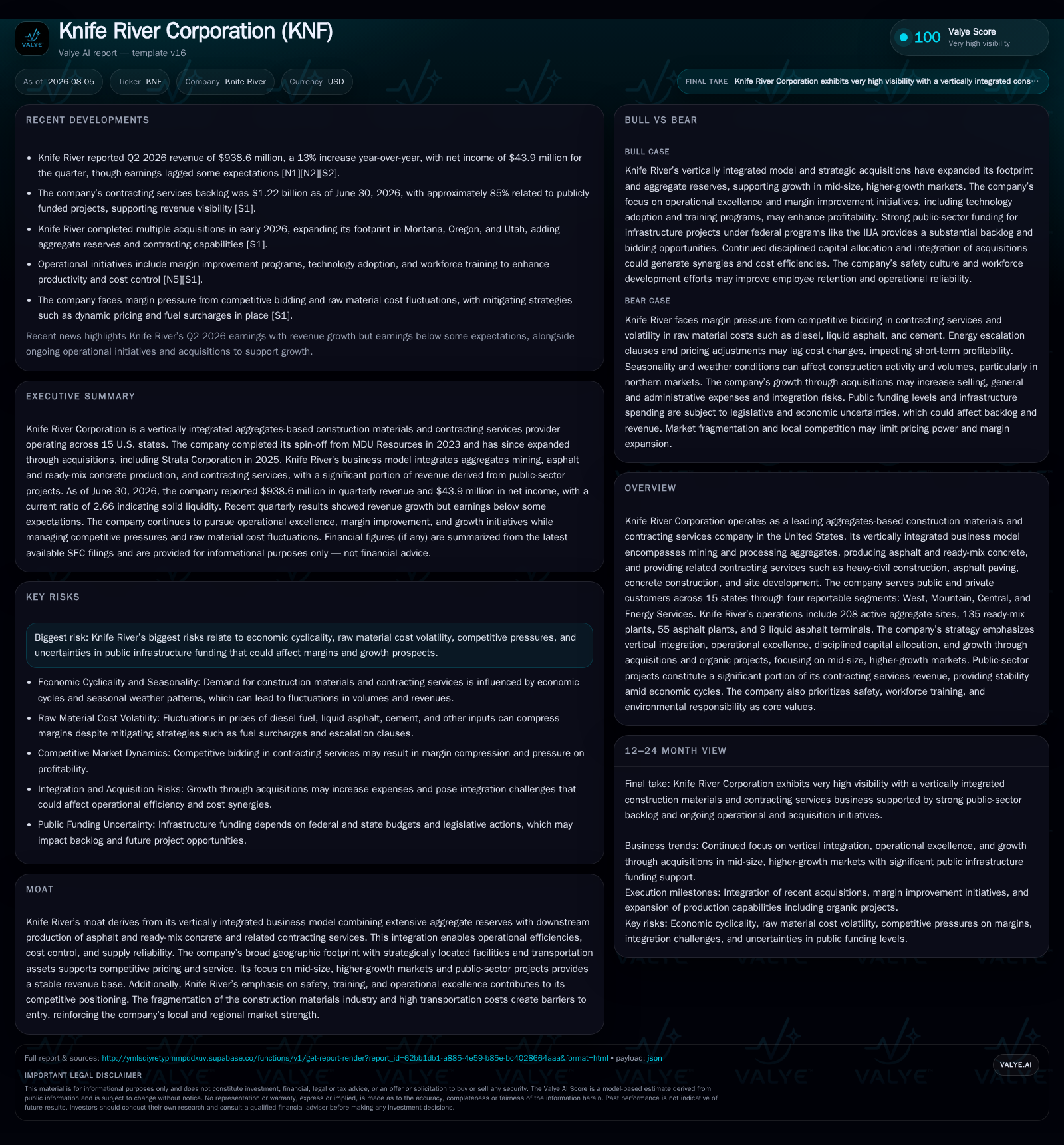
Knife River Corporation’s latest quarterly report confirms robust demand driven by early favorable weather and acquisition support, with revenue up sharply due to volume gains across its vertically integrated construction materials and contracting services franchise. The company leverages its extensive aggregate reserves and downstream production plants to serve public and private customers across 15 states. Despite macroeconomic cyclicality and cost pressures inherent to the sector, Knife River’s operational excellence initiatives, disciplined capital allocation, and regional market positioning underpin stable margin advancement and backlog growth. Liquidity remains adequate with a current ratio above 2.5 and $387 million borrowing capacity, though elevated net debt from prior acquisitions warrants monitoring. Near-term growth drivers include federal IIJA infrastructure spending rollout, expansions in mid-sized higher-growth markets, and further integration of acquired assets.
Recent Operating Performance
Business Model Analysis
Knife River’s business strategy is grounded in vertical integration across the construction materials value chain within its expansive U.S. footprint covering 14-15 states. The company controls over 1.3 billion tons of aggregate reserves distributed among more than 200 active sites strategically located adjacent to manufacturing plants including ready-mix concrete (135 plants) and asphalt production facilities (55 plants), supplemented by nine liquid asphalt terminals—facilities that allow blending specialty products essential for infrastructure projects [S1]. Approximately one-third of mined aggregates are retained internally for downstream conversion into value-added products or used directly in heavy-civil construction services such as paving or site development.
Vertical integration confers Knife River several structural advantages: reliable raw material supply shielding against third-party cost inflation; improved operational coordination reducing downtime or excess logistics expense; and ability to capture margin spread between raw material extraction and finished product delivery. This comprehensive control over inputs to end markets aligns well with the industry’s transportation-cost-sensitive nature where proximity reduces freight weight impacts—a sizable portion of total unit cost.
The company serves a dual customer base consisting primarily of public-sector clients commissioning infrastructure upgrades—roadways, bridges—and an array of private developers engaged in industrial or residential building projects. Public contracts typically come through competitive bidding but benefit from state-level funding boosts tied to federal programs such as the Infrastructure Investment and Jobs Act (IIJA). Private sector sales rely on steady urbanization trends fueling demand for construction materials.
Industry Landscape and Competitive Position
Operating within the broad U.S. construction materials and contracting services sector places Knife River alongside large-scale aggregates producers like Martin Marietta Materials and Vulcan Materials Company which similarly maintain vertically integrated models combining raw material extraction with asphalt/concrete production capabilities. However, Knife River's strategic targeting of mid-size high-growth regional markets provides a differentiated geographic niche focusing on less saturated zones outside major metropolitan hubs common among peers.
Competitive advantage is reinforced by Knife River’s resource depth—30+ years reserve life added recently via acquisition—and comprehensive equipment fleets supporting plant operations and contracting activities over a wide geography characterized by high transportation costs that dissuade new entrants or market entrants from distant jurisdictions [S1]. The company’s organizational structure amalgamating previous smaller segments into West, Mountain, Central (inclusive of the former North Central/South combined), along with the specialized Energy Services segment, facilitates focused management attention tailored by region while leveraging centralized corporate resources for efficiency gains [S1].
Since transportation expenses account for a steep proportion of total delivered cost in aggregates-based products (sometimes exceeding half), proximity effects grant Knife River enhanced pricing power relative to competitors forced to rely on longer hauls or external suppliers.
Growth Drivers
Several factors underpin Knife River's prospective growth trajectory:
- Infrastructure Funding Tailwinds: Approximately half of the IIJA formula funds remain pending distribution across its operating states as of late 2025; meanwhile state Department of Transportation budgets have hit record highs for FY26 enabling crucial projects with sizable bid lettings facilitating contract backlog growth especially notable in North Dakota where backlog expanded markedly year-over-year [S1].
- Acquisition-Driven Expansion: Inorganic growth remains core whereby recent transactions contribute new reserves (~30 years’ worth) alongside operating assets including ready-mix plants and asphalt facilities augmenting capacity while broadening regional footprint [S1].
- Organic Capacity Projects: Planned projects include an aggregates expansion near Sioux Falls scheduled for completion in 2027 aiming to enhance output without reliance on external suppliers concurrently increasing internal feedstock for downstream processes [S1,S6].
- Pricing Environment: The ability to pass through tariff-related cost increases effectively via customer contract clauses limits margin erosion risk amid volatile raw material input prices; this system has worked well historically without significant direct adverse impacts recorded in recent periods [S1].
- Operational Excellence Initiatives: Programs like EDGE initiatives focus on improving bidding sophistication towards higher-margin opportunities combined with productivity-enhancing technology rollouts under the Materials PIT Crew have delivered measurable efficiency gains contributing incremental profitability improvements [S1].
Risks and Constraints
Despite strengths beyond scale and integration several cautionary considerations prevail:
- Economic Cyclicality: Since much demand arises from public sector balances intertwined with political cycles while private development activity fluctuates with economic conditions affecting workload volume predictability.
- Raw Material Volatility: Input cost fluctuations especially fuel prices impact production expenses given energy-intensive nature of mining/extraction.
- Competition: Highly fragmented local aggregated producers challenge regional pricing leadership forcing continuous differentiation via service reliability or logistical advantages.
- Transportation Costs: Substantial logistic scaling limitations due to truck/rail/barge availability may curtail rapid geographical expansion.
- Regulatory Exposure: Environmental regulations coupled with permitting complexities can delay site developments or expansions affecting reserve replacement schedules.
- Debt Leverage Profile: Post-acquisition leverage elevated net debt close to $1.58 billion warrants monitoring particularly given interest expense pressures despite adequate liquidity buffers [S2]
What To Watch Next
Key milestones for stakeholders include:
- Backlog evolution particularly contract awards from state DOTs correlating with IIJA fund deployment progress.
- Operational metrics such as aggregate production volumes, plant utilization rates across ready-mix/asphalt lines signaling effective capacity absorption.
- Pricing trends per ton/unit reflecting market power resilience amidst input cost shifts.
- Integration progress on newly acquired entities influencing synergy realization timing/magnitude.
- Capital expenditure adherence ensuring timely commissioning of organic growth projects supporting volume expansion goals.
- Regulatory developments potentially impacting aggregate mining permits or emissions standards compliance costs.
Financial Profile Discussion
As of June 30, 2026, Knife River reported unrestricted cash balances of approximately $40.7 million coupled with working capital totaling $794.4 million evidencing strong near-term liquidity supported further by a revolving credit facility availability netting about $387.2 million post letters-of-credit deductions allowing flexible capital access for ongoing operations or strategic needs [S2,F1]
Total gross debt stood at approximately $1.62 billion resulting in elevated net leverage after considering cash holdings (~$1.58 billion net debt), reflective mainly of funding completed acquisitions expanding reserves base and product capacities especially within the last eighteen months [F1]
Importantly, management highlights that liquidity sources suffice comfortably to meet upcoming maturities payment obligations and operating requirements without stress expected over at least next twelve months evidencing conservative financial stewardship typical for materials-heavy infrastructure providers reliant on cyclical project flows [S2]
Overall profitability exhibits gradual recovery evidenced by improved EBITDA margins in Energy Services segment as well as gross profit enhancement across core operating lines driven partly through scale gains from acquisitions; however net income pressures persist tied partly due to amortization on intangible assets from purchase accounting related items indicating ongoing earnings dilution effects during integration periods warranting monitoring continuing forward quarters [S2]
This analysis synthesizes publicly disclosed data from Knife River Corporation's latest quarterly filings supplemented by recent annual reports reflecting consolidated results through fiscal year-end December 31, 2025. This memorandum does not constitute investment advice nor endorsement but serves professional due diligence needs concerning sector-specific business fundamentals.
Disclaimer: This is research-only, informational analysis and not investment advice. It may include AI-generated interpretation and general industry context. Always verify important details using primary sources.

Comments