
Columbia Banking’s Strategic Integration Boosts Western U.S. Franchise and Financial Performance
Columbia Banking System leverages its Pacific Premier acquisition to expand its regional presence and improve earnings, while managing integration and credit quality risks.
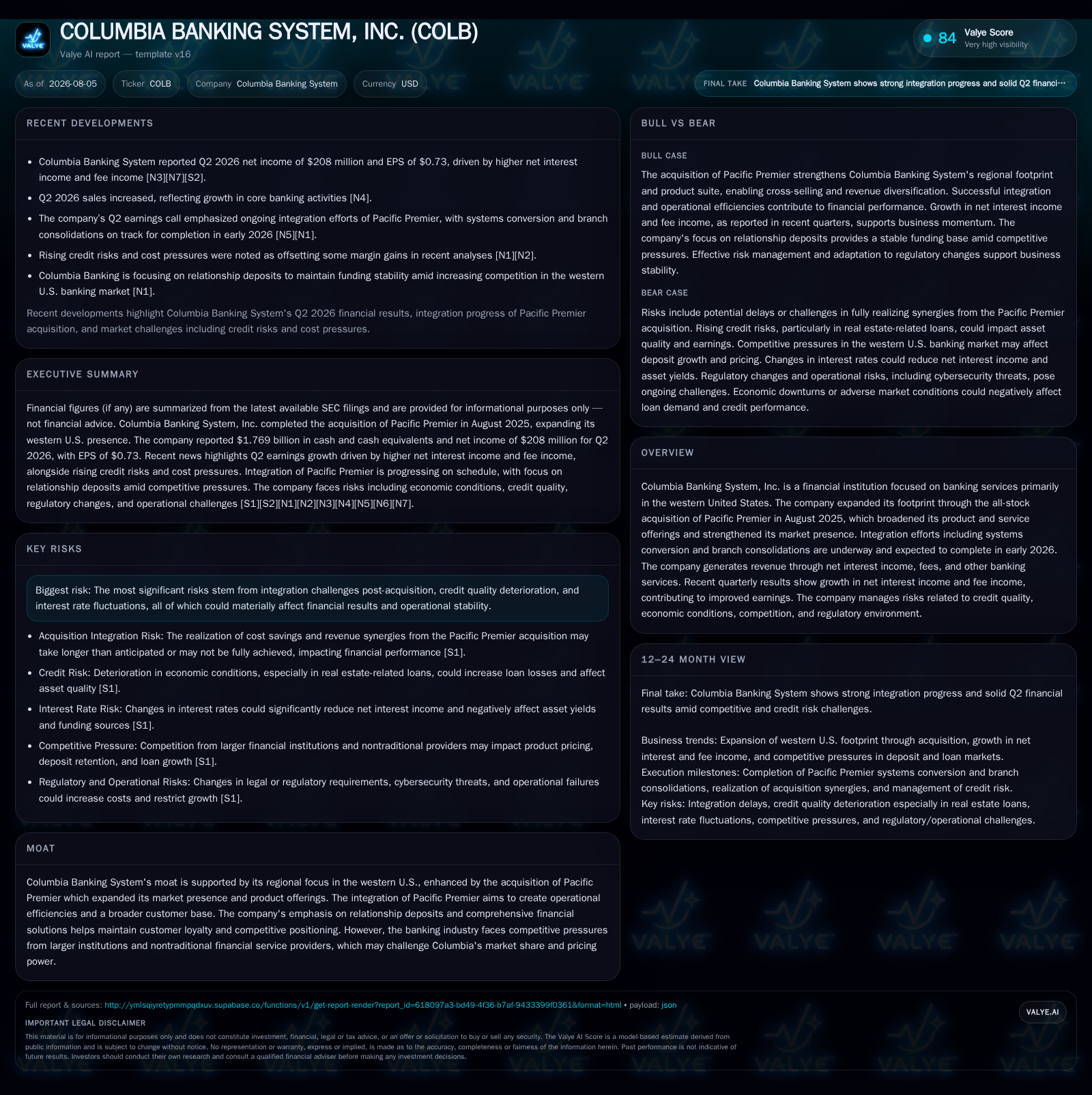
Columbia Banking System’s Q2 2026 results reveal notable benefits from the August 2025 acquisition of Pacific Premier, with growth in net interest income and fee income signaling effective integration and expanded product mix. The company is advancing branch consolidations and systems unification to realize operational synergies, which support margin expansion despite a cost environment that tempers near-term efficiency gains. Competitive positioning is enhanced by scale but faces pressure from larger regional banks and fintech disruptors. Credit quality trends warrant close monitoring given economic uncertainties in the western U.S.
Q2 Operating Metrics Signal Positive Acquisition Integration Momentum
Columbia Banking System’s second quarter 2026 filing offers the first clear quarterly performance snapshot following the August 2025 all-stock acquisition of Pacific Premier [S2]. Net interest income advanced, benefiting from increased earning asset yields as loan repricing captured recent Fed rate hikes, underpinning margin expansion. Concurrently, fee income rose both in absolute terms and as a proportion of total revenue, indicating successful cross-selling of diversified financial services within an expanded product suite brought by Pacific Premier [N3]. Branch network rationalization continued on schedule with consolidations underway, aligning overlapping footprints to reduce redundancies. While these actions have yet to fully translate into efficiency ratio improvement due to ongoing integration costs, they signal disciplined execution enhancing medium-term profitability prospects.
This tangible momentum underscores Columbia’s capacity to harness acquisition synergies without jeopardizing core banking relationships or deposit retention — a critical factor given the competitive western U.S. regional banking environment [S2]. The evolution in recurring revenue streams bolsters earnings stability amid market volatility.
Core Banking Model Enhanced by Expanded Product Mix and Relationship Pricing Power
Columbia’s revenue model remains anchored in net interest margins generated by lending at spreads above its predominantly low-cost relationship deposit base [S1]. The Pacific Premier acquisition broadened both loan portfolio diversity — incorporating more commercial real estate and business banking exposures — and fee-based income channels like wealth management and treasury services [S8]. This dual revenue stream architecture supports resilience against rate cycles by enabling asset-liability management that optimizes deposit repricing flexibility alongside selective loan growth.
Relationship deposits remain central to stable funding at favorable costs compared with volatile wholesale alternatives, supporting sustained margin capture even as competitive pressures mount [S1]. This deposit base expansion also affords Columbia optionality in loan repricing cadence amidst a rising rate regime. However, fee pricing competitiveness faces headwinds as larger regional peers leverage scale and fintech platforms intensify customer expectations.
Overall, Columbia leverages enhanced product breadth post-acquisition to deepen customer relationships, increase wallet share, and maintain relative pricing discipline within its western U.S. markets.
Competitive Position Bolstered by Scale Gains but Tempered by Regional Market Dynamics
Incorporating Pacific Premier’s footprint strategically rounds out Columbia’s presence across key western states, enabling it to better compete with sizeable regional banks such as Northrim BanCorp and KeyCorp. This scale gain improves negotiating leverage for funding costs while expanding cross-selling opportunities across refined customer segments.
Yet, this newly acquired scale juxtaposes against intensified competitive dynamics characterized by: (i) larger banks’ capacity for technology investment driving enhanced digital experiences; (ii) fintech entrants disrupting traditional banking value propositions via ease of access and novel products; (iii) regional economic variability influencing local loan demand elasticity.
Consequently, Columbia must balance pursuit of efficient branch network optimization with investments in digital transformation to defend market share and refine customer acquisition amid evolving preferences in relationship banking.
Acquisition Synergies Fuel Operational Efficiencies Yet Integration Risks Persist
Columbia’s Integration Management Office continues leading enterprise-wide convergence activities comprising systems conversion—critical for unified data platforms—and branch consolidations targeting early 2026 completion [S1], [S2]. These efforts aim to drive meaningful cost reductions reflected eventually in improved efficiency ratios through reduced overlapping functions.
While operational synergies underpin medium-term margin potential, integration risks are nontrivial: delays or budget overruns in IT harmonization could defer anticipated savings; cultural alignment between legacy staffs may affect retention; regulatory approvals can constrain dividend flow impacting capital deployment strategies [S3], [S22]. Forward-looking cadence on synergy realization will hinge on delivery timing against these variables.
Thus far, the company’s quarterly results reflect controlled cost trajectories without erosion of service standards — an encouraging sign though vigilance remains essential given sector-wide M&A complexity.
Macro and Credit Risks Poise as Primary Watchpoints Entering Late-2026 Environment
Credit quality indicators highlight emerging pressure consistent with broader western U.S. economic challenges affecting sectors such as commercial real estate and hospitality [S22]. The company's reported increase in non-performing loans coupled with moderate provision builds signals tightening credit risk management but also foreshadows potential loss reserves expansion if adverse conditions persist.
Interest rate risks remain salient as rising policy rates tighten borrower affordability while repricing assets affect net interest margin volatility. The lending environment’s sensitivity necessitates nimble underwriting adjustments balancing growth ambitions with portfolio risk containment.
Moreover, regulatory scrutiny is heightened on capital adequacy maintenance amid macroeconomic uncertainties — an area Columbia actively manages through prudent allowance calibration and capital buffers [S14], [S22]. These risk vectors underscore the importance of tracking loan-to-deposit ratios alongside allowance for credit losses metrics for timely detection of inflection points.
"What's Next": Key Milestones and Indicators for Execution and Credit Trends in Focus
Moving forward into late 2026 and early 2027, Columbia's pivotal near-term milestones include:
- Completion confirmation of system integrations and branch consolidations expected by Q1 2026, which will materially influence expense structure normalization;
- Monitoring loan growth trajectory relative to deposit accretion rates to gauge balance sheet optimization post-consolidation;
- Tracking net interest margin sustainable gains as rate environment stabilizes;
- Evaluating changes in efficiency ratio for evidence of synergistic cost saves converting into profitability leverage;
- Vigilant surveillance of credit portfolio metrics: non-performing loans ratio movements, net charge-off trends, allowance adequacy.
These operational KPIs collectively will validate management's ability to convert strategic acquisitions into durable earnings momentum amid evolving market conditions [N3], [S2].
Financial Profile Discussion: Balance Sheet Strength Supports Positioned Growth
Columbia Banking System maintains a robust balance sheet characterized by $1.77 billion in cash & equivalents as of June 30, 2026 with no material debt obligations disclosed [F1]. This strong liquidity position confers flexibility to support organic loan growth initiatives alongside conservative capital management strategies framed within regulatory guidelines [S2].
The absence of debt enhances Columbia's risk profile by limiting financial leverage exposure during periods of macroeconomic stress or rising interest rates. Additionally, ample cash balances provide a cushion against potential credit provisioning needs arising from observed asset quality pressures.
In essence, Columbia enters the post-integration phase financially well positioned to capitalize on synergy-driven efficiency improvements while navigating prudently emerging credit headwinds.
This analysis integrates recent SEC disclosures with industry context to assess Columbia Banking System’s current trajectory following its strategic acquisition. Continued focus on integration progress alongside vigilant risk oversight will be determinative for sustaining competitive advantage within the fluctuating dynamics of the western regional banking sector.
Disclaimer: This is research-only, informational analysis and not investment advice. It may include AI-generated interpretation and general industry context. Always verify important details using primary sources.

Comments