
Ultra Clean Holdings Tests Supply Chain Agility Amid AI-Driven Semiconductor Demand Surge
Robust AI-related semiconductor investment lifts Ultra Clean’s order backlog but stresses capacity amid elevated debt constraints.
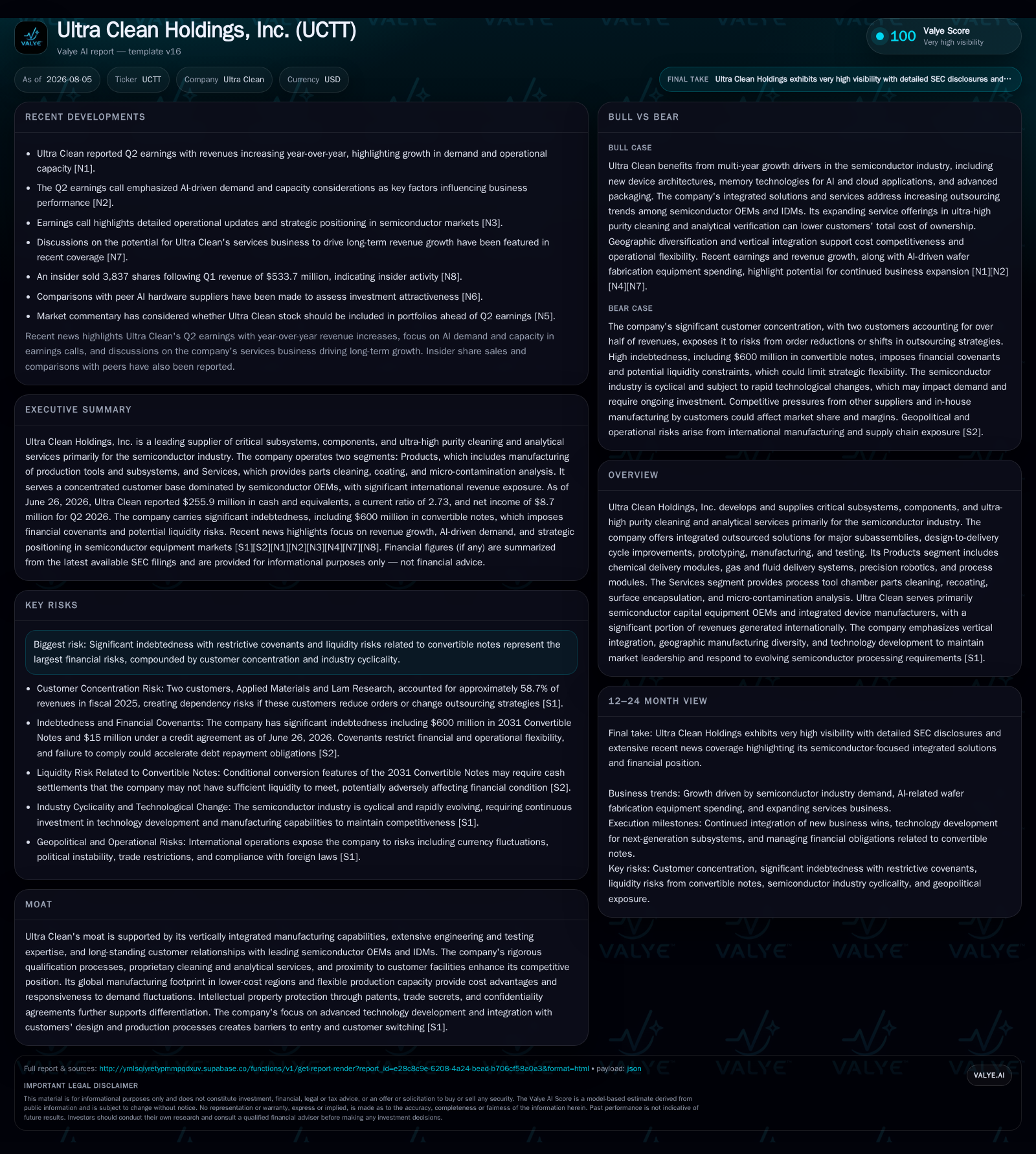
Ultra Clean Holdings reported a significant rise in order backlog in Q2 2026, driven primarily by growing AI-driven semiconductor capital expenditure. The company’s vertically integrated model paired with proprietary ultra-high purity cleaning and analytical services continues to secure customer loyalty and premium contract terms. However, manufacturing cycle times and supply chain bottlenecks strain capacity expansion efforts. Elevated leverage from recent convertible notes limits financial flexibility, challenging the firm’s ability to scale rapidly. Customer concentration remains high, underscoring the importance of ongoing qualification cycles and contract renewals.
AI-Driven Semiconductor Investment Elevates Backlog but Tests Capacity Limits
Ultra Clean Holdings’ Q2 2026 filings reveal a substantial increase in order backlog originating from heightened demand for semiconductor capital equipment, particularly fueled by the AI investment cycle [S2][N1]. This backlog acceleration demonstrates customers’ intensified plans to build wafer fabrication (wafer fab) capacity with advanced subsystems and critical modules that Ultra Clean supplies. The typical prolonged lead times across the semiconductor capital equipment value chain mean that such backlogs translate into committed revenue visibility over months if not quarters.
However, Ultra Clean also disclosed challenges ramping manufacturing throughput due to supply chain constraints on specialized components and skilled labor shortages impacting cycle times [S2]. These factors elevate capacity utilization to near-full levels, squeezing flexibility in meeting customer timelines. Increased scrutiny is necessary on Ultra Clean’s ability to convert this backlog into shipped orders without degrading quality or delivery metrics—a core competitive dimension given OEM customer expectations.
Confirmation that Ultra Clean manages this surge effectively would arise from stable or improved manufacturing cycle time KPIs and on-time delivery rates in subsequent quarters. Conversely, signs of escalating work-in-progress inventories or missed delivery windows would warn of bottlenecks that could incentivize customers to seek alternative suppliers.
Integrated Hardware Manufacturing Paired With Differentiated Services Fortify Customer Lock-In
Ultra Clean’s business model combines vertical integration across component design, prototyping, manufacturing, and assembly of complex gas delivery systems, chemical delivery modules, precision robotics, and process modules with a complementary services segment offering ultra-high purity cleaning, chamber part recoating, surface encapsulation, and micro-contamination analysis [S1].
This dual revenue stream model affords the company cost control benefits through tightly coordinated supply chains while creating switching costs rooted in protracted customer qualification and approval cycles. Customer qualification involves rigorous audits of facility capabilities, engineering documentation, quality systems, and process control protocols—a high barrier for competitors or internal insourcing efforts by OEMs or IDMs.
Additionally, their proprietary cleaning and analytical protocols represent strategic differentiators as device nodes shrink and contamination limits tighten. The service segment generates recurring revenues through contracts for tool chamber maintenance—critical for sustaining operational uptime within wafer fabs.
Key operating KPIs such as service contract renewal rates and average duration of customer qualification approvals underscore this lock-in effect. A stable or rising renewal rate signals sustained trust in Ultra Clean’s differentiated offerings while elongating lifecycle value beyond one-time module sales.
Customer Concentration & Outsourcing Dynamics Require Careful Contractual Management
Consistent with industry norms for semiconductor capital equipment suppliers, Ultra Clean experiences pronounced revenue concentration risks—its two largest customers accounted for roughly 58.7% of total revenues in fiscal 2025 [S1][S16]. These major OEMs exercise substantial discretion around outsourcing decisions since they own the intellectual property for many products manufactured by Ultra Clean.
Consequently, any decision by these large customers to insource gas delivery systems or reduce reliance on external cleaning/coating services could materially reduce Ultra Clean's revenues. Furthermore, orders are generally non-contractual with no guaranteed minimums; thus order flow can be volatile depending on semiconductor market cycles and internal OEM priorities.
The lengthy qualification approval process—while an advantage—also introduces lag in reflecting shifts in customer sourcing strategy. This cyclical exposure requires continuous client engagement from dedicated relationship managers aligned closely with OEM operations to anticipate changing needs.
Maintaining favorable contractual terms that balance proximity and resilience against cancellation risks remains critical. Shifts in mix toward longer-term service contracts could mitigate some revenue volatility inherent to product sales.
Peer Landscape Reflects Competitive Pressures from Both External Suppliers and Internal IDM Producing
Ultra Clean's direct competitors on gas delivery systems include Ichor Systems Inc. and Fujikin Incorporated—both established providers specializing in fluid and gas handling solutions for semiconductor fabs [S1][S28]. These peers emphasize similarly high-precision subsystems but may lack Ultra Clean's breadth of integrated services.
The competitive dynamic extends beyond external suppliers: major integrated device manufacturers (IDMs) have begun evaluating internal manufacturing of certain subsystems to control cost structures more tightly or preserve IP confidentiality. This potential internalization poses distinct threat lines that require continuous technology development partnerships between Ultra Clean and its customer base.
The company’s broader offering set—including ultra-high purity cleaning—places it alongside specialist service firms like KoMiCo or Balazs (Air Liquide), focusing on contamination control rather than pure hardware supply chains.
A nuanced understanding of each peer's focus area clarifies that market competition is multi-dimensional: customers weigh outsourcing benefits against internal capabilities considering cost efficiency, quality assurance, development agility, and integration compatibility.
Growth Catalysts Boost Demand Yet Intensify Working Capital And Supply Chain Risks
The ongoing wave of semiconductor capital equipment spending is propelled by demand for advanced node architectures tailored for AI/ML workloads, aggressive scaling of memory technologies (like HBM), and sophisticated packaging techniques—a domain where Ultra Clean’s subsystems play critical functional roles [S1][N1]. These secular tailwinds underpin a multi-year growth runway driven by end markets including data centers, 5G infrastructure deployment, cloud computing, and consumer electronics.
Yet growth at this scale intensifies pressure points: manufacturing must absorb complex designs requiring specialized materials constrained globally; precision component yields must improve even as volumes surge; skilled labor scarcity heightens wage inflation risk; raw material lead time unpredictability threatens vendor commitments.
Such factors collectively stress working capital dynamics—inventory management becomes delicate balancing act between readiness for orders versus exposure to sudden demand contractions typical of semiconductor cyclical downturns.
Average order size rising alongside product complexity may argue margin expansion possibilities if mix improves favorably toward higher value-added modules or premium service contracts.
However, operational managers must monitor capacity utilization metrics carefully to avoid overextension that undermines quality or delivery reliability—both paramount in this high-stakes supply chain ecosystem.
Debt Levels And Covenant Rules Cloud Operational Flexibility Amid Expansion Efforts
Ultra Clean’s capital-intensive business faces an overlay of financial constraints intensified by its current indebtedness profile: approximately $600 million principal outstanding on convertible senior notes issued early 2026 plus about $15 million drawn under a revolving credit facility at quarter-end June 26, 2026 [S2][F1]
This leverage restricts discretionary spending capacity due to mandatory interest service requirements consuming significant operating cash flow portions. The company’s credit agreement imposes covenants limiting additional borrowings or liens without lender consents while mandating maintenance of leverage ratio thresholds [S2]. Failure to comply might trigger accelerated repayment demands risking destabilizing liquidity shocks.
Additionally, convertible note terms obligate partial cash settlement upon conversion events accompanied by capped call transactions intended to mitigate dilution—nonetheless representing contingent cash flow uncertainties during active trading intervals near conversion thresholds.
In a rapidly evolving capital equipment market subject to cyclicality fluctuations, such financial rigidities complicate strategic investments like expanding Malaysian manufacturing footprint or augmenting R&D budgets necessary for sustaining technological leadership [S4].
Robust liquidity—evidenced by a current ratio near 2.73—and solid cash reserves (~$256 million) provide some cushion but close monitoring remains warranted given net debt approximates $359 million net of cash balances [F1]
Upcoming Milestones: Capacity Ramp Timelines, Order Flow Visibility, And Service Renewal Rates
Looking forward into the remainder of FY 2026 and early FY 2027, critical execution markers will clarify Ultra Clean’s trajectory amid prevailing demand intensity:
- Capacity ramp progress: Successful commissioning or expansion at existing plants particularly Malaysia should enhance throughput metrics easing current bottlenecks noted in Q2 [N1].
- Order backlog quality: Monitoring cancellations vs firm purchase orders will indicate robustness of AI-driven spending commitment amidst volatile macro conditions.
- Service segment renewal rates: High retention here stabilizes recurring revenue bases providing defensible margin floors especially during down cycles [N6].
- Debt maturities/refinancing: Tracking note conversion rates or refinancing moves sheds light on financial strategy adaptability relative to leverage pressures.
- Technology co-development partnerships: Announcements around new engagements with key OEMs signal moat strengthening through deeper integration into customer design ecosystems.
Investors keenly assessing Ultra Clean should weigh these operational milestones against increasingly challenging financial parameters shaping medium-term risk/reward balance.
Financial Profile Discussion
Disclaimer: This is research-only, informational analysis and not investment advice. It may include AI-generated interpretation and general industry context. Always verify important details using primary sources.

Comments