
Blackstone Digital Infrastructure Trust’s IPO Fuels Entry Into Hyperscale Data Center REIT Market
Following its May 2026 IPO, BXDC holds over $1.9 billion in cash targeting stabilized data centers leased to high-credit hyperscale tenants.
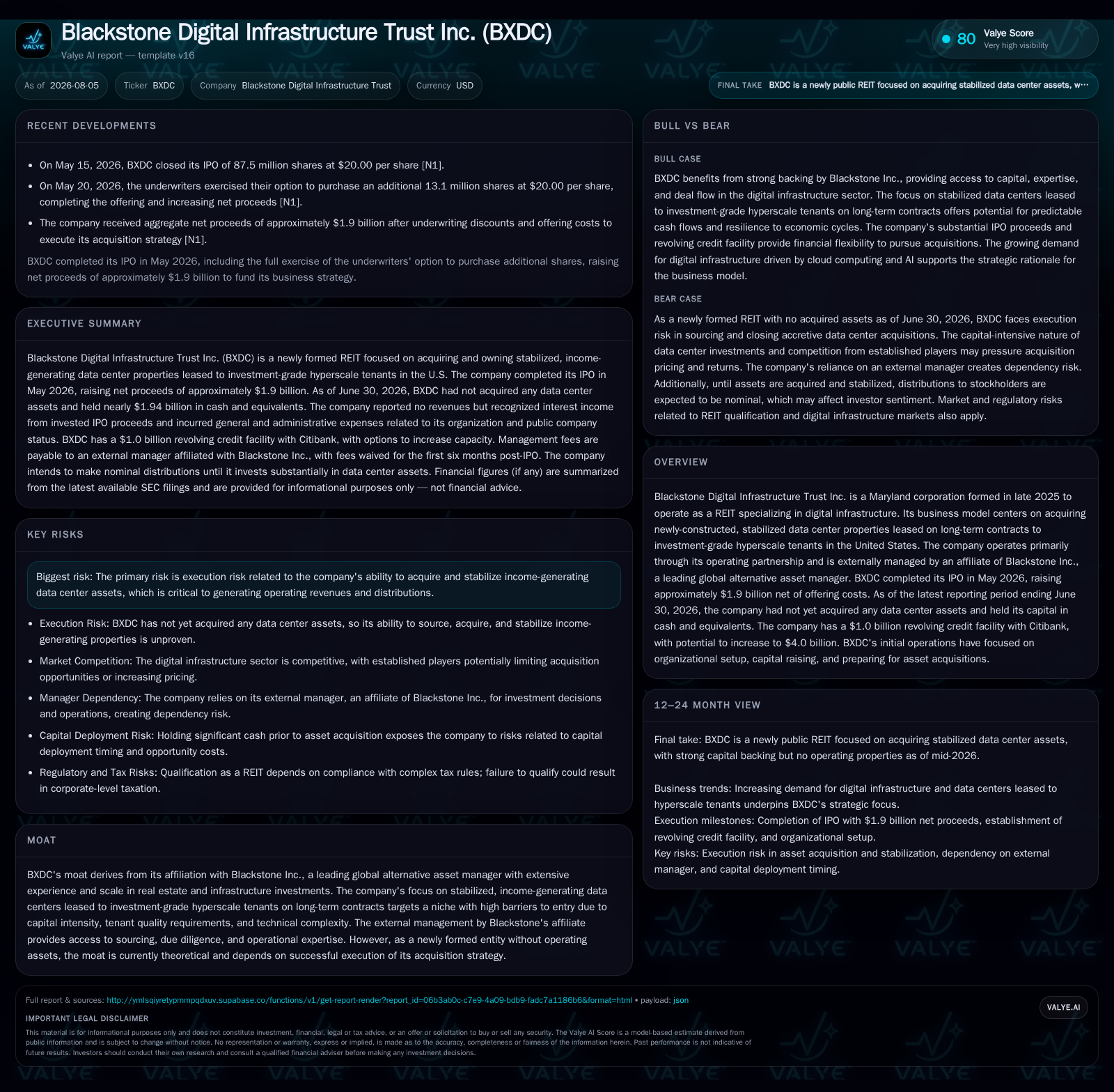
Blackstone Digital Infrastructure Trust Inc. (BXDC) launched operations in mid-2026 after raising approximately $1.9 billion net proceeds through its IPO. As a newly formed digital infrastructure REIT, BXDC’s business model focuses on acquiring stabilized, income-generating data center facilities leased under long-term contracts to investment-grade hyperscale tenants in the U.S. With no properties acquired yet, the company maintains a strong liquidity position and a $1 billion revolving credit facility to support capital deployment. Its competitive edge rests on Blackstone’s asset management capabilities and sector expertise, although significant execution risk remains given the absence of operating assets.
Recent Operating Update
Blackstone Digital Infrastructure Trust Inc. (BXDC) declared financial results for the second quarter ending June 30, 2026—the first such report since completing its IPO on May 15, 2026. With its IPO raising gross proceeds exceeding $2.0 billion (net proceeds around $1.9 billion after underwriting costs), BXDC began principal operations focused exclusively on acquiring newly-constructed, stabilized data center assets leased primarily to investment-grade hyperscale tenants on long-term leases [S2][S22][F1]. However, as of the end of Q2 2026, the company has not yet executed any acquisitions or entered into contracts to purchase data centers and holds its capital predominantly in cash and cash equivalents totaling approximately $1.94 billion [F1].
Given this nascent stage, BXDC’s reported revenues remain nil while operating results reflect organizational expenses and interest earned on cash holdings. The management team reports nominal general and administrative expenses (~$1.4 million for H1 2026), primarily comprising legal, audit, listing fees, and other public company-related costs following its transition from formation phase into active operation post-IPO [S13]. Interest income of roughly $9.3 million during the period arose from short-term investments of the IPO proceeds pending deployment into data center acquisitions [S13].
A critical financial instrument supporting BXDC’s acquisition strategy is its revolving credit facility: a $1.0 billion senior secured revolving credit line established with Citibank upon IPO closing. This facility matures in May 2030 and may be increased up to $4.0 billion subject to customary lender conditions and additional commitments—offering significant financing flexibility for scalability as acquisitions accelerate [S2][S9][S13][S20]. The company had no borrowings drawn as of quarter-end but recorded interest expenses tied to commitment fees and amortization of financing costs totaling approximately $0.8 million [S13][S20].
Management fees payable under the external management agreement with BX REIT Advisors L.L.C., an affiliate of Blackstone Inc., were waived for the first six months after IPO completion—helping conserve resources during the foundational build-out phase while organizational costs are borne primarily by the Manager with repayment terms structured over five years post-June 2027 [S2][S13][S23]
Business Model Overview
BXDC operates as a publicly traded real estate investment trust (REIT) specializing solely in digital infrastructure assets—specifically stabilized data centers leased to hyperscale tenants with long-term contracts that typically feature fixed annual rent escalations alongside favorable expense reimbursement clauses for tenant-incurred costs such as power usage or maintenance [S18]. This focus targets a niche within digital infrastructure that is capital intensive but offers durable recurring revenues via high-credit tenants who require mission-critical infrastructure supporting cloud computing, AI workloads, content delivery networks, and large enterprise IT.
The company’s model monetizes ownership of the physical facilities—rooftops, power supplies, cooling systems—and leases discrete space measured in square footage or megawatts of power capacity to high-credit tenants rather than managing colocation services themselves. Revenue mechanics hinge on lease volume committed (leased square footage or power capacity), contractual rent levels (base plus escalators), tenant credit quality ensuring low counterparty risk, and effective capital deployment into stabilized assets producing positive net operating income (NOI). Margins emerge from leasing economics minus property-level capex required for ongoing upgrades that maintain relevance amid technological change.
External management by Blackstone's affiliates anchors operational execution — leveraging longstanding sector expertise for deal sourcing, due diligence rigor excluding amateur distortion risks common among new entrants outside established alternative asset platforms. This alignment intends to facilitate disciplined acquisitions optimizing portfolio quality within top U.S. data center markets exhibiting strong supply-demand imbalances supportive of price premiums.
Industry Structure and Competitive Position
Digital infrastructure REITs occupy a unique real estate sub-sector characterized by intense upfront capital requirements driven by specialized construction needs: redundant power feeds, advanced cooling systems designed for high-density racks often above 10 kW per rack fueled by growing AI workloads requiring GPU clusters with substantial power draw, high security standards supporting hyperscalers’ compliance demands.
Peers such as Digital Realty Trust and Equinix operate at scale but differ slightly in product scope—Equinix emphasizes colocation interconnection while Digital Realty tilts toward hyperscale leases similar to BXDC’s strategy. Other players like CyrusOne have mixed enterprise-hyperscale exposure lending diversification advantages but also complexity.
Competitive differentiation depends heavily on access to prime locations near fiber-rich urban hubs or supply-constrained markets enabling premium pricing; tenant relationships with major cloud providers granting contracting leverage; cost of capital advantages enabling accretive acquisitions; and operational excellence maintaining uptime SLAs critical for tenant retention.
For BXDC as an emerging entrant without current operating assets, competitive moats stem principally from Blackstone’s backing — unlocking proprietary dealflow pipelines and financing credibility — rather than incumbent economies of scale that peers exploit daily. Execution risk around asset deployment pace directly impacts ability to generate stable FFO distributions that form investor return pillars.
Growth Drivers
Long-term growth trajectories underpinning BXDC’s business case are largely secular:
- Exponential global data consumption driven by cloud migration accelerates hyperscalers’ demand for expanded footprint.
- Rapid advances in AI (especially generative AI requiring GPU-heavy deployments) escalate power density requirements favoring modern facilities adaptable to increasing load.
- Increasing industry adoption of multi-cloud strategies requires geographically dispersed yet interconnected data center presence.
- Long-dated lease contracts provide earnings visibility essential to REIT structure optimizing distribution stability.
- Capital markets’ receptivity toward digital infrastructure allows ongoing equity/debt raises fueling acquisitions and development pipeline capitalization.
- Technological advancements improve cooling efficiencies helping manage capex cycles enhancing net yields over time.
These factors converge toward a structural increase in addressable market size supporting sustained acquisition opportunities even amid macroeconomic cycles.
Risks and Watchpoints
Principal risks cluster around execution feasibility:
- Significant capital deployment needed within reasonable timelines: holding excessive cash without asset acquisitions dilutes investor returns relative to peers actively scaling portfolios.
- Competition among deep-pocketed institutional buyers heightens pricing pressure decreasing future yield spreads.
- Tenant concentration risks inherent in reliance on very few large hyperscale entities amplify revenue volatility potential if lease renewals falter unexpectedly or if technological shifts reduce footprint demand.
- Regulatory challenges concerning REIT qualification status or taxation could alter cash flow profiles materially.
- Technological obsolescence demands continuous reinvestment in upgrade cycles lest aging facilities lose attractiveness versus newer competition.
- Dependency on external manager underscores governance importance; failure of managerial alignment would be disruptive.
Regular monitoring should track capital deployment pace against stated milestones; new asset acquisitions signed; development or expansion starts; tenant lease renewal rates; weighted average lease term updates; borrowing levels related to drawn debt versus undrawn revolver capacity; issuing equity dilutive effects; share-based compensation expense trends indicating managerial incentives alignment; evolving macroeconomic indicators impacting tech sector spend patterns.
What to Watch Next
Near-term scrutiny should focus on:
- Announcements confirming asset acquisitions or contracts executed substantiating transition from cash-holding shell toward income-generating portfolio buildout,
- Updated guidance around targeted leverage ratios consummate with credit facility covenants,
- Disclosure regarding portfolio composition including geographic dispersion and tenant mix,
- Milestones surrounding inaugural distributions or dividend policies confirming alignment with REIT requirements,
- Management commentary detailing competitive landscape changes including new market entries,
- Capital market transactions involving follow-on equity offerings or debt financings reflecting appetite for growth capitalization,
- Emerging technology integration initiatives impacting capex allocation strategies such as ESG-driven improvements enhancing facilities operational efficiency.
Disclaimer: This is research-only, informational analysis and not investment advice. It may include AI-generated interpretation and general industry context. Always verify important details using primary sources.

Comments