
ACRES Commercial Realty Corp’s Merger Completion Challenges Capital Efficiency and Growth Trajectory
The company’s Q2 results highlight operational pressures ahead of a pivotal merger and internalization expected to reshape its capital structure and growth path.
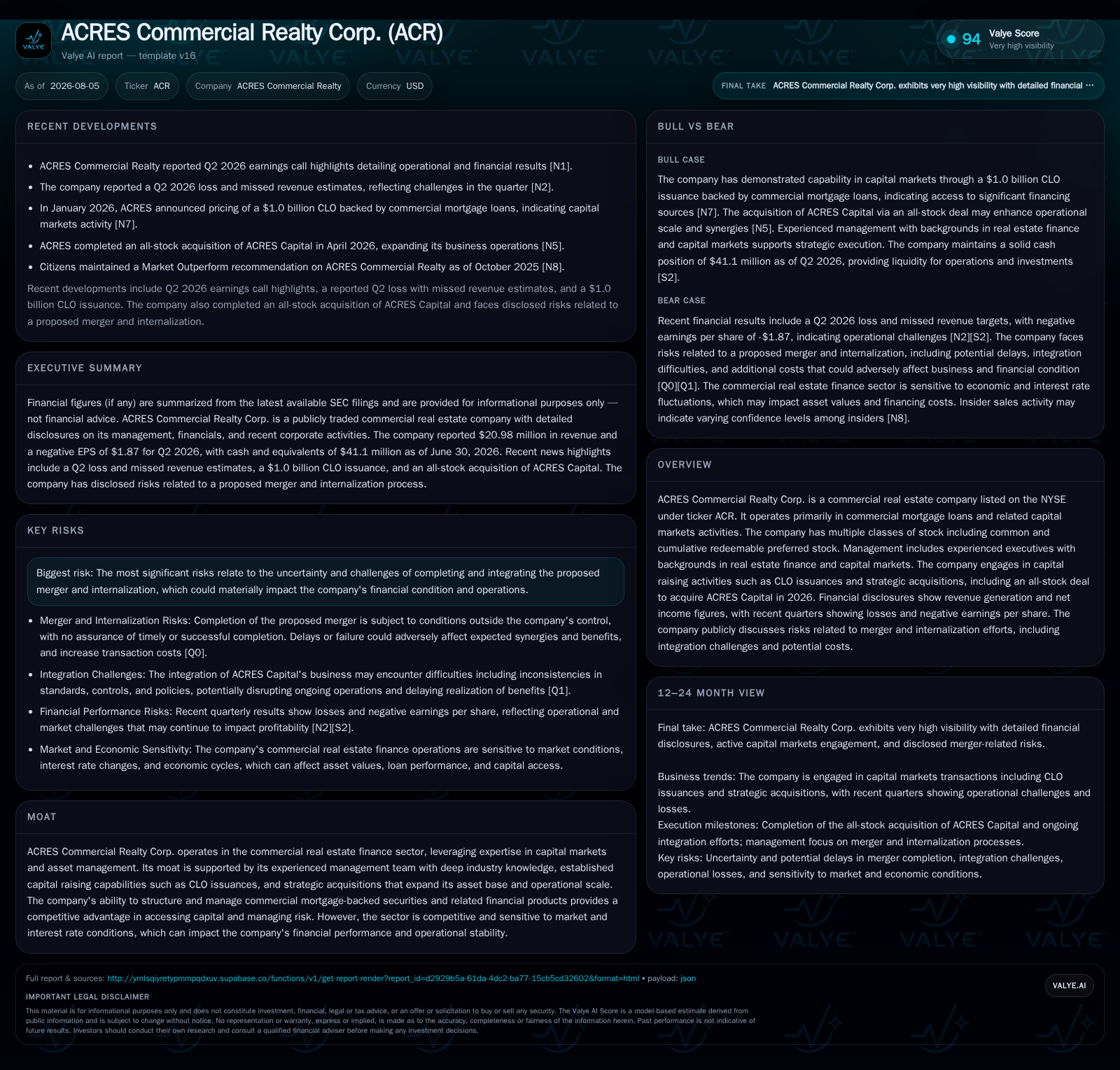
ACRES Commercial Realty Corp is nearing completion of a transformative merger and internalization transaction expected on August 6, 2026, which will significantly alter its operating scale and capital base. The latest quarterly filing reveals continued operating losses and revenue shortfalls, underscoring challenges amid integration costs and a complex interest rate environment. The merger also entails substantial refinancing through senior secured notes with stringent covenants, impacting liquidity and leverage management. Operationally, ACRES remains concentrated on originating and managing commercial mortgage loans funded via CLOs and preferred stock issuances, but near-term execution risks around credit quality, capital raising, and cost synergies are notable. Industry peers have similarly faced pressures when integrating acquisitions while navigating volatile CRE finance markets.
Q2 Operational Performance Sets Stage for Transformative Merger Close
The imminent merger will consolidate ACRES Capital’s assets into ACRES Commercial Realty Corp., resulting in the issuance of approximately 7.5 million new shares of common stock as merger consideration [S14]. Additionally, the company will assume ACC’s $185 million credit facility while also conducting a $200 million private placement of senior secured notes at an 8.625% coupon due 2031 to refinance maturing debt obligations [S12][S14]. These moves collectively reshape the company's balance sheet by increasing leverage yet aiming to secure more favorable financing terms through first-lien collateralized debt enhancing liquidity stability.
Business Model Strength Hinges on Securitization and Asset Management Execution
ACRES operates as an originator and manager of commercial mortgage loans largely secured against income-producing real estate assets including office buildings, retail centers, industrial properties, and multifamily housing [S1]. Revenue streams derive from net interest income earned on commercial mortgage loans held or securitized into collateralized loan obligations (CLOs), fees from servicing those loans post-origination, asset management fees related to structured finance products sold to institutional investors, as well as dividends from multiple classes of cumulative redeemable preferred stock [S1]. Loan portfolio growth depends heavily on efficient capital raising efforts through CLO issuances alongside equity offerings to fund new originations or acquisitions.
Effective underwriting standards aimed at credit risk mitigation underpin product quality within this model since delinquency or default rates can materially impair net interest margin (NIM) — a key profitability metric in CRE finance. Additionally, interest rate sensitivity influences portfolio yield because variable-rate instruments dominate CLO-backed loans; rising benchmark rates can widen spreads but also increase borrowing costs creating margin pressure if not carefully managed. Asset management fees provide recurring revenue which helps offset volatility inherent in loan origination activity that fluctuates with economic cycles and real estate market conditions.
Capital Structure Evolution through Debt Covenants and CLO Issuances Post-Merger
The post-merger capital structure incorporates new senior secured notes featuring covenants that impose minimum liquidity thresholds ($20 million), tangible net worth floors ($175 million plus half of net equity capital activity), net debt-to-equity ceilings (5:1 total; 2.25:1 recourse), EBITDACoverage requirements (minimums phased between 1.25x to 1.35x depending on fiscal period), plus a quarterly collateral coverage ratio target above 200% [S12]. These stringent terms reflect investor demand for protective measures in volatile CRE finance markets but also constrain financial flexibility for additional borrowing or dividend payments.
The private placement proceeds partially repay $150 million in maturing unsecured notes slated for August 2026 maturity while funding general corporate purposes including integration expenses tied to the internalization transaction [S14]
Competitive Positioning in CRE Finance Amid Peer Deals and Interest Rate Pressures
ACRES occupies a specialized niche within the broader commercial real estate finance ecosystem spanning originators focused on middle-market borrowers up to large mortgage REITs such as Annaly Capital Management (NLY) or diversified specialty financiers like Starwood Property Trust. While these peers enjoy scale advantages enabling deeper liquidity access and diversified risk pools, ACRES’ moat resides in its focused CLO structuring capabilities combined with active asset management expertise.
Yet recent peer performances underscore challenges inherent in combining sizable loan portfolios under one umbrella especially during periods marked by rising interest rates coupled with uncertain economic outlooks affecting borrower creditworthiness. For instance, Annaly recently faced earnings misses partly attributable to mark-to-market impacts on CMBS holdings triggered by rate volatility [N3]. Such market dynamics amplify the urgency for ACRES’ upcoming merger integration efforts to stabilize cost bases whilst preserving underwriting discipline amidst evolving portfolio composition.
Growth Prospects Driven by Strategic Acquisition and Internalization Ambitions
The combination with ACRES Capital aims to deliver operational synergies through internalizing external management functions thereby potentially lowering fee expenses long term while expanding origination pipeline capacity via combined teams led by newly appointed managing directors specializing in capital markets and loan originations [S1][S14][S27]. Moreover, scaling loan origination volume benefits from strengthened balance sheet flexibility post notes issuance allowing pursuit of higher-quality transactions supporting incremental portfolio yield enhancement.
Economic factors such as increased demand for CRE financing stemming from property development growth or leasing activity underpin structural opportunity; however these trends are subject to cyclical fluctuations sensitive to monetary policy shifts impacting interest rate levels which ultimately feed into borrowing costs charged by companies like ACRES.
Risks Centered on Integration Complexity, Credit Exposure, and Market Sensitivity
Critical near-term risks center on successfully completing the merger within expected timelines given conditions precedent uncertainties that could delay or derail transaction benefits realization [S2]. The integration demands substantial management focus given potential difficulties aligning disparate business processes, control standards, employee compensation frameworks plus unanticipated liabilities arising from acquired operations [S2]. Failure to achieve targeted expense efficiencies or revenue synergies may prolong losses beyond current guidance.
Additionally, credit risk intensifies amid tightening economic conditions where borrower defaults could rise affecting delinquency metrics crucial for sustaining net interest margins. Interest rate volatility presents further uncertainty by complicating forecasting for loan portfolio yields versus funding costs given partial floating rate exposure across CLO securities financed.
Counterparty risks inherent in securitization transactions add complexity requiring vigilant risk management architecture.
What to Watch Next
Key milestones include verifying successful closure of the merger expected August 6 along with seamless internalization implementation reflected through updated pro forma financial disclosures revealing synergy capture progress alongside expense rationalizations [S3][S11]. Tracking quarterly earnings updates will clarify whether operating losses narrow as loan origination volume recovers post-integration.
Delinquency trends throughout second half-2026 provide early signals about credit environment stress impacts influencing NIM trajectories.
Management commentary during forthcoming calls regarding cost control initiatives alongside evolving competitive positioning relative to mortgage REIT peers such as Blackstone Mortgage Trust or Apollo CRE Finance offers proxy insights into industry consolidation effectiveness under interest rate pressure scenarios.
Financial Profile Discussion
As of June 30, 2026, ACRES holds approximately $41 million cash & equivalents against total debt near $1.79 billion resulting in net debt around $1.75 billion [F1]. The looming maturity of $150 million unsecured notes in August precipitated replacement with a new $200 million senior secured note issuance featuring rigorous restrictive covenants designed to maintain minimum liquidity levels above $20 million alongside net debt-to-equity maximums below five times total leverage threshold [S12][F1]. Such financial discipline is critical given ongoing operating losses due partly to merger-related charges disclosed in Q2 filings [N2][S2], limiting free cash flow generation capacity amid integration expenditures.
Maintaining EBITDA-to-interest-coverage ratio above mandated minimums (projected at ≥1.25x for year-end 2026) is crucial for compliance avoiding default scenarios under bond agreements impacting credit ratings which trigger coupon step-ups adding financing costs further straining profitability margins [S12]. Efficiently converting operating cash flow into funds from operations (FFO) post-merger will serve as an important metric indicating healthiness of core commercial mortgage lending operations vital for sustaining dividend capacity favored by preferred stockholders.
Disclaimer: This analysis is based solely on publicly available SEC filings dated through August 2026 alongside verified news reports without speculative projections beyond stated company data or industry-standard framing. It does not constitute investment advice but aims to provide an informed perspective on ACRES Commercial Realty Corp’s evolving operating context given impending strategic transactions and market conditions.
Disclaimer: This is research-only, informational analysis and not investment advice. It may include AI-generated interpretation and general industry context. Always verify important details using primary sources.

Comments