
Hut 8 Corp Advances Power-First AI Infrastructure with Long-Term Leases Amid Capital Intensity
Hut 8's integrated power, data center, and compute platform is expanding utility-scale AI infrastructure while managing elevated capital and execution risks.
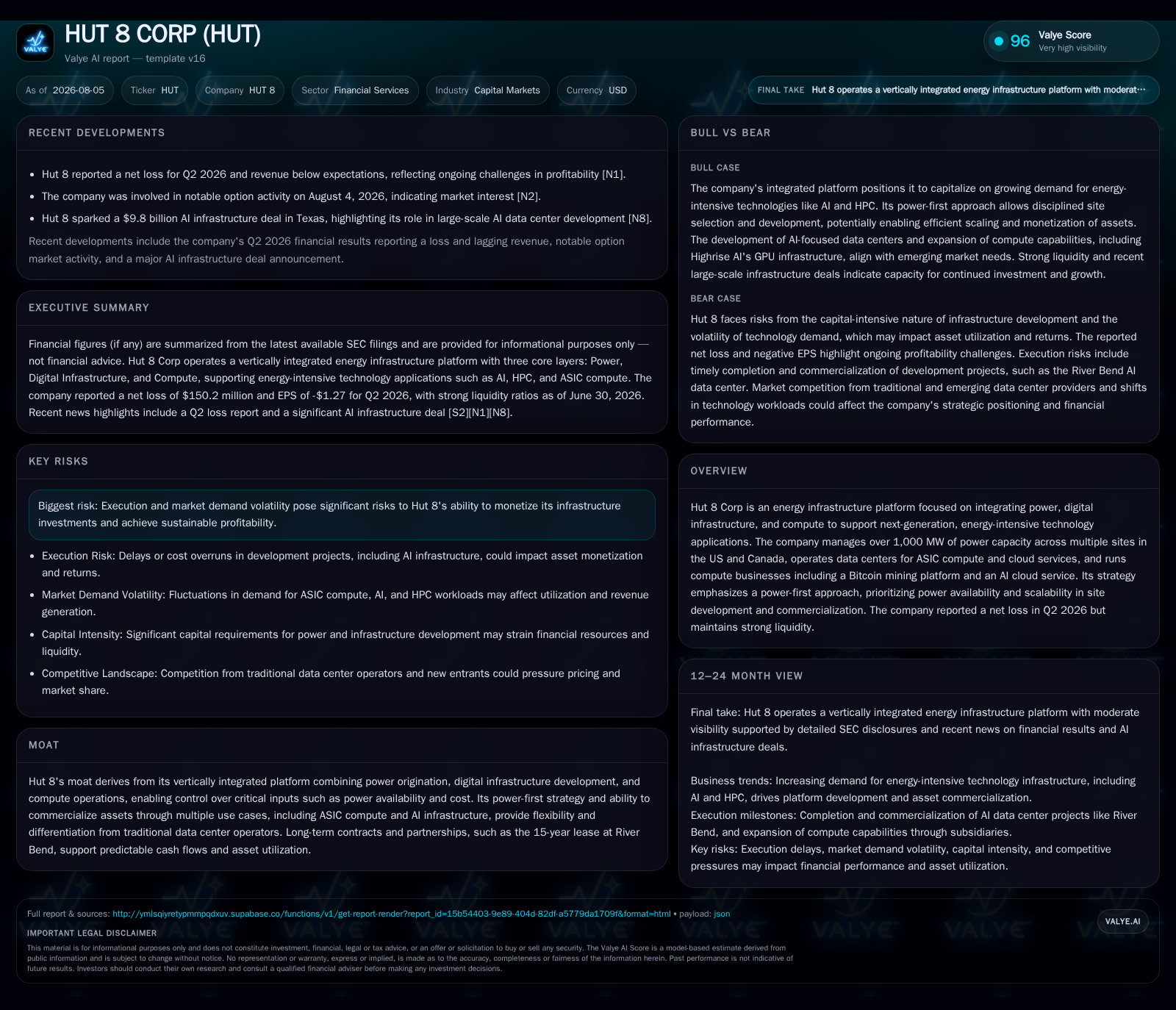
In Q2 2026, Hut 8 Corp reported a net loss driven by continued investment in its vertically integrated energy, digital infrastructure, and compute platform centered on energy-intensive workloads like AI and ASIC mining. The company manages over 1,000 MW of power capacity across US and Canadian sites and is commercializing a 245 MW AI data center under a long-term lease at River Bend, targeting initial delivery in Q2 2027. Despite strong liquidity, Hut 8 faces typical sector risks including construction delays, power cost volatility, and capital intensity. Its competitive moat is rooted in owning critical power assets combined with flexible compute offerings that differentiate it from pure data center operators or standalone miners.
Recent Operating Update
In its Q2 2026 filings dated August 4, Hut 8 Corp reported ongoing net losses that reflect the company's heavy investment phase investing in power and digital infrastructure alongside compute deployment [S2][N2]. The company operationalizes an extensive portfolio managing over 1,000 megawatts (MW) of power capacity spanning multiple sites in the United States and Canada. This platform supports ASIC-based Bitcoin mining operations as well as emerging AI workloads requiring specialized infrastructure [S1].
A signature development is the River Bend campus in Louisiana where Hut 8 secured a landmark 15-year lease for a purpose-built AI data center with an initial capacity of approximately 245 MW. This project aligns with the company's "power-first" approach prioritizing scalable, reliable utility capacity for energy-intensive uses. The facility is slated for phased delivery starting in Q2 2027 [S1]. This long-duration contract anchors predictable cash flow potential once operational.
Business Model Overview
Hut 8’s vertically integrated business model operates along three primary layers: Power, Digital Infrastructure (data centers), and Compute. Power origination involves acquiring or leasing critical energy assets such as land with interconnection rights, substations, switchyards, and other electrical systems designed to support high-capacity loads essential for next-generation computing workloads. Owning or controlling these inputs affords strategic cost control advantages against volatile electricity markets.
Digital Infrastructure consists of designing and developing purpose-built data centers optimized for diverse workloads including ASIC mining facilities for cryptocurrency and traditional cloud/colocation spaces aimed at hyperscalers or enterprise customers. The current portfolio includes five ASIC compute sites plus several cloud-oriented data centers spread primarily across North America [S1].
The Compute segment operates dedicated businesses—launched under distinct brands—to deploy specialized hardware aligned with specific technology cycles like Bitcoin mining (American Bitcoin brand) or high-performance AI services. This separation facilitates targeted capital allocation and operational focus while leveraging the underlying infrastructure platform [S1]. Revenue streams thus comprise power sales (including electricity sold through managed services agreements), long-term data center leases (often build-to-suit arrangements), colocation fees, and compute hosting/operation income from ASIC mining or emerging AI offerings.
Revenue mechanics depend heavily on contracted megawatt capacities under long-term leases—such as the River Bend commitment—and ongoing deployment/utilization of compute hardware units (ASICs for Bitcoin or GPUs/servers for AI). Margins benefit from proprietary access to reasonably priced energy sources combined with efficient facility design (low PUE) but remain sensitive to fluctuations in power costs and hardware depreciation. Capital expenditures mainly fund expanding power lines/sites and constructing data centers tailored for evolving workload requirements.
Industry Structure & Competitive Position
Hut 8 occupies a hybrid niche within the broad Data Center Infrastructure and Compute Services sector that blends elements from data center operators (e.g., Digital Realty or Equinix), cryptocurrency miners (e.g., Marathon Digital), and emerging AI-focused cloud providers. Unlike pure-play data center landlords who monetize mostly via space leasing or colocation fees relying on third-party customers’ deployed hardware, Hut 8 controls both infrastructure inputs—especially power—and deploys its own compute assets.
This vertical integration forms a competitive moat by internally aligning access to low-cost power with optimized data center designs specialized for high-intensity computing demands. Many peers lack either scale in regulated power acquisition or the capability to monetize multiple end-use applications effectively. The company's long-term lease contracts provide revenue visibility uncommon among more commoditized colocation providers.
However, the model is capital-intensive and execution-dependent given complex permitting processes for power assets, extended construction cycles for large-scale data centers supporting cutting-edge workloads like AI HPC clusters or blockchain mining rigs, plus evolving customer demands requiring adaptability in design specs.
Growth Drivers
Key growth opportunities stem from:
- Expanding AI infrastructure demand: Accelerating adoption of machine learning models fuels appetite for high-performance computing capacity requiring specialty facilities that integrate tightly coupled power resources.
- Rising cryptocurrency mining markets: Growth or retrenchment cycles influence demand for ASIC compute deployments; Hut 8’s branded subsidiary American Bitcoin enables direct market participation.
- Long-term utility capacity commercialization: Large-scale projects like River Bend illustrate how securing multi-year leases underpinned by solid counterparties can stabilize cash flows.
- Development pipeline leverage: Ongoing projects aggregating over a gigawatt of utility-class capacity across multiple sites indicate scalability potential.
- Strategic partnerships: Collaborations with engineering firms such as Jacobs and Vertiv at River Bend underscore operational capabilities to execute complex builds fitting customer load profiles [S1][S4]
Enhanced monetization from diversifying compute use-cases beyond cryptocurrency toward AI services could also boost profitability if underlying hardware cost trends remain favorable.
Risks & Constraints
Hut 8 faces well-understood industry risks exacerbated by its vertically integrated model:
- Construction Delays & Cost Overruns: Large capital projects risk schedule slips due to regulatory hurdles, supply chain shortages (especially amid inflationary pressures), labor availability constraints, or unanticipated site conditions [S28][S2]. Delays hamper revenue generation timing.
- Capital Intensity & Liquidity Needs: Sustained funding is required to maintain pipeline buildouts; although liquidity remains strong with cash and equivalents of approximately $234 million as of June 30, 2026 [F1], continual equity/driven capital raises may dilute shareholders if market conditions deteriorate.
- Power Cost Volatility: Fluctuating energy prices affect margin stability despite efforts to lock favorable supply contracts; increasing renewables integration brings regulatory complexity.
- Technology Obsolescence & Demand Volatility: Rapid shifts in hardware efficiency or changes in blockchain network economics could impact compute utilization rates; similarly, evolving hyperscaler preferences might reduce demand intermittently.
- Concentration Risk: The large lease at River Bend represents both an anchor asset but also customer concentration vulnerability needing careful management.
Execution discipline is pivotal to mitigate these constraints during scale-up phases underway.
What to Watch Next
Critical upcoming milestones encompass:
- Progress towards phased commissioning of the River Bend data center starting Q2 2027—on-schedule delivery will validate project management capabilities [S1].
- Updates on additional long-term lease agreements securing expanded megawatt utilization across development pipeline sites.
- Compute business performance metrics including unit deployment rate of ASIC miners or GPU servers within branded segments like American Bitcoin.
- Capital expenditure pacing relative to liquidity trends to assess funding sufficiency alongside potential market-driven equity/dilution events.
- Regulatory developments impacting site construction timelines or renewable energy sourcing affecting cost structure.
Financial disclosures referencing these indicators coupled with management commentary will clarify sustainability of growth strategy execution going forward.
Financial Profile Discussion
At June 30, 2026, Hut 8 reported cash and equivalents totaling approximately $234 million alongside total debt near $7.7 billion resulting in net debt around $7.5 billion [F1]. The company maintains a very strong current ratio of approximately 19.35x, indicative of solid near-term liquidity management supported by current assets substantially surpassing current liabilities ($366 million) [F1]. This financial positioning aligns with typical characteristics of capital-intensive infrastructure operators navigating multi-year project cycles requiring steady capital infusions balanced against contractual revenue streams from long-term leases [F1][S4].
Net losses reported continue to reflect elevated depreciation/amortization tied to recent asset additions as well as interest expense burden given high debt levels [F1]. Cash flow metrics remain dependent on ramping operational phases aligned with commissioning schedules especially at flagship projects like River Bend.
The company's credit arrangement history shows active use of convertible notes exchanged recently into equity instruments enhancing balance sheet flexibility without immediate cash outflow impact [S2]. Future financing efforts are likely planned around sustaining momentum on strategic expansions without unduly stressing solvency ratios or shareholder dilution beyond market tolerance thresholds.
Disclaimer: This is research-only, informational analysis and not investment advice. It may include AI-generated interpretation and general industry context. Always verify important details using primary sources.

Comments