
Rigel Pharmaceuticals Expands Niche Hematology and Oncology Franchise with Growing FDA-Approved Portfolio
Recent quarterly results highlight strong execution in specialty drug commercialization amid ongoing pipeline advancement and patent settlement.
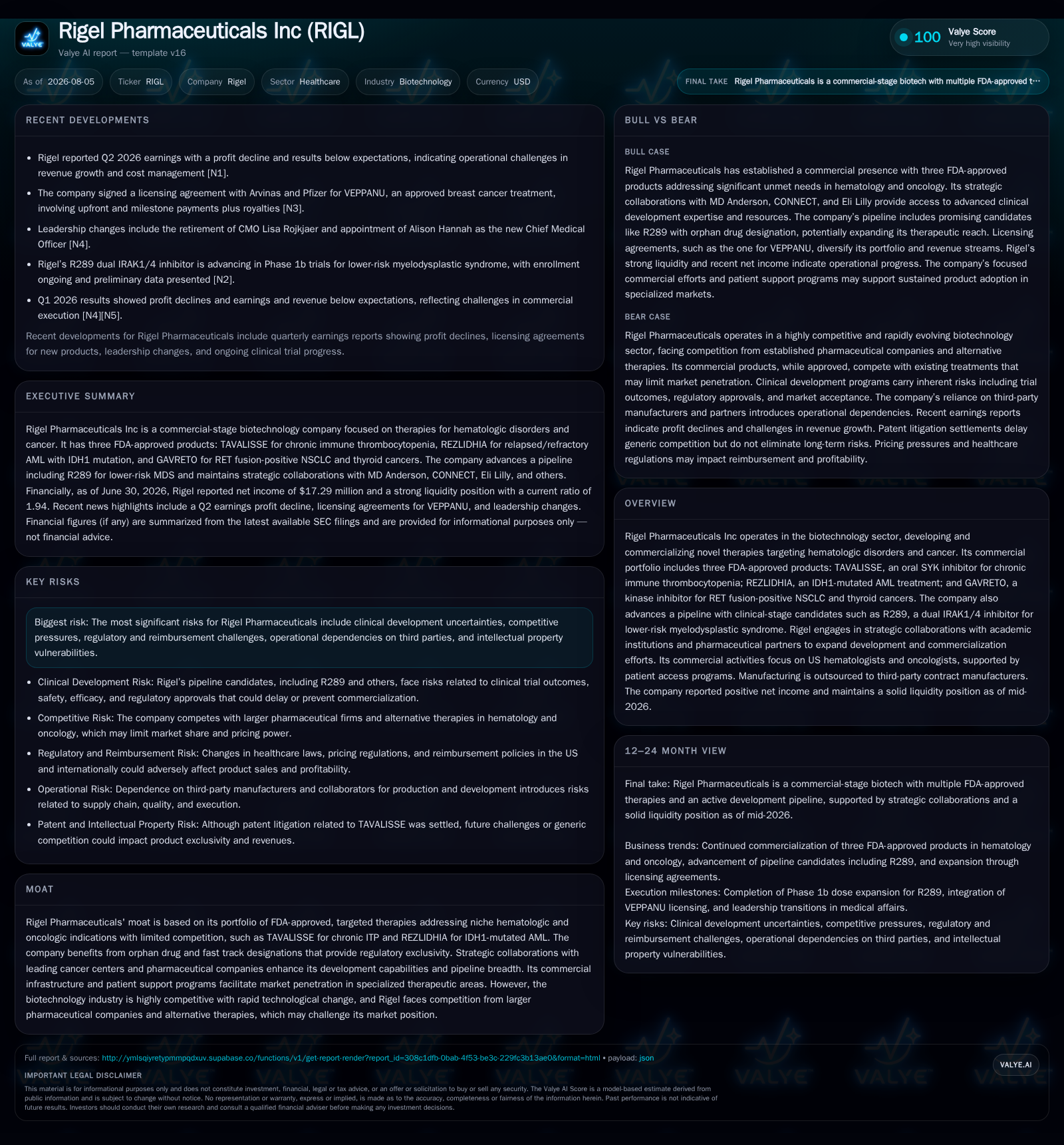
Rigel Pharmaceuticals reported continued growth in net product sales driven by its targeted therapies addressing hematologic and oncologic rare diseases. The company’s commercial portfolio now includes three FDA-approved drugs—TAVALISSE, REZLIDHIA, and GAVRETO—with expanding market penetration in US hematology and oncology segments. Strategic collaborations enhance development efforts, notably for R289 in lower-risk myelodysplastic syndrome. While the biotech firm benefits from orphan drug exclusivity and a focused commercial footprint, it faces competitive pressures from larger pharma players, generic challenges, and evolving reimbursement landscapes. Rigel maintains a solid liquidity position with approximately $61 million in cash and manageable debt as of mid-2026.
Recent Operating Update: Q2 2026 Execution Underscores Portfolio Momentum
Rigel Pharmaceuticals’ latest quarterly filing dated August 4, 2026 [S2], complemented by an 8-K release the same day [S3], provides an updated operating picture centered on commercial execution of its three approved products: TAVALISSE (fostamatinib), REZLIDHIA (olutasidenib), and GAVRETO (pralsetinib). Highlights include ongoing revenue growth linked to increased quantities sold and favorable price realization across these niche therapies. The company continues leveraging its established commercial infrastructure for GAVRETO, integrated since its June 2024 launch following acquisition from Blueprint Medicines [S1].
Notably, Rigel is advancing its clinical-stage candidate R289—a dual interleukin receptor-associated kinases IRAK1/4 inhibitor—in an open-label Phase 1b study targeting relapsed or refractory lower-risk myelodysplastic syndrome (MDS) [S1][S28]. This pipeline diversification aims to strengthen hematologic oncology coverage beyond marketed assets.
The recent settlement agreement resolving patent litigation around TAVALISSE grants generic licensing no earlier than Q2 2032 under defined circumstances [S20][S22]. This outcome preserves significant regulatory exclusivity critical to sustaining TAVALISSE’s market position amidst mounting pressure on oral SYK inhibitors.
Business Model: Targeted Therapies Serving Specialized Hematology-Oncology Segments
Rigel’s business model centers on developing small molecule inhibitors that interrupt disease-critical signaling pathways within hematology disorders and oncology. Revenue is primarily driven by product sales through direct commercialization in the US specialist channel—hematologists and oncologists—with patient access programs mitigating payor reimbursement hurdles. Licensed-in products like REZLIDHIA underscore a hybrid approach blending internal discovery with external acquisitions/licensing deals to expand its product slate.
Monetization mechanics rest on controlled pricing power granted by orphan drug designations and expedited FDA approvals (Fast Track, Breakthrough Therapy), which generate regulatory exclusivity periods limiting competition. This exclusivity underpins pricing leverage essential given specialty drug reimbursement scrutiny [S5][S7]. Sales are influenced by prescribing patterns within narrow patient subpopulations characterized by molecular biomarkers (e.g., IDH1 mutations, RET fusions) adding differentiated clinical value but constraining scale potential.
Manufacturing is outsourced to third-party contract manufacturing organizations (CMOs), reducing capital intensity but exposing operations to supply chain coordination risks [S12]. The company’s focus remains US-centric commercialization supplemented by international licensing for TAVALISSE outside the US.
Industry Structure and Competitive Position
The biotechnology sector serving hematology and oncology is highly innovative yet intensely competitive. Rigel operates in a specialized niche dominated by innovative targeted therapies approved via expedited regulatory pathways for rare disease indications. Its primary competitors include both biotech firms with similar orphan portfolios (e.g., Blueprint Medicines before asset transfer, Forma Therapeutics/Novo Nordisk) and large pharmaceutical companies capable of leveraging scale advantages and diversified product lines.
GAVRETO competes directly against Lilly’s selpercatinib (Retevmo) for RET fusion-positive non-small cell lung cancer (NSCLC) and thyroid cancers [S15]. Despite this head-to-head competition, Rigel benefits from focused commercialization enabling it to capture patients progressing through standard-of-care lines involving chemotherapy or immune checkpoint inhibitors.
Patent-litigation outcomes such as those with Annora Pharma effectively delay generic erosion of TAVALISSE’s revenues until at least 2032, extending sustainable cash flows characteristic of orphan drug exclusivity [S20]. However, pricing reform initiatives under Medicare Parts B/D including inflation rebates introduced by the Inflation Reduction Act present enduring reimbursement risks that may compress gross margins over time [S7][S10].
Growth Drivers
Key growth drivers for Rigel include:
- Commercial Expansion of Approved Drugs: Increasing unit volumes driven by physician uptake bolstered by medical affairs support; especially notable was a reported 51.6% increase in TAVALISSE net sales in 2025 relative to prior year due to volume gains alongside price adjustments [S1].
- Pipeline Advancement: Clinical progress of R289 immunomodulatory program could broaden treatment options in lower-risk MDS—a segment with limited effective therapies—adding future growth potential [S28].
- Strategic Collaborations: Partnerships with academic centers like MD Anderson Cancer Center for olutasidenib enable rigorous clinical evaluation across expanded indications potentially supporting label broadening or new regulatory filings [S1].
- Orphan Drug & Regulatory Exclusivities: Orphan designation confers periods of market protection allowing sustained pricing power absent generic competition, crucial for mid-size biotechs like Rigel competing against larger firms.
Risks / Watchpoints / Growth Constraints
Despite strategic strengths, Rigel faces several key constraints:
- Clinical Development Uncertainty: Pipeline assets remain early-stage; failure or delay in pivotal trials would curtail longer-term revenue trajectories.
- Competition: Larger pharma companies' resources may yield more rapidly advancing alternatives targeting overlapping mutations or pathways leading to prescribing shifts [S19].
- Pricing & Reimbursement Pressure: Ongoing healthcare reforms imposing cost-containment measures introduce demand elasticity that could dampen unit pricing or market access consistency across payors [S5][S7][S10].
- Dependence on Third Parties: Reliance on CMOs for manufacturing involves supply continuity risks; disruptions could impact commercial supply or trial timelines [S12].
- IP Litigation Exposure: Although recent patent litigation settled favorably for TAVALISSE exclusivity through 2032, further legal challenges remain a risk impacting generic entry timing [S20].
- Healthcare Compliance Complexity: Regulatory compliance costs linked to anti-kickback statutes, false claims laws, data privacy rules heighten operational burden particularly during new product launches or promotional campaigns [S4][S9][S27].
What to Watch Next
Upcoming milestones critical to validating Rigel’s growth prospects include:
- R289 Phase 1b Trial Readouts: Early efficacy/safety data will shape development trajectory for this immunomodulatory candidate targeting relapsed/refractory lower-risk MDS patients [S28].
- Market Uptake Velocity: Continued quarterly updates on net product sales growth trajectory for TAVALISSE, REZLIDHIA, and GAVRETO will signal commercial execution effectiveness.
- Label Expansions: Progression of regulatory submissions based on clinical data supporting expanded indications or pediatric usage offer incremental driving forces.
- Patent Litigation Developments: Monitoring any challenges or settlements related to remaining patents protecting key products.
- Healthcare Policy Changes: Tracking effects of evolving US federal/state pricing reforms or international reimbursement policies impacting orphan drug economics.
Financial Profile Discussion
As of June 30, 2026, Rigel maintains $60.8 million in cash and equivalents against $40 million total debt, resulting in a net cash position approximating $20.8 million [F1]. This financial positioning combined with steady revenue inflows from specialty product sales underpins manageable leverage levels appropriate for a commercial-stage biotech investing heavily in R&D pipelines.
Operating income reached $125.5 million with net income at $367 million as of the prior fiscal year-end December 31, 2025 [F1], reflective of expanding core profitability largely driven by rising net product sales volumes coupled with operational efficiencies. However, sustaining positive operating income will depend on successfully balancing marketing investment intensity against growing competitive and regulatory pressures.
R&D expense management remains pivotal given ongoing clinical development programs especially R289; partnership milestone payments are expected to supplement funding needs without excessive capital outlays owing to shared-risk collaboration models with academic institutions and larger pharmaceutical partners like Eli Lilly [S1][S13]. Rigel’s capitalization allows continued advancement while aiming to preserve runway amid affordability-driven payor environments.
This analysis synthesizes SEC filings and sector knowledge without offering investment research views. Information is presented solely for industry insight purposes based on available disclosures as of August 2026.
Disclaimer: This is research-only, informational analysis and not investment advice. It may include AI-generated interpretation and general industry context. Always verify important details using primary sources.

Comments