
PBF Energy Turns a Corner with Higher Refining Margins and Strengthened Liquidity
Q2 2026 results highlight operational recovery post-Martinez disruption and a proactive debt refinancing that improves financial flexibility.
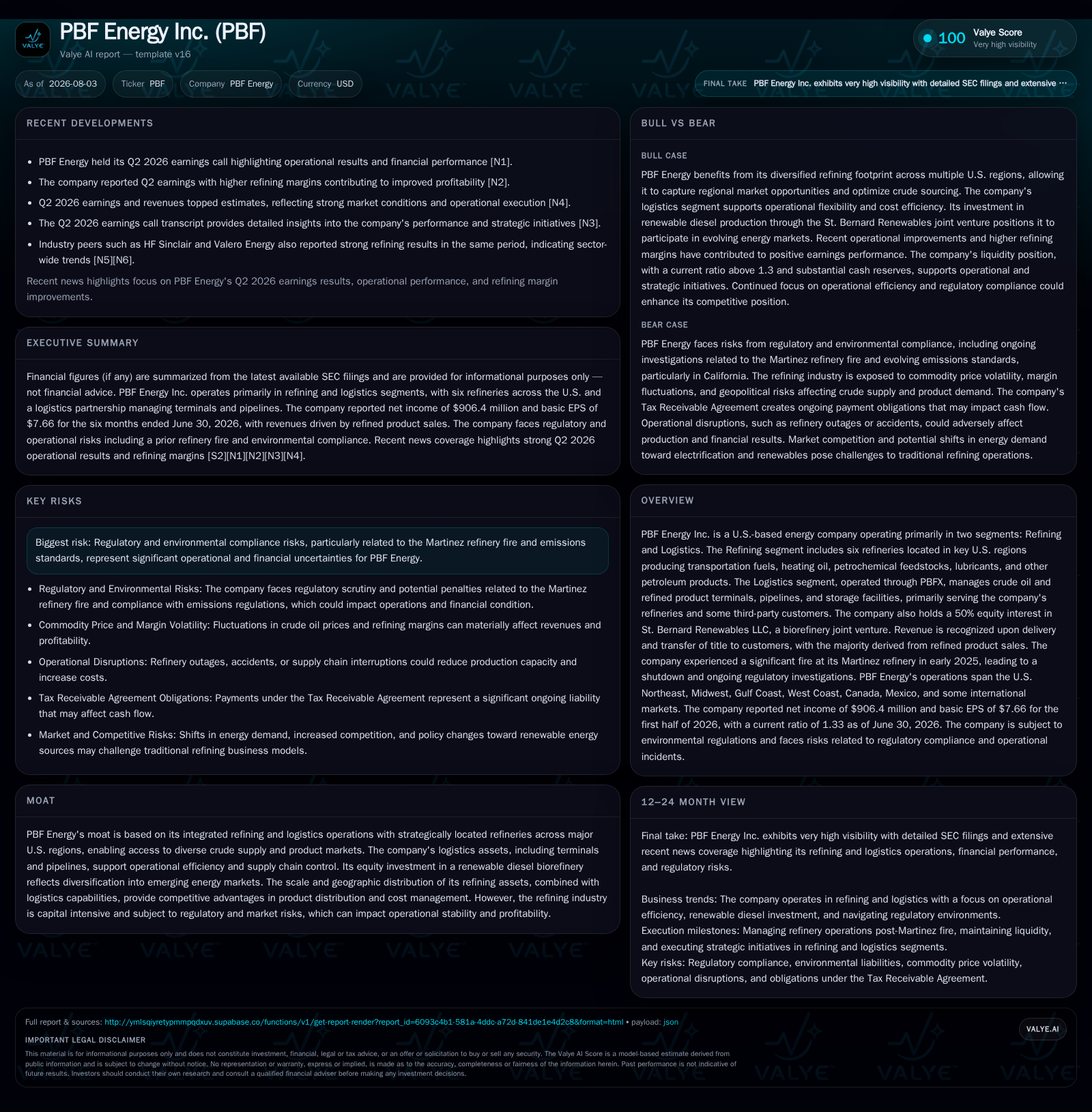
PBF Energy’s Q2 2026 filing reveals significant refining margin improvement driven by higher refinery utilization following the full operational restart of all Martinez refinery units in May 2026, reversing prior fire-related shutdown impacts. The company’s integrated logistics assets maintain steady throughput volumes, supporting margin stability amid crude slate diversity. Regulatory compliance from the 2025 Martinez fire remains an open risk with ongoing investigations. Meanwhile, a strategic capital structure overhaul, including redemption of higher-cost notes and fresh issuance of longer-term debt, has bolstered liquidity and reduced short-term maturity pressure.
Q2 Refining Recovery Drives Margin Expansion After Martinez Disruptions
PBF Energy’s second quarter of 2026 marks a pivotal operational rebound after the substantial disruption caused by the February 2025 fire at its Martinez refinery. The detailed quarterly disclosure confirms that all fire-affected units at Martinez were fully restored and resumed planned operating rates by May 2026 [S7]. This restart enabled the company to increase refinery throughput significantly, moving utilization rates back toward normalized levels across its six refining facilities.
The higher throughput directly translated into improved refining margins as reflected in increased crack spreads reported during the quarter [N2]. The company's revenue primarily stems from the sale of refined petroleum products recognized upon delivery and title transfer—meaning any volume ramp-up or yield improvement materially enhances top-line performance [S1]. The improvement follows a nearly year-long period of partial shutdowns which compressed margins through mid-2025 and persisted as a headwind into early 2026.
While exact barrels per day processed are not detailed in the Q2 filing, management commentary during the earnings call emphasizes a marked uptick in volumes consistent with resumption of full operations at Martinez [N1]. This suggests that refinery utilization—the critical KPI reflecting operational efficiency—is recovering toward peer benchmarks typical of independent refiners like Delek US Holdings and Par Petroleum. These peers generally operate smaller-scale assets but illustrate similarly tight correlations between incident-driven disruptions and earnings volatility.
Integrated Logistics Assets Underpin Supply Chain Efficiency and Margin Stability
PBF Energy’s Logistics segment continues to play a strategic role in smoothing refining operations by managing key pipeline transportation networks, storage terminals, and related infrastructure primarily servicing PBF’s refineries but also some third-party users [S1]. The logistics throughput volumes reported exhibit steady handling of crude inputs and refined products even amid volatile refining throughput earlier this year.
This integration confers cost advantages by controlling supply chain bottlenecks—a critical factor in operating expense management where margins are thin and refining economics highly sensitive to feedstock sourcing costs. Maintaining high terminal capacity utilization sustains cash flow stability independent of short-term refining rigmarole [S2]. In comparison to integrated competitors such as Phillips 66 or Valero Energy, PBF's logistics footprint remains focused but strategically positioned near core refineries enhancing crude slate flexibility—an increasingly valuable trait given recent market volatility.
Regulatory Compliance Remains Critical Uncertainty with Market Implications
Despite operational gains, regulatory risks tied to the Martinez refinery fire remain unresolved. Investigations by multiple agencies—including state occupational safety authorities, environmental regulators like the EPA and California Air Resources Board, as well as federal enforcement bodies—have yet to conclude [S7]. The company disclosed receipt of numerous Notices of Violation (NOVs) associated with this incident indicating significant regulatory scrutiny persists.
While PBF anticipates that most fire-related repair costs will be covered under property insurance less a $30 million deductible [S7], potential long-term remediation expenses or changes demanded by regulators could raise operating costs or even constrain future throughput if permit conditions tighten. Industry-wide experience suggests that these environmental compliance risks pose episodic financial uncertainty but can become structural if resultantly enforced operational modifications reduce capacity or increase downtime frequency.
In comparison to sector peers who also navigate evolving environmental mandates such as renewable fuel standards (RFS) adjustments announced by EPA through 2027 [S1], PBF must proactively manage these risks alongside integrating emerging compliance frameworks for renewable diesel production.
Growth Enablers: Renewable Diesel Play and Targeted Capex Upgrades
Demonstrating strategic diversification ambitions alongside traditional refining margins exposure, PBF maintains a 50% equity stake in St. Bernard Renewables LLC (SBR), a bio-refinery producing renewable diesel co-located adjacent to its Chalmette facility [S1]. This positions the company to capitalize on tightening regulatory renewable fuel mandates expected through at least 2027 while diversifying product mixes away from conventional petroleum fuels.
Capital expenditures continue prioritizing both environmental compliance upgrades—critical amid intensified emissions scrutiny post-Martinez—and enhancements facilitating processing of heavier or alternative crude grades that improve product yield mix and profitability [N3].
Such investments are essential in an industry where heavy capital intensity restricts swift capacity expansions but can differentiate operators who successfully blend legacy refining strengths with emerging low-carbon fuel production trends.
Capital Structure Overhauled to Enhance Liquidity and Debt Flexibility
A notable highlight within Q2 filings is PBF's active management of its capital structure to reduce refinancing risk and enhance liquidity [S2]. The company redeemed its $801.6 million senior notes due in 2028 and issued $500 million aggregate principal amount of senior unsecured notes bearing a coupon rate of 7.25% due 2034 during the first half of 2026, extending debt maturities and reducing total outstanding debt to $1.8 billion as of June 30, 2026 [S2]. Cash and equivalents rose substantially to $894 million, placing net debt around $906 million—a decrease enhancing credit metrics [F1].
The current ratio improves accordingly—reported at roughly 1.33—indicating sound short-term liquidity against current liabilities exceeding $4.3 billion which includes accrued expenses largely correlated with inventory purchases and payables from integrated operations [F1]. This blend of reduced total debt burden paired with augmented liquidity bolsters resilience against commodity price volatility or unexpected capital demands relative to peers like Phillips 66 or Valero who similarly navigate tightening credit markets.
What Investors Should Watch Next: Operational Milestones and Regulatory Updates
Key upcoming milestones that will validate whether recent margin improvements represent durable operational gains include monitoring continued refinery uptime post-turnaround cycles scheduled at other facilities within PBF’s portfolio—turnarounds being periodic but essential events impacting utilization rates temporarily.
Additionally crucial is the resolution timeline for ongoing regulatory proceedings stemming from the Martinez fire incident; any material penalties or mandated operational restrictions would directly influence margin sustainability and capital deployment plans [S7]. Moreover, evolving renewable fuel standards adjustments announced for RFS years beyond 2025 will test PBF’s ability to convert its SBR joint venture into meaningful revenue diversification amidst tightening blending mandates [S1].
From a competitive perspective, watching how independent refiners compare throughput growth trajectories post-pandemic normalization alongside integrated operators’ ability to refinance debt amid changing interest rate environments provides important context for assessing PBF’s forward trajectory.
Financial Profile Discussion
PBF Energy improves its financial posture markedly as of mid-2026 through active capital restructuring aligned with improving operating cash flows driven by refining margin recovery [S2]. The redemption of shorter-dated high principal notes using proceeds from longer maturity bonds reduces immediate refinancing risk despite a modest step-up in coupon cost—a tradeoff favoring solvency over near-term interest savings.
Strong cash reserves nearing $900 million provide cushion against working capital swings stemming from commodity price fluctuations affecting inventory valuations—a critical factor considering hydrocarbons accounted heavily within current assets totaling over $5.8 billion at quarter end [F1]. Total debt outstanding stood at $1.8 billion as of June 30, 2026, down from $2.2 billion at end-2025, with net debt approximately $906 million [S2][F1]. The current ratio of 1.33x reflects sound short-term liquidity against current liabilities of $4.4 billion [F1].
While regulatory uncertainty tied to prior incidents introduces risk layers requiring vigilant monitoring, the combined refining-logistics business model anchored on geographically diversified assets plus emerging renewable fuel integration positions PBF well within its peer landscape facing persistently volatile energy markets.
This analysis is based solely on publicly available SEC filings dated July 30, 2026 ([S1–S3]) supplemented by market reports ([N1–N3]) and current financial metrics ([F1]) without extrapolations or speculative forward projections.
Disclaimer: This is research-only, informational analysis and not investment advice. It may include AI-generated interpretation and general industry context. Always verify important details using primary sources.

Comments