
Escalade Enhances Margins and Strengthens Market Niche with Focused Innovation and Acquisitions
Escalade's Q2 2026 results reflect strategic margin improvement backed by niche market positioning and operational discipline.
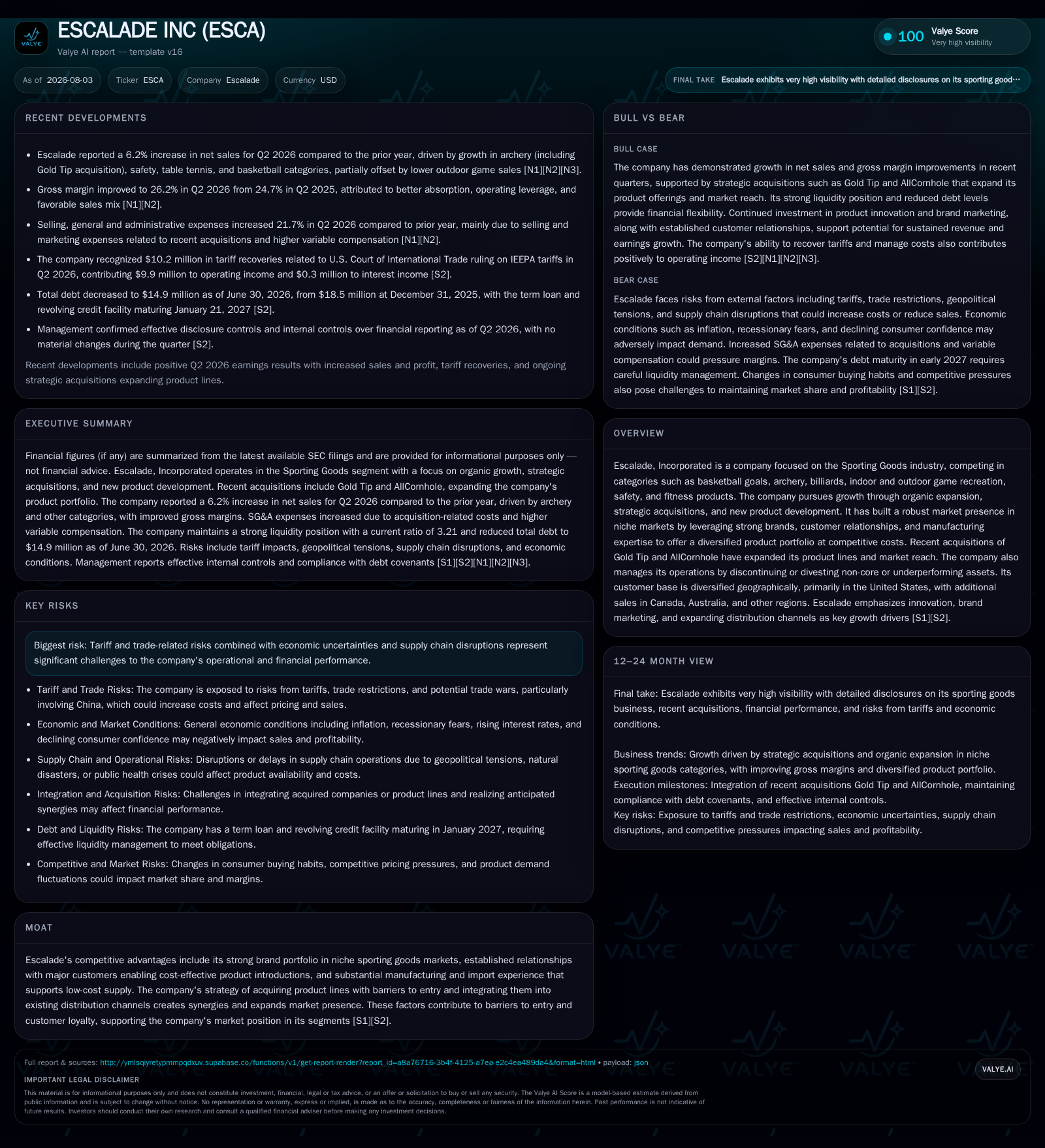
In its latest quarter, Escalade Inc. delivered a notable gross margin expansion to 26.2%, driven by operating leverage, improved absorption, and favorable sales mix. The company continues to grow organically and via acquisitions in niche sporting goods categories such as archery and billiards while maintaining low-cost supply chain advantages. Operational risks include tariff volatility and economic uncertainty, but a strong balance sheet with manageable debt enhances financial flexibility. Monitoring revenue growth from new product introductions and direct-to-consumer channel expansion will be key to assessing sustainability of momentum.
Recent Operating Update
During this period, Escalade's sales rose marginally by 0.6%, supported notably by increases in archery segments following the acquisition of Gold Tip, along with growth in billiards and safety product categories. These gains were offset partially by declines in outdoor and indoor games [S16]. The company's broad product portfolio across niche sporting goods markets helps balance cyclical variability inherent in discretionary consumer spending.
The Board authorized a quarterly dividend payment of $0.1525 per share payable October 13, 2026, reflecting continued confidence in cash flow stability despite ongoing economic uncertainties [S3]
Business Model Overview
Escalade functions primarily as a sporting goods manufacturer and brand owner focused on specialized categories such as basketball goals, archery equipment (notably post-acquisition of Gold Tip), billiards tables and accessories, various indoor/outdoor recreation games including cornhole (via AllCornhole acquisition), safety products, and fitness equipment [S1][S2]. Revenue is generated through sales primarily to wholesale customers including specialty sports retailers, mass merchants with sporting goods divisions, and select e-commerce channels.
The company's monetization revolves around leveraging its established brands combined with ongoing innovation to maintain customer loyalty and capture market share within defined niches less susceptible to commoditization. Escalade integrates manufacturing expertise both domestically and via imports to sustain a low-cost base while controlling quality—this dual sourcing approach supports competitive pricing while preserving margins [S2]
New product development acts as a catalyst for organic growth while strategic acquisitions expand the product portfolio into adjacencies or strengthen positions within core categories [S28]. Crucially, Escalade emphasizes synergies from assimilating acquired businesses into existing distribution frameworks rather than standalone expansion, enhancing operating leverage.
Customer relationships underpin the business model's efficiency; longstanding partnerships allow Escalade to introduce new products cost-effectively while managing inventory risk through diversified offerings tailored to demand patterns [S2]. Distribution channels primarily still rely on wholesale but management is advancing direct-to-consumer e-commerce capabilities—a critical adaptation given evolving retail trends [S1][S11].
Industry Structure & Competitive Position
Within the broader Sporting Goods Manufacturing industry, Escalade occupies a position as a multi-category niche player rather than competing head-on with large diversified peers like Brunswick Corporation or Vista Outdoor. Its competitive edge stems from brand equity cultivated over decades in specialized segments that have higher barriers to entry due to product complexity or customer loyalty dynamics.
The industry itself is characterized by sensitivity to consumer discretionary spending fluctuations, seasonal demand cycles linked especially to outdoor recreation periods, and vulnerability to supply chain disruptions—including tariffs on imported components predominantly sourced from China [S26].
Escalade’s capacity to sustain competitive margins hinges on efficient supply chain management amid these headwinds plus ongoing innovation matched with targeted acquisitions that deepen market penetration or open new geographic avenues.
Comparatively, peers often compete via scale or mass-market appeal; Escalade’s differentiation focuses on specialized offerings spanning archery (aided recently by acquiring Gold Tip), billiards equipment known for craftsmanship standards, and emerging indoor game categories such as cornhole where brand identity drives premium pricing potential.
Growth Drivers
Escalade identifies several clear levers fueling near- and medium-term growth:
- Product Innovation: Continuous introduction of updated or new lines across core categories drives customer interest and repeat purchases. Investments in R&D coupled with brand marketing enhance equity.
- Strategic Acquisitions: Recent deals for companies like Gold Tip (archery) and AllCornhole broaden both product scope and channel access—for example expanding into high-growth activities such as cornhole that sees rising consumer participation.
- Channel Expansion: Efforts underway to develop direct-to-consumer e-commerce sales provide another revenue line potentially capturing demographic shifts favoring online purchasing behaviors.
- Operational Efficiency: Improved manufacturing absorption rates reduce per-unit fixed costs enabling better gross margins even during moderate revenue increases.
- Geographic Diversification: While U.S.-centric currently (~95%+ sales domestic), some international exposure exists mainly Canada/Australia which offers incremental upside without major currency risk.
- Customer Relationships: Deep ties with major retail chains facilitate smoother rollout of innovations at lower customer acquisition costs compared to new entrants.
These drivers are reflected in improving gross margin percentages alongside stable sales volumes indicating controlled cost structures with growing scale benefits [S2]
These factors collectively inform whether current performance enhancements translate into sustainable competitive advantage within the fragmented sporting goods landscape.
Financial Profile Discussion
As of June 30, 2026, Escalade held $14.9 million in outstanding principal on its term loan facility due January 21, 2027, with no amounts drawn on its $60 million revolving credit facility under the amended credit agreement [S2]
Current assets stood at approximately $144 million versus current liabilities about $45 million yielding a robust current ratio of 3.21 indicative of strong short-term liquidity [F1]. Cash flows from operations continue funding working capital needs along with dividend distributions which most recently were approved at $0.1525 per share quarterly [S3].
Gross margin improvements throughout recent quarters—from roughly mid-20% range moving above 28% year-to-date—highlight increasing operating leverage potentially improving operating income margins as fixed cost absorption grows faster than SG&A expenses which remain stable as a percentage of revenue [S16][S2]. Keeping COGS disciplined while scaling selective investments in innovation supports this trend.
Looking forward, maintaining this financial discipline heading into debt maturity early next year combined with measured capital allocation will be crucial for balancing shareholder returns against funding growth initiatives.
Disclaimer: This report is an independent analyst perspective on Escalade Inc.'s business model and industry context based strictly on publicly available SEC filings and credible news sources as referenced. It does not constitute investment advice or research views.
Disclaimer: This is research-only, informational analysis and not investment advice. It may include AI-generated interpretation and general industry context. Always verify important details using primary sources.

Comments