
Cinemark’s Q2 Performance Signals Premium Format and Loyalty Program as Growth Engines
Latest quarterly results reveal how Cinemark leverages premium large format offerings and its expansive loyalty program to navigate evolving market dynamics.
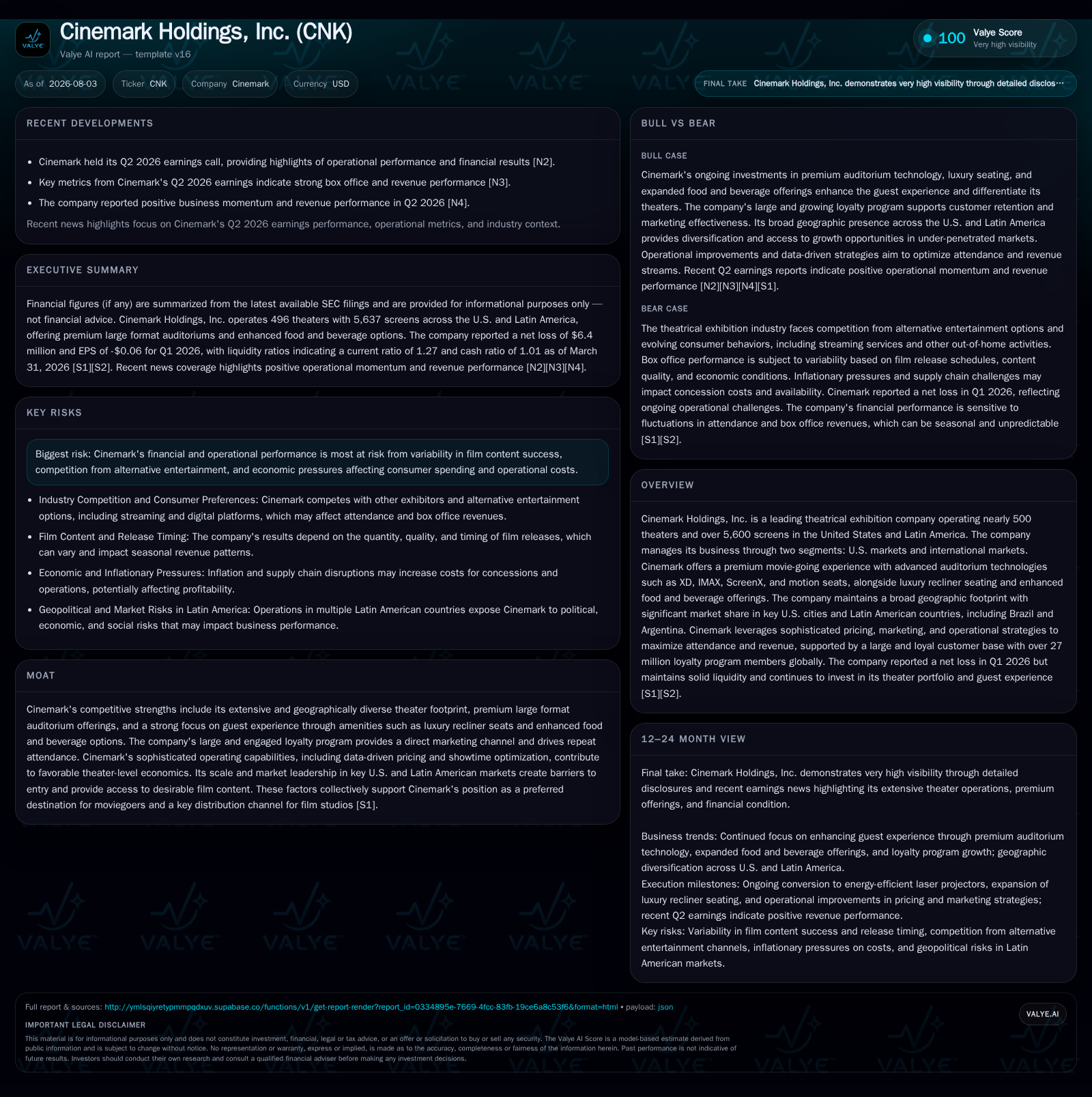
In its Q2 2026 report, Cinemark Holdings highlighted a nuanced recovery in movie attendance supported by premium auditorium technologies such as XD and IMAX, alongside robust engagement from a loyalty base exceeding 27 million members globally. Despite pressures from film content variability and rising operational costs, the company’s strategic focus on pricing optimization, geographic diversification across the U.S. and Latin America, and enhanced concession sales underpin revenue growth. Key risks remain linked to blockbuster film performance uncertainty and growing competition from streaming platforms, requiring close monitoring of attendance trends and membership metrics in coming quarters.
Q2 Operating Outcomes Reflect Attendance Recovery Mixed With Cost Pressures
Cinemark’s Q2 2026 results demonstrate an ongoing recovery in attendance following a period of pandemic-related disruption, yet the trajectory remains uneven due to the variable strength of released film content. The company operates nearly 500 theaters encompassing over 5,600 screens across the U.S. and Latin America [S1]. In Q2, management reported improved total attendance compared to prior quarters but noted that box office revenue growth was tempered by a softer-than-expected slate of new releases—an intrinsic challenge given the theatrical exhibition industry's dependence on blockbuster success to drive foot traffic [S2],[N2]. Concurrent inflationary pressures in labor and real estate costs squeezed operating margins during the quarter despite this top-line resilience.
Concession sales per patron remained a pivotal profitability lever, benefiting from Cinemark's emphasis on enhanced food and beverage offerings that complement the moviegoing experience. This premiumization helps offset some margin pressure while increasing overall revenue per patron. Absent sustained box office momentum or further price escalation consistent with demand elasticity, margin expansion could be constrained going forward.
Premium Large Format Technology as a Lever for Revenue Expansion
Cinemark underscores its commitment to premium large format (PLF) auditoriums as central to its revenue growth strategy. The portfolio includes XD auditoriums featuring proprietary sound and projection technology as well as partnerships delivering IMAX and ScreenX experiences supplemented by motion seats that heighten immersion [S1],[S2]. These formats command surcharges over standard tickets which enhance average ticket prices without markedly depressing volume due to consumer willingness to pay for differentiated experiences.
Compared to peers such as AMC Entertainment—which conversely leverages Dolby Cinema—the emphasis on multi-format PLF variety diversifies Cinemark’s attraction to various customer segments. Capital expenditures for installing or upgrading PLF auditoriums remain a key investment focus but entail balancing cost against anticipated yield improvement. Blockbuster releases anchor the value proposition of PLFs; therefore sustained pipeline quality materially affects return on these capex-intensive features.
Loyalty Program Dynamics Fuel Repeat Visitation and Concession Growth
The Movie Fan loyalty program represents a cornerstone of Cinemark’s marketing architecture with membership surpassing 27 million globally. This sizable base facilitates direct digital marketing campaigns fostering repeat visitation—a critical factor given competitive leisure alternatives including at-home streaming services [S1],. The program allows members to earn points redeemable on tickets or concessions which encourages incremental spending beyond initial admissions.
Subscription-like offerings such as Movie Club also provide ticket discounts with an upsell path enabling members to purchase credits for PLF upgrades. This tiered engagement mechanism boosts both attendance frequency among core users and concession per patron through enhanced amenities usage [S1],[N3]. However, sustaining engagement intensity demands ongoing feature enrichment and rewards competitiveness relative to rival exhibitors’ programs.
Competitive Landscape: Geographic Scale Meets Content Reliance Risks
Cinemark’s market footprint covers 303 U.S.-based theaters with 4,241 screens plus an international circuit operating 193 theaters with roughly 1,396 screens across 13 Latin American countries including Brazil and Argentina [S1]. This scale affords bargaining power in film distribution rights negotiations critical to securing timely access to marquee titles during exclusive theatrical windows—an essential screening period before digital release.
However, geographic exposure entails inherent heterogeneity risks stemming from varying regional economic conditions and political factors impacting box office demand in Latin America versus North America. Emerging markets present expansion opportunities but require nuanced understanding of consumer preferences which can diverge from Hollywood-centric content appeal.
Furthermore, elevated competition not only arises from other theater chains like Regal Cinemas but significantly from streaming platforms that increasingly consume consumers’ entertainment time budgets outside traditional venues. Thus maintaining strong studio relationships and providing top-tier theatrical experiences remain imperative competitive levers.
Growth Opportunities Via Pricing Strategy and Market Penetration Enhancements
Cinemark actively experiments with dynamic pricing models incorporating subscription options such as Movie Club offering discounted admission plus add-on premium screen credits for formats like XD or IMAX [S1]. These strategies aim to grow average ticket price while minimizing adverse volume impact.
Expansion in Latin America remains a tangible growth vector where underpenetrated markets paired with population growth can increase box office revenues. Additionally, improving premium format penetration combined with targeted food & beverage menu enhancements aids concession revenue uplift—both increasing spend per visit metrics tied directly to operating margin improvement.
Concrete KPI tracking such as revenue per screen alongside concession per patron will clarify the efficacy of these initiatives; any barriers faced might include consumer pushback on pricing or slower-than-expected adoption rates in emerging regions [N3]
Critical Risks: Film Content Variability, Alternative Entertainment, Economic Sensitivities
A central risk profile element lies in the cyclical nature of box office returns heavily dependent on blockbuster volume, quality, and timing. Fluctuations in content success directly translate into attendance swings impacting ticket sale-dependent revenues [S1]. Competing entertainment forms—particularly streaming services providing convenient at-home options—create ongoing substitution pressure dampening theatrical attendance potential.
Economic headwinds posing disposable income contraction risks further threaten discretionary spend allocation towards moviegoing. Meanwhile rising labor costs and real estate expenses compress operating margins if not offset by productivity gains or price increases consistent with consumer tolerance levels.
Operationally, technology obsolescence risk around auditorium upgrades requires continuous capital commitment balancing ROI prospects against financial capacity constraints inherent amid substantial debt loads documented below, [S1]
"Signals to Watch": Key Milestones in Content Slate, Pricing Tests, and Membership Trends Ahead
Looking forward into H2 2026 and beyond, monitoring blockbusters scheduled—including titles like The Super Mario Galaxy Movie, Spider-Man: Brand New Day, Avengers: Doomsday—and their box office traction is paramount given linkages to overall attendance trends [S1]. Loyalty program membership growth rates combined with consumer engagement metrics will indicate marketing effectiveness sustaining repeat visitation essential to smooth revenue streams.
Ticket pricing test outcomes particularly around premium format surcharges will elucidate consumer elasticity profiles helping calibrate optimal price points without volume loss. Showtime optimization advances aimed at enhancing screen utilization rates provide another near-term operational lever bearing directly on revenue per screen — a critical benchmark for efficiency assessing circuit health across geographic segments [S2],[S3].
Financial Profile Discussion: Balance Sheet Flexibility Amid Investment Demands
This financial posture reflects prudent capital allocation between facility modernization investments—especially related to PLF auditorium technologies—and disciplined debt servicing priorities. The ability to sustain investment flows into premium amenities critical for competitive advantage hinges upon managing these leverage levels alongside operating cash flow generation.
This analysis synthesizes Cinemark’s latest operating disclosures integrating sector-specific context relevant for understanding theatrical exhibition dynamics amid ongoing industry evolution. It aims solely to describe company positioning without providing investment research views or forecasts.
Disclaimer: This is research-only, informational analysis and not investment advice. It may include AI-generated interpretation and general industry context. Always verify important details using primary sources.

Comments