
Moelis & Co Strengthens Advisory Franchise with Discretionary Compensation and Global Expansion
The firm’s latest quarter highlights resilience amid market cyclicality, driven by scale, expertise, and a collaborative culture.
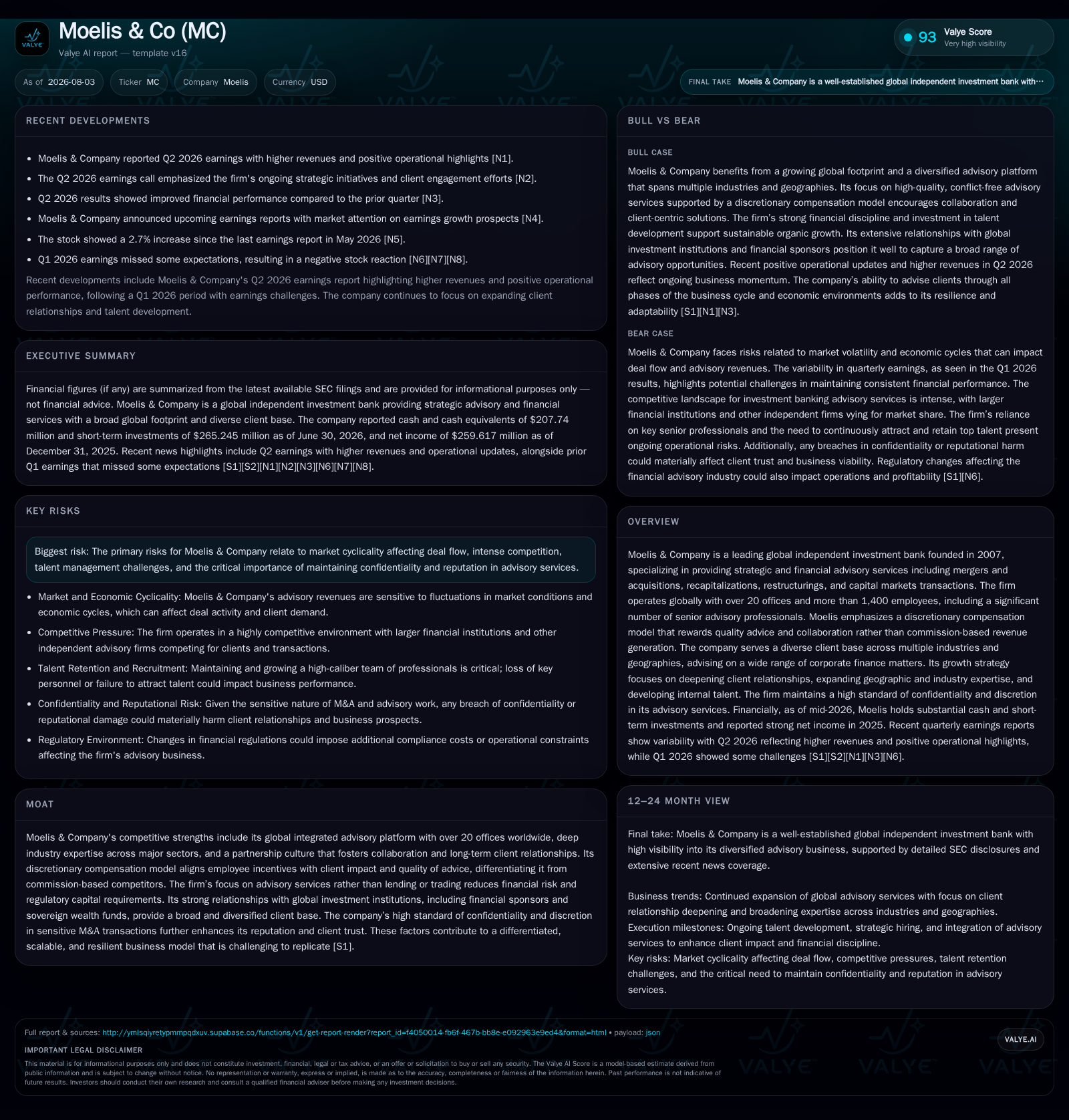
Moelis & Company reported solid second-quarter revenue growth in July 2026, reflecting ongoing demand for its advisory services despite macroeconomic volatility. The firm’s business model centers on providing high-touch M&A, restructuring, and capital markets advice with a global footprint exceeding 20 offices and a discretionary compensation structure that prioritizes advisory quality over volume. Market cyclicality and talent retention remain key risks, although Moelis’ integrated platform and deep industry expertise position it well to capture growth opportunities in restructuring and cross-border deals. Its capital-light model supports attractive margins and operational discipline.
Recent Operating Update
In its Q2 2026 earnings reported on July 29, Moelis & Company posted stronger-than-expected revenues, reflecting continued demand for its financial advisory services despite persistent macroeconomic uncertainties [S3][N1][N3]. The firm did not disclose specific transaction volumes or fee revenues in the filings but emphasized robust engagement levels across mergers and acquisitions (M&A), recapitalizations, restructuring assignments, and capital markets advisory. This performance signals resilience within the capital-light investment banking segment that is primarily fee-driven by deal flow rather than underwriting or trading activities.
Business Model Overview
Moelis & Company's core value proposition lies in providing independent strategic and financial advice to a diverse client base comprising corporations, financial sponsors including private equity firms, governments, and sovereign wealth funds [S1][S20]. The company excels in executing complex transactions such as M&A deals, recapitalizations, restructurings during distress scenarios, as well as capital markets transactions that encompass public and private equity or debt offerings.
Fundamental to Moelis’ business model is its discretionary compensation framework that incentivizes collaboration across teams rather than commission-based revenue generation tied to individual transactions. This culture promotes delivering nuanced advice tailored to clients’ long-term strategic interests rather than short-term transactional volume [S1]. This approach differentiates Moelis from many traditional investment banks where compensation can be heavily dependent on deal fees generated by individual bankers.
The firm’s advisory fees are earned upon successful transaction completion or milestone achievement within mandates. Fee revenue is influenced by factors such as number of completed advisory transactions, total transaction values advised on (which aggregate currently exceed $5.5 trillion since inception), average fee per transaction depending on deal complexity, industry sector focus, and client type [S1]. As an independent adviser with no balance sheet lending or trading operations, Moelis faces relatively low regulatory capital requirements which support expedient cash conversion cycles.
Moelis maintains over 20 offices globally staffed by approximately 1,416 employees including more than 178 Managing Directors — a senior professional cadre pivotal for sourcing mandates and leading client relationships [S1]. Geographic diversity includes coverage across North America, South America, Europe, the Middle East, Asia, and Australia. Industry coverage spans technology; healthcare; industrials; energy; consumer & retail; financial institutions; media & entertainment; telecommunications; real estate among others. This breadth enables it to participate in a wide variety of cross-border transactions leveraging deep local insights combined with global execution capabilities.
Industry Structure and Competitive Landscape
The investment banking advisory sector is characterized by intense competition from bulge bracket firms (e.g., Goldman Sachs), boutique specialists like Evercore or Lazard focusing purely on M&A advisory, as well as restructuring-focused advisors such as Houlihan Lokey. Moelis positions itself firmly amongst the global independent investment banks with a multi-disciplinary platform that balances scale with specialization.
Unlike full-service banks that engage heavily in lending or underwriting for attached fee streams but also assume balance sheet risks, Moelis concentrates exclusively on advisory services. This independence shields it from conflicts of interest common in institutions juggling credit exposure alongside advisory responsibilities. It also facilitates confidentiality—an essential attribute when advising on sensitive corporate strategic transactions or restructurings where premature information leakage can derail deal-making efforts.
Nonetheless, competition remains formidable given overlap with larger peers possessing deeper pockets and broader service offerings which can exert pricing pressure on fees. Additionally, boutique firms excel at offering personalized service but may lack Moelis’ geographic reach or breadth of industry knowledge. Winning mandates often depends heavily on the reputation of senior Managing Directors whose client relationships form the backbone of recurring business.
Growth Drivers
Several factors undergird Moelis’ growth trajectory:
- Increasing M&A Complexity: Corporations face evolving strategic challenges requiring sophisticated advisory input spanning cross-border deals and multi-industry negotiations.
- Rising Restructuring Needs: Economic volatility drives heightened demand for recapitalization and distressed advisory services where Moelis has developed strong credentials [S18].
- Expansion into Emerging Markets: Strategic alliances such as with Alfaro Dávila y Scherer S.C. expand capability into Latin America supporting international transaction flow [S1].
- Financial Sponsor Engagement: Deepening relationships with private equity firms boost secondary market advisory and fundraising mandates including continuation funds and direct secondaries [S18].
- Talent Development: Sustained internal promotion of talented bankers coupled with selective external hires bolsters intellectual capital while maintaining cultural coherence required for high-quality advice [S1].
Managing these risks necessitates consistent operational discipline aligned with the firm's partnership culture emphasizing fiduciary duty over short-term profit maximization.
What to Watch Next
Key upcoming indicators to track include:
- Quarterly disclosures for shifts in deal pipeline composition by region or sector.
- Changes in average fee per transaction signaling pricing power relative to competitors.
- Headcount trends within senior professional ranks indicating recruitment success or attrition rates.
- Regulatory developments impacting broker-dealer licensing requirements or reporting obligations.
- Broader M&A market metrics such as announced transaction volumes from third-party sources which serve as leading indicators of fee revenue momentum.
Financial Profile Discussion
While detailed latest quarter financials were limited in filing excerpts reviewed here, Moelis reported approximately $207.7 million in cash and cash equivalents as of June 30, 2026 [F1], reinforcing a solid liquidity position supportive of organic expansion initiatives. The firm operates a capital-light model focusing on intellectual capital rather than balance sheet-intensive lending or underwriting businesses which generally results in attractive operating margins [S1]. Maintaining prudent cost-to-income ratios aligned with controlled headcount growth remains vital given fluctuating top-line fee income linked closely to deal cycle dynamics.
In summary, Moelis & Company demonstrates resilience through thoughtful secular positioning emphasizing independent advice delivered via a global integrated platform supported by discretionary incentives fostering collaboration rather than sales volume-driven pay structures. This distinctiveness underpins its competitive moat inside an intensely competitive global investment banking landscape shaped by cyclical deal flow risk moderated through diversified sector coverage and deep institutional client relationships. Monitoring talent management outcomes alongside evolving deal pipeline metrics will provide crucial windows into sustaining both near-term earnings strength and long-term franchise value.
Disclaimer: This is research-only, informational analysis and not investment advice. It may include AI-generated interpretation and general industry context. Always verify important details using primary sources.

Comments