
Blackstone Mortgage Trust's Resilient Loan Portfolio Faces Pressure from Rising Credit Costs
Despite a challenging quarter reflected in net loss, BXMT leverages Blackstone’s scale and expertise to manage commercial real estate loans amid market uncertainty.
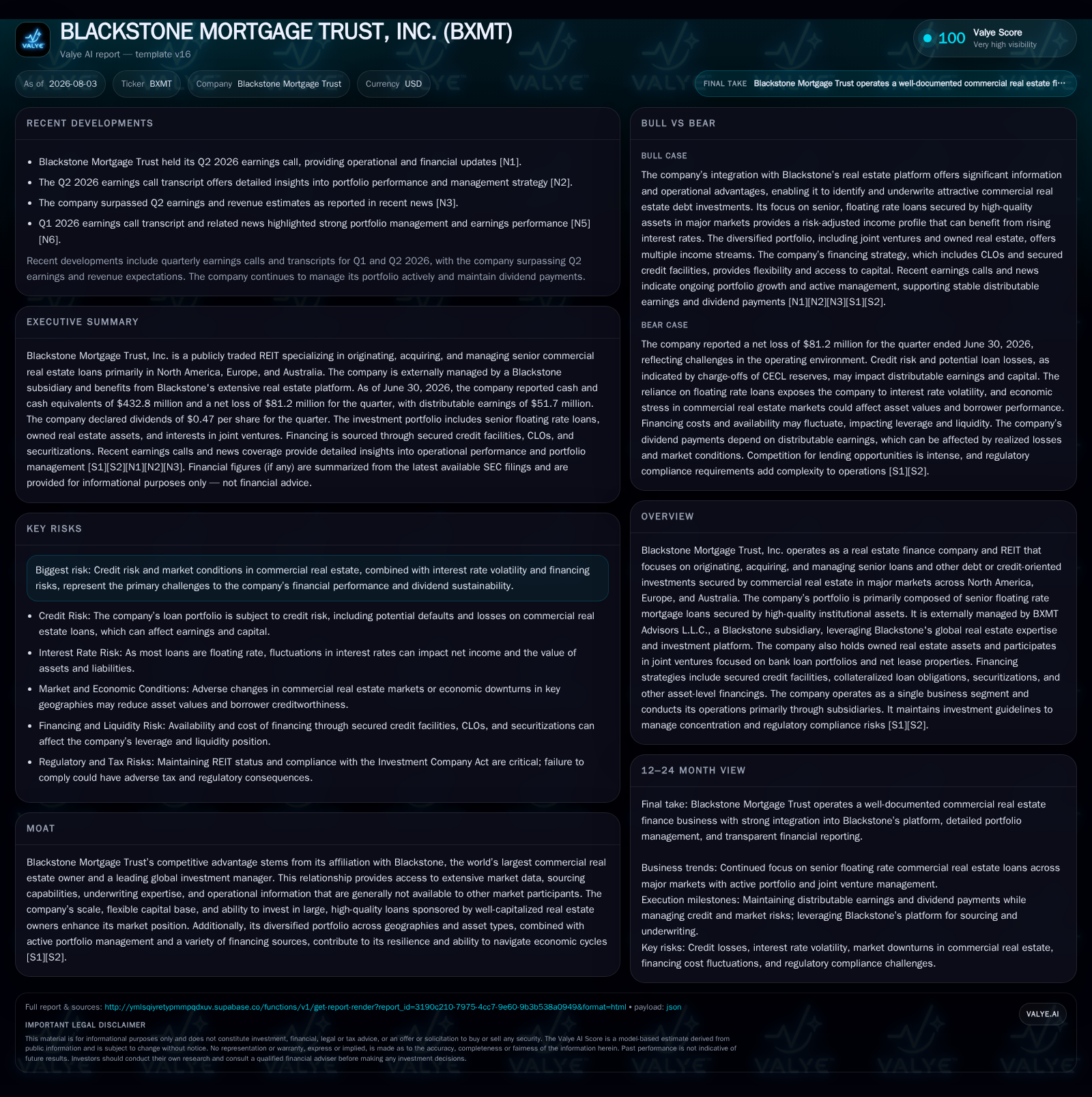
Blackstone Mortgage Trust, Inc. reported a notable net loss of $81 million in Q2 2026, pressured by higher credit loss provisions and widening credit spreads. The company’s business model centers on originating and managing senior floating rate mortgage loans on high-quality commercial real estate across major global markets. Leveraging an external management relationship with Blackstone’s real estate platform, BXMT benefits from superior underwriting intelligence and diversified financing sources including CLOs and secured credit facilities. While distributable earnings remain positive after adjusting for realized gains and losses, rising CECL reserves and a decline in book value per share reflect ongoing stress in commercial real estate credit markets. Key risks include credit deterioration, interest rate volatility, and liquidity constraints, but the firm’s geographic and asset-class diversification alongside its capital structure flexibility may help mitigate these headwinds. Upcoming indicators to watch include trends in non-performing loans, loan origination volume, and net interest margin performance.
Recent Operating Update
Blackstone Mortgage Trust (BXMT) reported a challenging Q2 2026 with a GAAP net loss of $81 million or $0.48 per share [S2][S26]. This compares unfavorably to a relatively flat net loss of $6.3 million in Q1 2026 but masks operational resilience seen in Distributable Earnings metrics. On a non-GAAP basis excluding realized gains/losses, BXMT posted Distributable Earnings of $0.48 per share in the quarter—stable with the prior quarter—highlighting the underlying income generation from its core commercial mortgage portfolio [S26]. The compressed earnings under GAAP largely stem from an increase in CECL reserves related to expected credit losses that rose to $2.43 per share by June-end from $1.80 three months earlier [S26][F1]. Accumulated depreciation also contributed partially to lower book value per share which fell from $20.20 to $19.31 over the quarter [S26].
These figures emphasize emerging stress in the commercial real estate finance environment as CRE fundamentals face slower growth combined with inflationary pressures on lender funding costs.
Business Model Overview
BXMT operates as a real estate investment trust focused primarily on originating, acquiring, and managing senior secured mortgage loans against commercial real estate assets spread across North America, Europe, and Australia [S1][S2]. Its portfolio is dominated by floating-rate senior loans backed by high-quality institutional properties owned by well-capitalized sponsors—this limits risk case relative to subordinated debt or equity investments while providing pricing protection against rising base rates.
The company’s revenue derives mainly from interest income on its loan portfolio along with fees earned via loan syndications or asset management activities associated with joint ventures covering bank loan portfolios and net lease properties [S1]. BXMT finances these loans through diverse channels including secured credit facilities, its proprietary collateralized loan obligations (CLOs), securitizations of pools of loans or debt securities, and participation sales—offering capital structure flexibility to optimize funding costs depending on prevailing market conditions [S1][S4].
Importantly, as a REIT it is structured to distribute most taxable income as dividends while maintaining tax efficiency via qualification requirements.
BXMT is externally managed by BXMT Advisors L.L.C., a Blackstone subsidiary that provides strategic investment decisions plus detailed underwriting informed by Blackstone Real Estate’s global footprint with over $319 billion assets under management as of end-2025 [S1][S2]. This affiliation grants BXMT privileged access to market data, sourcing capabilities for large-size deals not accessible to smaller peers, deep operational insights into property performance during economic stress periods, and economies of scale that enhance risk-adjusted returns.
Industry Structure and Competitive Position
Commercial Real Estate Finance REITs like BXMT operate upstream of property operators but downstream of capital providers such as banks or institutional investors focusing on either equity or debt layers within CRE capital stacks. Competitors typically range from other mortgage REITs focusing on CRE debt (e.g., Starwood Property Trust), specialty finance firms (e.g., Apollo Commercial Real Estate Finance), traditional banks' CRE lending arms, to REITs owning physical CRE assets.
BXMT distinguishes itself by specializing in senior floating-rate mortgages on institutional-grade assets backed by strong sponsors—reducing credit risk relative to mezzanine lenders or equity investors subject to valuation volatility [S1]. Its scale is considerable; the company reported total debt outstanding around $13.15 billion at mid-2026 alongside cash balances approximating $433 million providing liquidity flexibility [F1]. Strong diversification across geographies (North America predominately), property types (industrial, office, multifamily), and sponsor relationships further mitigates concentration risk.
Elevated CECL reserves point toward higher anticipated credit losses requiring monitoring if actual defaults rise substantially beyond provisions.
Interest rate volatility influences both loan yield resets given floating rate exposure versus funding cost movements affecting net interest margin sustainability.
Liquidity risk could emerge if capital markets tighten impacting BXMT's ability to securitize or syndicate loans efficiently with cost-effective terms especially given substantial leverage employed relative to equity base.
Operational risks including cybersecurity vulnerabilities are mitigated through Blackstone’s dedicated governance framework but remain relevant [S1]. Regulatory changes affecting REIT taxation status or securities compliance add complexity yet are closely managed.
Concentration risks exist if geographic or borrower segments deteriorate disproportionately but current diversification somewhat buffers this effect.
What To Watch Next
Future quarters will be pivotal regarding:
- Non-performing loan ratio trends signaling potential worsening credit performance beyond elevated CECL reserves.
- Loan origination volumes indicating demand strength for CRE financing amidst macroeconomic uncertainty.
- Net interest margin trajectory reflecting pricing power offsetting funding cost pressures.
- Book value per share movements illuminating cumulative asset impairment or recovery status.
- Capital markets engagement around CLO issuances or debt refinancing shaping financial flexibility.
- Dividend declaration consistency offering insight into distributable earnings confidence vs earnings volatility.
- Management commentary on evolving underwriting standards adapting to changing market dynamics.
- Macro factors such as CRE rents growth rates and occupancy statistics that impact collateral valuations indirectly affecting loan performance.
Financial Profile Discussion
As of June 30, 2026 BXMT held cash & equivalents of approximately $433 million against total indebtedness near $13.15 billion—implying net debt around $12.7 billion [F1]
The decline in book value per share from $20.20 at Q1-end to $19.31 at Q2-end exemplifies asset value adjustments linked primarily to increased CECL allowances ($2.43 per share) reflective of heightened expected credit losses reported during this period [F1][S26]. Distributable Earnings of $0.31 per share were sufficient to cover declared dividends at $0.47 per share partly due to payout exceeding current operating distributions leading possibly to retained earnings drawdown or capital raises if sustained long term [S26].
This financial posture underscores BXMT's dual imperative: navigate near-term pressures from tightening CRE credit conditions while deploying flexible capital solutions leveraging its Blackstone affiliation—a balance critical for dividend sustainability amid sector cyclicality.
This analysis synthesizes public filings and known industry mechanics without making investment research views or forecasts.
Disclaimer: This is research-only, informational analysis and not investment advice. It may include AI-generated interpretation and general industry context. Always verify important details using primary sources.

Comments