
CRH’s Strategic Acquisition of Arcosa Shapes Growth Amid Rising Leverage
CRH advances its acquisition-driven growth with the pending Arcosa deal, balancing integration risks and leverage management in the capital-intensive building materials sector.
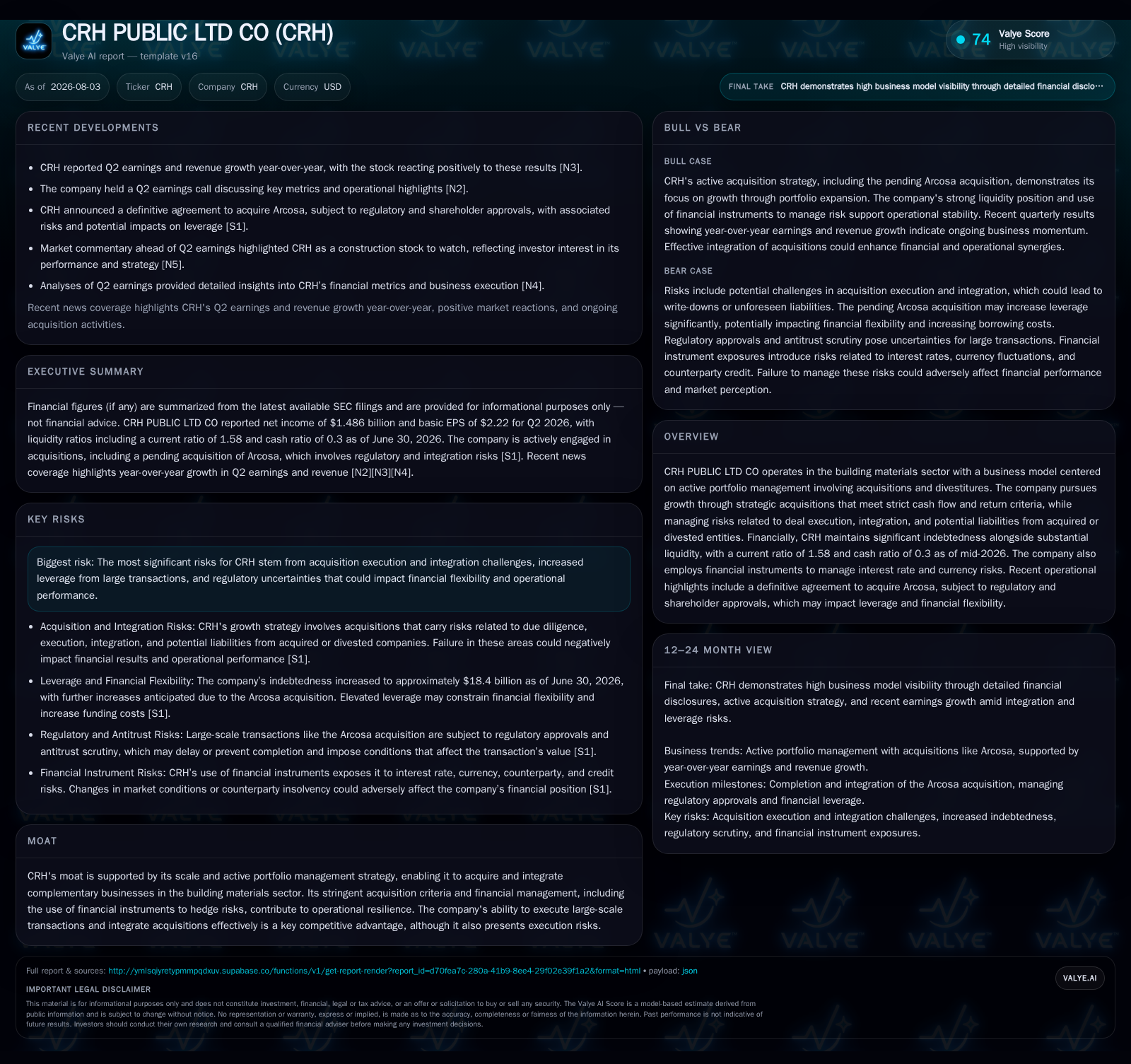
CRH Public Ltd Co reinforced its active portfolio management strategy in Q2 2026 by entering into a definitive agreement to acquire Arcosa, a large-scale transaction subject to regulatory and shareholder approvals. This move reflects CRH’s strategic emphasis on carefully selected acquisitions to grow its footprint across construction materials markets. Operating within the capital-intensive and cyclical building materials industry, CRH's acquisition approach hinges on stringent cash flow and ROI criteria but introduces execution risks and increased indebtedness. With gross debt near $18.4 billion and a net debt of approximately $14.8 billion mid-2026, CRH faces balancing growth ambitions against rising leverage and potential regulatory hurdles linked to sizeable deals.
Recent Operating Update: Strategic Acquisition Advances CRH’s Growth Narrative
In its latest quarterly filing dated July 30, 2026, CRH Public Ltd Co announced a definitive agreement to acquire Arcosa, a transaction emblematic of its active portfolio management philosophy [S2], [S5]. The deal, contingent on customary regulatory approvals—including scrutiny under the Hart-Scott-Rodino Antitrust Improvements Act—and Arcosa stockholder approval, is poised to reshape CRH’s business scale and geographic footprint [S7]. Importantly, this sizable acquisition will likely elevate the group's indebtedness by an estimated $8.75 billion [S8], intensifying leverage metrics from an already elevated gross debt position of approximately $18.4 billion as of mid-2026 [F1].
Acquisition execution risk is front and center: integration complexities could delay realization of anticipated synergies or incur impairments if operational fit proves challenging [S7]. Furthermore, liability exposure from acquired entities—ranging from environmental commitments to IT system dependencies—introduces contingent risk even post-closing [S7]. These factors highlight that while acquisitions fuel CRH’s expansion, they require disciplined due diligence and post-merger management.
In July 2026 investor communications accompanying the earnings release [S3], CRH emphasized its use of financial instruments like interest rate swaps to hedge against interest rate volatility within its capital structure amidst rising debt levels. Such tools are critical during macroeconomic pressures affecting borrowing costs.
Business Model: Acquisition-Driven Growth Across Building Materials Value Chain
CRH operates predominantly as an upstream and midstream supplier within the building materials value chain—manufacturing and distributing essential inputs such as cement aggregates, ready-mix concrete, and asphalt primarily sold to contractors and infrastructure developers. Revenue streams derive from volume-based sales contracts supplemented by price per unit adjustments influenced by commodity cost fluctuations.
Central to CRH’s model is active portfolio management involving frequent acquisitions calibrated against strict cash flow generation and return on investment (ROI) hurdles [S2], [S7]. This strategy enables CRH to broaden its footprint efficiently across regions while optimizing product mix. However, portfolio churn introduces exposure to integration costs, potential write-downs of underperforming assets post-acquisition, and occasional divestiture liabilities.
Unlike peers who emphasize organic growth or regional consolidation alone—such as Martin Marietta focusing heavily on U.S. aggregates or LafargeHolcim refining global cement operations—CRH’s acquisition cadence aims for scale synergy yet requires superior execution capability. Its revenue mechanics therefore rely not only on operational throughput but also on successful deal flow and integration win rates.
Industry Structure & Competitive Position
The building materials industry is capital-intensive with major firms investing heavily in production capacity and logistic networks. Demand is largely cyclical, driven by public infrastructure spending cycles alongside residential and commercial construction trends.
CRH competes with large multinational manufacturers like LafargeHolcim alongside regional players such as Vulcan Materials. Compared with these peers who often focus more narrowly on specific product lines or geographies with stable expansion tactics, CRH’s broader acquisition scope is both a differentiator and a source of complexity. This positions CRH well for diversified revenue streams but forces it to manage higher integration risk.
Regulatory oversight poses an ongoing challenge given environmental compliance demands and antitrust considerations inherent in large deals—accentuated by the pending Arcosa transaction which may face structural remedies or divestitures to gain approval [S7], [S25]. Effective risk mitigation here will be pivotal for maintaining competitive positioning.
Growth Drivers: Strategic Acquisitions Amid Favorable Construction Cycles
Structural growth drivers include increasing infrastructure investments globally fueled by governmental stimulus programs targeting urbanization and sustainable development. Residential housing demand rebounds also underpin increased sales volumes for aggregates and ready-mix concrete.
CRH leverages these market fundamentals through M&A activity designed to expand product range geographically while securing operational synergies—cost reductions via economies of scale or shared distribution networks are key ROI catalysts [S2], [S7]. The Arcosa deal exemplifies this approach as it promises incremental scale in infrastructure-related materials serving complementary markets.
Technological advances aimed at production efficiency improvement also support margin enhancements through better capacity utilization rates—a critical KPI reflecting operational leverage in this capital-heavy sector. Meanwhile, sustainability trends encouraging eco-friendly materials adoption could present new market opportunities if incorporated effectively into product portfolios.
Risks & Watchpoints: Integration Complexity & Leverage Elevation
Perhaps most prominent is the risk inherent in integrating large-scale acquisitions without dilution of core operational focus or unexpected impairment charges [S2], [S7]. Given the scale of Arcosa relative to previous deals, missteps could substantially affect reported operating margins or cash flow generation.
Elevated gross indebtedness near $18.4 billion with net debt about $14.8 billion (total debt minus cash) as of June 30, 2026 indicates tightening financial flexibility [F1]. Increased borrowing costs linked to market interest rate dynamics pose affordability concerns despite use of hedging instruments. Additionally, regulatory delays or required divestitures could reduce planned synergy capture or inflate transaction expenses.
Commodity price volatility remains an endemic challenge impacting input costs like fuel or raw minerals used in cement production; hedging strategies help but cannot fully eliminate margin uncertainty. Moreover, any deterioration in construction activity due to macroeconomic shocks could suppress volumes especially in geographically saturated markets with intense peer rivalry.
What To Watch Next
Key upcoming milestones include regulatory review outcomes for the Arcosa acquisition which will validate CRH's ability to complete transformative deals without excessive concessions or protracted timelines [S9]. Observation over early integration progress will be crucial; KPIs such as cost synergy recognition timelines or post-merger profit margin trajectories should attract attention.
Financially, monitoring net debt-to-EBITDA ratios post-closing will indicate how well CRH manages increased leverage without compromising investment capacity for capex or dividend sustainability [S26]. Also important will be indications on share buyback resumption timing following current financing priorities pause
Additionally, pricing trends across aggregates and ready-mix concrete segments alongside capacity utilization rates will signal underlying demand strength — vital given cyclicality within building materials sectors.
Financial Profile Discussion
Disclaimer: This is research-only, informational analysis and not investment advice. It may include AI-generated interpretation and general industry context. Always verify important details using primary sources.

Comments