
ProPetro’s Contract Mix and Liquidity Strengthen Position Amid Cyclical Oilfield Services Demand
ProPetro Holding Corp. reports solid Q2 service revenue with strategic contract structures and ample liquidity supporting resilience in volatile market conditions.
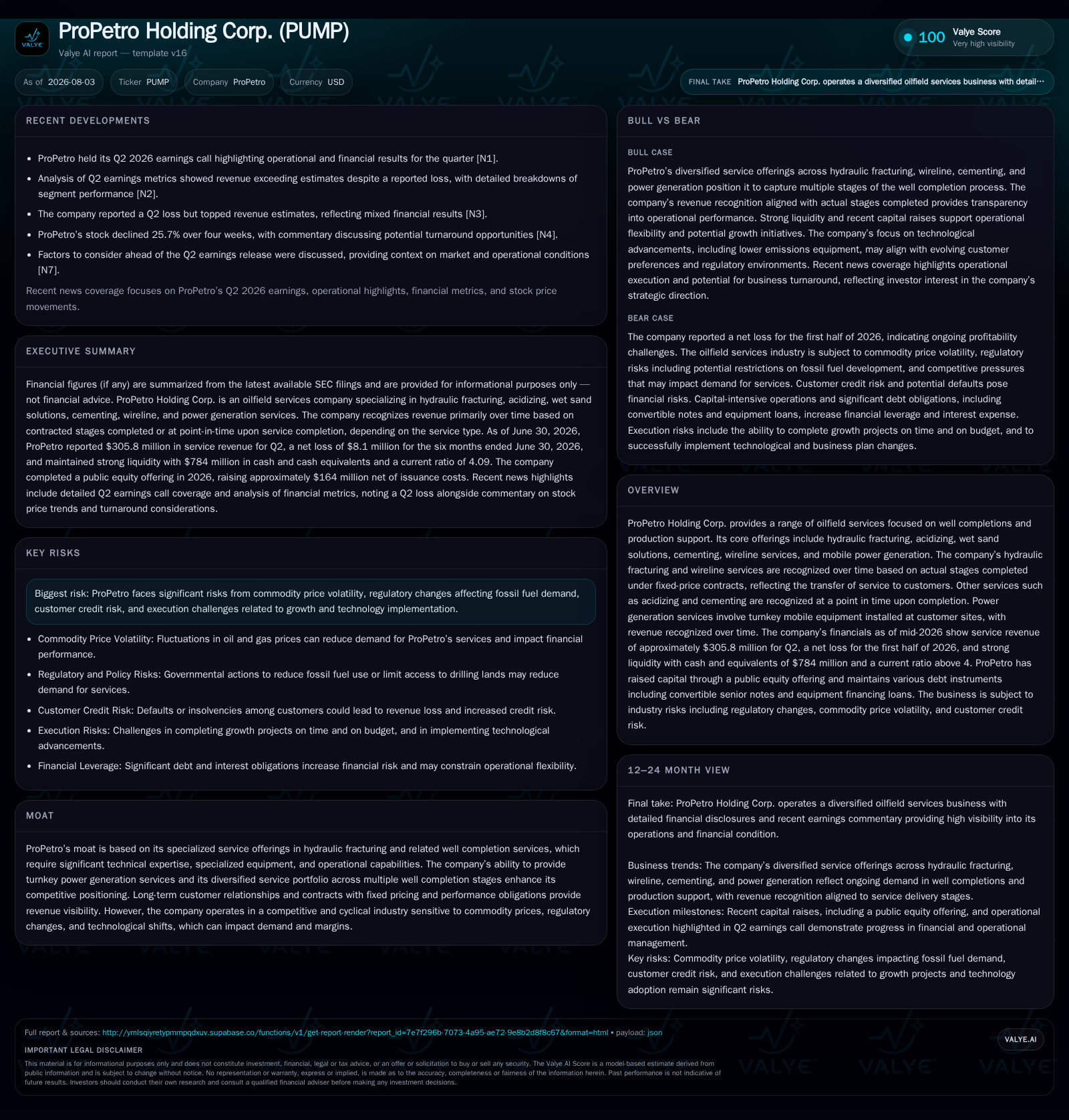
ProPetro Holding Corp. released its Q2 2026 results highlighting approximately $306 million in service revenue driven by fixed-price hydraulic fracturing contracts recognized over completed stages. The company maintains strong liquidity with $784 million in cash and a current ratio above 4, reflecting financial flexibility amid a cyclical oilfield services market. Its diversified offerings across frac, wireline, cementing, acidizing, and power generation equip it to capture upstream activity cycles, but commodity price swings and regulatory risks remain key demand constraints. ProPetro’s expanded asset-based credit facility and zero reported debt further underpin its capital structure resilience.
Recent Operating Update
ProPetro Holding Corp.'s Q2 2026 report underscores steady operational momentum within its core oilfield services business during a cyclical offshore backdrop. The company recorded roughly $305.8 million in service revenues driven primarily by its hydraulic fracturing and wireline services segments, where revenue recognition follows actual stages completed on fixed-price contracts—a model that provides revenue visibility tied closely to upstream operational cadence [S2]. This variable consideration approach balances operational risk by aligning billing with quantifiable service delivery milestones such as stage counts.
Other well completion services like acidizing and cementing realize revenue at completion points while power generation revenues are recognized over the lifecycle of deployed mobile equipment, reflecting the predominance of nonlease components in such arrangements [S2]. Importantly, ProPetro indicates no provision for credit losses during this period, which signals effective credit risk management and suggests resilient customer payment patterns despite ongoing sector cyclicality.
Business Model Nuances
ProPetro primarily serves upstream exploration and production (E&P) operators by providing specialized hydraulic fracturing—critical for well stimulation in unconventional reservoirs—and complementary services such as wireline logging, acidizing, cementing, and mobile power generation solutions. The revenue mechanics hinge on contract types: fixed-price agreements dominate for fracturing stages completed, which transfers performance risk but ties revenue more directly to operational milestones. Power generation contracts typically bundle lease and service elements into a single performance obligation accounted for over time under ASC Topic 606 guidance.
This segmentation supports diversified monetization streams while allowing tailored exposure to upstream activity cycles. For instance, the turnkey nature of mobile power solutions adds recurring revenue from installed bases alongside large episodic well completion engagements. However, the capital-intensive nature of equipment fleets—fracturing spreads and power units—demands substantial upfront investment balanced by fleet utilization levels to sustain margins.
Industry Structure & Competitive Position
The oilfield services sector remains highly cyclical and sensitive to commodity price fluctuations dictated by global supply-demand dynamics. ProPetro operates alongside larger integrated peers like Halliburton and Schlumberger but retains a more specialized focus on hydraulic fracturing along with associated niche well completion support. This specialization grants it technical expertise advantages but also exposes it to direct pressure from commodity-driven spending cuts especially in North American unconventional shale plays.
Operational efficiency metrics such as fleet utilization rate, average revenue per stage completed, contract backlog depth, equipment uptime, and days sales outstanding (DSO) are critical KPIs shaping competitive positioning here. ProPetro's ability to recognize variable consideration linked explicitly to actual work stages completed is an accounting reflection of its embedded operational execution discipline.
The company's diversification into mobile natural gas-fueled power generation distinguishes it as it leverages non-frac-related infrastructure support opportunities within E&P operations—a segment less correlated with immediate drilling activity but requiring technical installation and maintenance capabilities.
Growth Drivers
A structural uptick in upstream drilling and completion activity fueled by sustained unconventional resource development underpins ProPetro's growth outlook. Recent periods have seen favorable reinvestment trends from customer operators seeking efficient completions amid evolving reservoir technologies [N1], supported by incremental adoption of acidizing and cementing services that complement hydraulic fracturing treatments.
Additionally, the expansion of the mobile power generation segment not only broadens service scope but enhances customer retention through integrated site energy solutions. Fleet expansion strategies combined with modernization programs aim to boost utilization rates while controlling operating cost per service unit—a dual lever vital for margin improvement.
Contract renewals under fixed pricing terms also create visibility over mid-cycle capex spending given long-term operator relationships. Operational efficiency gains from technology upgrades or digitization of wireline offerings can reduce downtime risks enhancing competitive differentiation.
Risks & Watchpoints
The principal vulnerability stems from volatile global oil prices impacting operator drilling budgets; sudden spend curtailments directly depress demand for fracturing stages—the primary revenue driver—and ancillary completion services. Regulatory uncertainties around fossil fuel production coupled with environmental governance pressures may compound medium-term structural headwinds.
Customer concentration risk could emerge if a small number of large operators reduce activity or delay payments; however, absence of significant credit loss provisions offers some reassurance on collections quality currently [S2]. Execution risks related to scaling advanced technology deployments or maintaining equipment uptime remain prevalent given high capital intensity.
Monitoring fleet utilization trends closely will be critical—any protracted underutilization can strain margins given fixed overhead absorption requirements. The recently amended asset-based revolving credit facility imposes customary affirmative/negative covenants which expand leverage baskets but anchor debt capacity relative to earnings—compliance here will require continued prudence as market dynamics evolve [S4], [S11].
What to Watch Next
Investors should focus on subsequent quarterly reports for updates on:
- Hydraulic fracturing stage volumes completed versus prior quarters reflecting upstream activity shifts,
- Revenues from complementary segments like acidizing, cementing, wireline, and power generation for signs of portfolio balance,
- Operating cost per stage/service unit trends signaling margin trajectory,
- Utilization metrics of equipment fleets disclosing capacity deployment,
- Contract backlog updates offering forward-looking revenue insight,
- Balance sheet commentary especially around liquidity availability under the amended ABL facility,
- Any incremental disclosures on technological innovation rollouts or new integrated customer offerings.
Financial Profile Discussion
At mid-2026 quarter-end, ProPetro reported robust liquidity with cash and equivalents totaling approximately $784 million complemented by strong current assets against modest current liabilities yielding a current ratio exceeding 4.09—an unusually healthy buffer in the capital-intensive oilfield services sector [F1]. Notably absent were outstanding borrowings under the amended asset-based revolving credit (ABL) facility despite an enlarged borrowing capacity boosted recently from $225 million to $350 million plus an uncommitted accordion potentially extending availability up to $500 million through May 2031 [S4], [S11].
This expanded credit facility broadens borrowing base collateral to include eligible accounts receivable—as high as 90% advance rates depending on counterparty ratings—and accommodates substantial valuation of power generation equipment up to 35% of total borrowing base value. These features enhance financial flexibility helpful during cyclical demand troughs when working capital swings can be pronounced.
Although the company posted a net loss for the first half of 2026 reflecting transitional industry pressures [S2], its operating cash flow remains positive with depreciation/amortization expenses significantly non-cash allowing room for future free cash flow improvements contingent on activity recovery. Capital expenditures outpaced prior periods consistent with fleet modernization initiatives—a necessary step given rapid technology evolution in completions equipment.
ProPetro's zero reported total debt figure as of September 2020 underscores conservative leverage stance though selective use of secured equipment loans under Caterpillar arrangements supplements financing strategies without overstretching risk profiles [F1], [S7]. Compliance with all financial covenants was confirmed as of June 30, 2026 supporting credit profile stability [S11].
Overall, ProPetro’s liquidity strength paired with contract structure provides a sound platform suited to weather sector volatility while enabling measured growth investments aligned with upstream market conditions.
This analysis is based solely on public filings dated July 29-30, 2026; no proprietary information was used. It aims to contextualize operating data within industry dynamics without providing investment advice.
Disclaimer: This is research-only, informational analysis and not investment advice. It may include AI-generated interpretation and general industry context. Always verify important details using primary sources.

Comments