
Madison Air Solutions’ Q2 Unveils Revenue Resilience Amid Industry Cyclicality
The company’s latest quarterly results highlight stable revenue and operating income amid market headwinds, driven by installation and maintenance contract execution.
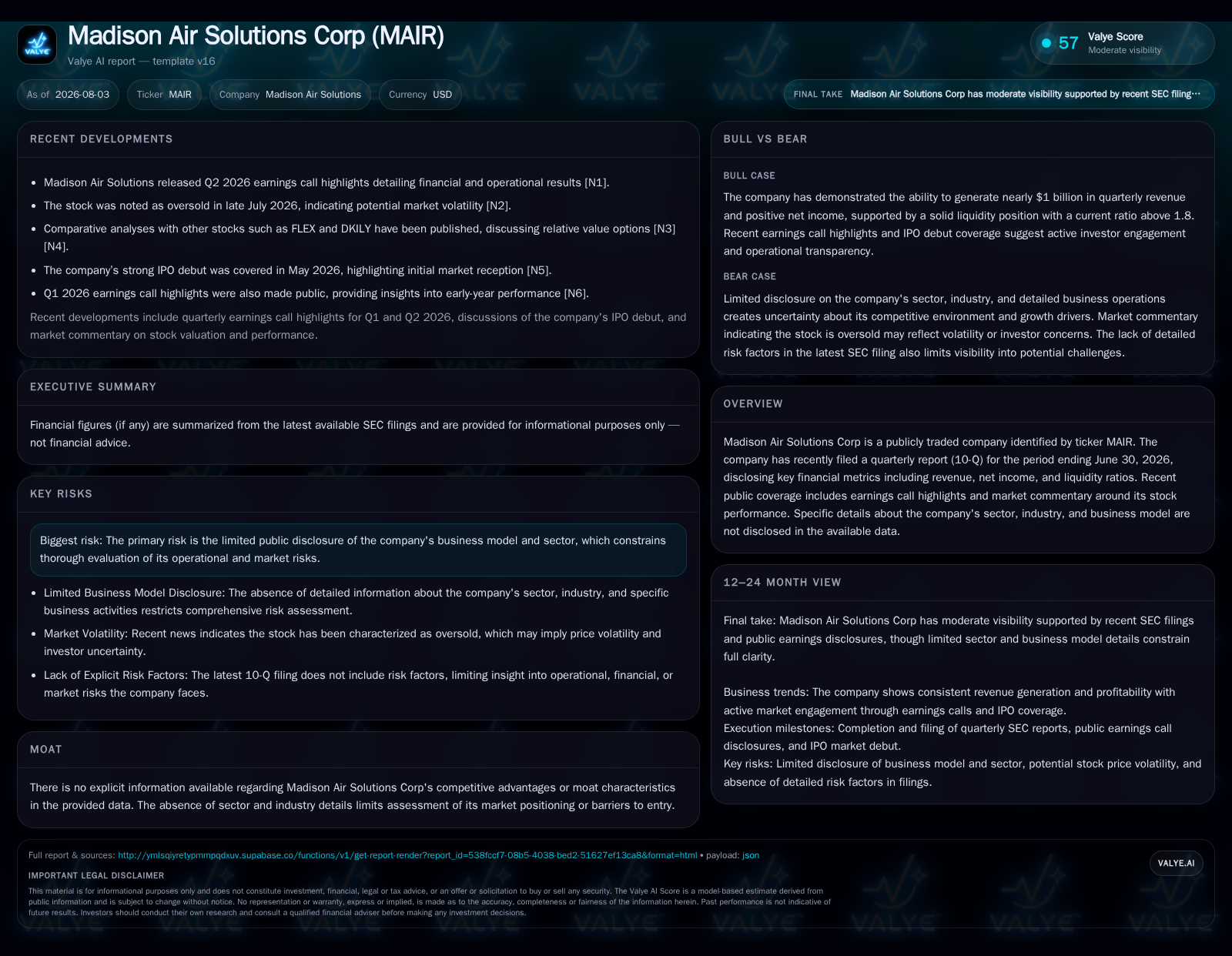
Madison Air Solutions reported Q2 2026 revenue of $991.3 million and operating income of $195.3 million, reflecting resilience in the face of industrial HVAC sector cyclicality [F1], [S2]. The company’s dual revenue streams from new installations and recurring maintenance contracts underpin margin stability amid fluctuating order backlog trends [S2], [N1]. While leverage exceeds $3 billion, reflective of capital intensity typical in the sector, liquidity remains adequate with a current ratio of 1.82 [F1]. Key near-term focus should be on backlog evolution and service contract renewals as leading indicators of demand and recurring revenue sustainability [S2].
Q2 Performance Signals Revenue Stability during Industry Headwinds
Madison Air Solutions Corp delivered second-quarter 2026 results demonstrating resilience during an uneven industrial HVAC market landscape. Reported revenue reached $991.3 million while operating income arrived at $195.3 million, underscoring the company’s ability to maintain profitability despite pressure across certain segments [F1], [S2]. Net income stood at $69.2 million, reflecting moderate net margin performance given sector capital costs and integration expenses. This performance suggests Madison retains operational discipline in managing fluctuating demand patterns tied to broader commercial and industrial construction cyclicality.
The stability in revenue and operating margins likely stems from a balanced portfolio encompassing both new HVAC system installations and recurring service contracts that tend to provide steadier cash flows, even when new project bookings soften. These figures indicate that Madison's exposure to market downturns is partially mitigated by its after-sales service business, which offers predictability through contractual agreements.
Installation Services & Maintenance Contracts as Twin Revenue Engines
Madison’s business model generates revenue principally from product sales typically coupled with complex installation services required for commercial HVAC and industrial ventilation solutions [S2]. This midstream role in the value chain involves not only manufacturing or sourcing air handling units but also integrating these systems into client facilities — a process necessitating skilled labor and effective project management.
Equally important to Madison’s earnings quality are its maintenance contracts representing recurring revenue streams that contribute disproportionately to operating margin stability due to their higher service content and less cyclicality compared with installations. Such agreements often include service level commitments and can lock-in customer retention, creating barriers against competitor encroachment while providing steady cash inflows.
This dual revenue strategy — blending large project installations with ongoing system servicing — aligns Madison with peers like Trane Technologies and Johnson Controls known for their similar mix of equipment supply plus robust service portfolios, which smooths earnings volatility inherent in cyclical installation demand.
Order Backlog Profile Illuminates Demand Trajectory for Industrial HVAC Solutions
Order backlog acts as a paramount leading indicator for Madison, revealing pipeline strength ahead of recognized installation revenues [S2]. While exact backlog figures are not publicly detailed, management commentary highlights the sensitivity of this KPI to commercial construction activity levels.
A stable or growing backlog suggests near-term installation pipeline health conducive to sustaining top-line growth and efficient capacity utilization — crucial given the labor- and capital-intensive nature of HVAC system deployment. Conversely, a shrinking backlog could foreshadow revenue contraction risks as projects complete faster than replacements materialize.
Backlog fluctuations also influence working capital dynamics since sizable projects typically require upfront material procurement followed by phased billing schedules impacting cash conversion cycles.
Positioned Against Peers: Service Penetration and Capital Intensity Benchmarks
Compared against large-scale industrial HVAC players like Carrier Global Corporation or Honeywell Building Solutions, Madison appears positioned as a mid-cap player balancing equipment manufacturing complexity with integrated service offerings [N1], [S2], [F1]. This positioning entails grappling with similar raw material cost volatilities — notably steel and copper price swings — while striving to maintain gross margins through pricing power on installation and aftermarket services.
Financially, Madison carries over $3 billion in total debt balanced by roughly $262 million in cash equivalents yielding a current ratio around 1.82 at quarter-end 2026 [F1]. This net leverage reflects funding requirements typical within capital-intensive manufacturing sectors where sustaining production capacity alongside service infrastructure demands substantial ongoing investment.
Peers often show comparable leverage profiles justified by asset-heavy operations; however, such debt levels limit financial flexibility, placing a premium on efficient cash flow generation and prudent capital allocation strategies going forward.
Growth Path Supported by Regulatory Momentum and Retrofit Opportunities
Looking beyond cyclical headwinds, Madison’s growth prospects receive tailwinds from tightening regulatory regimes focusing on indoor air quality standards, emissions ceilings, and energy efficiency mandates affecting commercial real estate tenants and industrial operators alike [N1], [S2].
These regulatory developments incentivize retrofit projects aimed at upgrading aging HVAC infrastructure — a segment less correlated with new building completions — thereby fostering incremental demand for Madison’s installation services complemented by ongoing maintenance agreements.
Additionally, innovations in smart HVAC technology integration present avenues for differentiated product offerings enabling better energy management outcomes for customers, potentially enhancing Madison’s competitive positioning relative to peers focused predominantly on traditional equipment sales.
Risks From Cyclical Construction Markets and Raw Material Price Pressure
Despite promising structural drivers, Madison remains exposed to pronounced industry risks including the well-documented cyclicality tied to commercial construction investment cycles which significantly influence order intake timing and size [S2].
Raw material price volatility—principally steel, copper, refrigerants—directly impacts cost of goods sold threatening gross margin compression if cost increases cannot be fully passed through to customers amidst competitive pressures. Supply chain disruptions exacerbate these challenges by extending lead times or increasing component costs.
Project execution risks also persist; delays or cost overruns on installation contracts can erode profitability given fixed-price agreements or penalty provisions embedded within service level agreements common in this sector.
What To Watch: Backlog Trends, Contract Renewals, Margin Stability Indicators
Key performance indicators warranting close monitoring include sequential changes in order backlog which signal demand momentum shifts ahead of recognized revenues [S2]. A rising backlog would validate sustained installation growth while a declining figure would highlight exposure to slowing construction markets.
Maintenance contract renewal rates constitute a critical metric reflecting customer satisfaction and recurring revenue durability. Elevated renewal rates underpin predictable cash flow bases shielding operating margins during periods of installation volatility.
Gross margin trends serve as an early warning gauge for pricing power vs cost pressure balance. Margin erosion could presage challenges in procuring raw materials competitively or maintaining premium pricing amidst intensified competition.
Financial Profile Discussion: Leverage and Liquidity in Capital-Heavy Context
As of June 30, 2026, Madison Air Solutions held total debt approximating $3.05 billion against cash reserves near $262 million, implying net debt around $2.79 billion alongside a current ratio of approximately 1.82 signaling comfortable short-term liquidity coverage [F1]
This financial profile aligns with expectations for a company engaged heavily in manufacturing and servicing HVAC equipment where sizable working capital requirements coexist with ongoing capital expenditures necessary to sustain production throughput and field service capacity.
Readers should consider industry cyclicality inherent in industrial HVAC markets when evaluating operational trends or financial metrics discussed herein.
Disclaimer: This is research-only, informational analysis and not investment advice. It may include AI-generated interpretation and general industry context. Always verify important details using primary sources.

Comments