
Ventas’ Q2 2026 Strength Highlights Healthcare REIT Resilience Amid Rising Rates
Ventas posted solid second-quarter growth in FFO and revenues driven by stable occupancy and effective portfolio management in healthcare real estate.
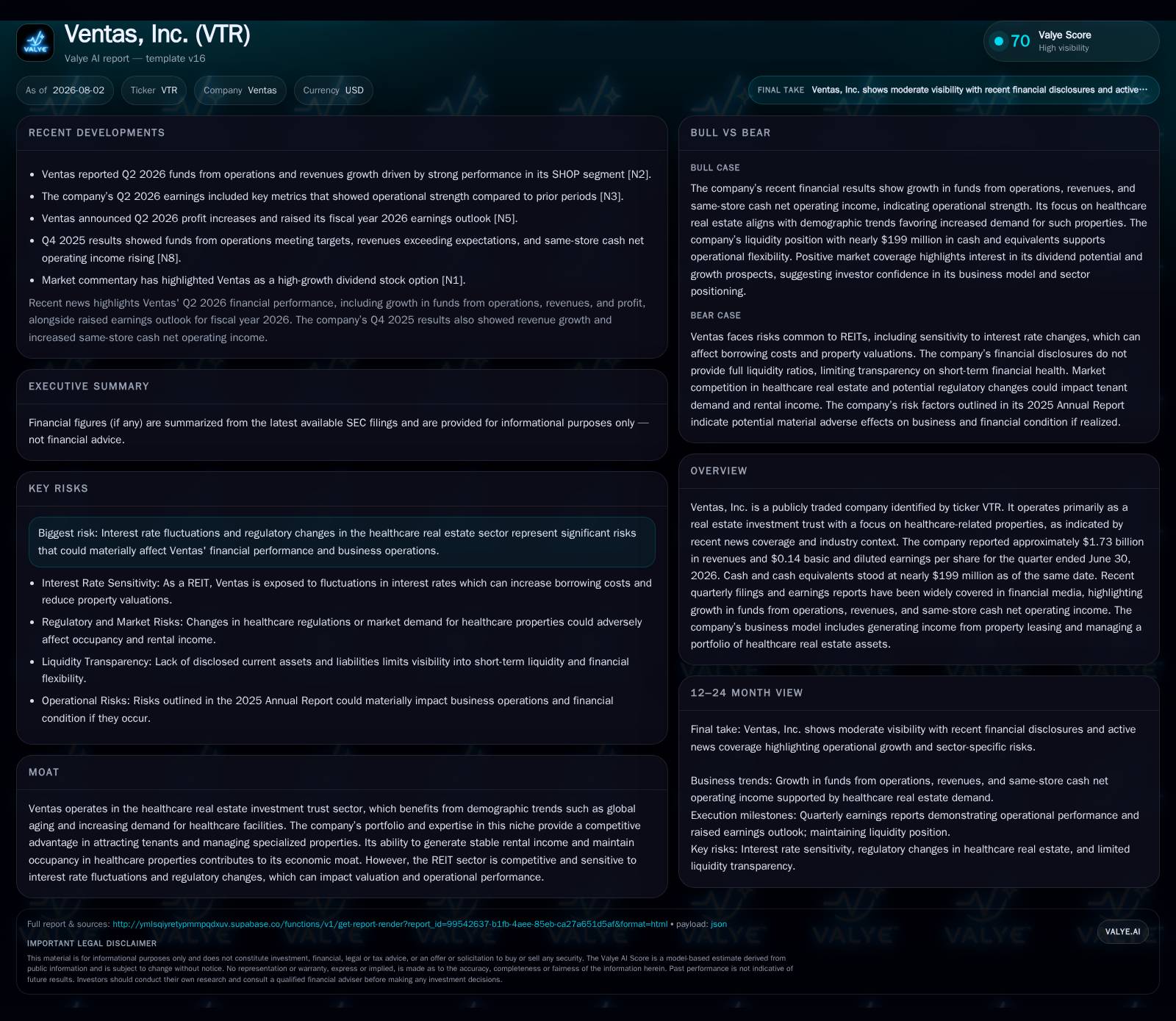
Ventas, Inc. reported a strong second quarter ending June 30, 2026, with revenue of roughly $1.73 billion and basic/diluted earnings per share of $0.14, underpinned by growth in funds from operations (FFO) and same-store cash net operating income (NOI). This reinforces the strength of its healthcare-focused REIT model amid sector headwinds such as interest rate fluctuations and regulatory risks. Ventas’ diversified portfolio of senior housing, medical office buildings, and specialized healthcare properties continues to generate stable rental income supported by long-term leases with reputable healthcare tenants. Key operating metrics like occupancy rates and lease renewal momentum remain central to sustaining revenue growth and margin durability. Going forward, Ventas’ ability to strategically deploy capital and navigate regulatory shifts will be critical to maintaining its competitive advantage within the specialized healthcare real estate niche.
Recent Operating Update: Q2 2026 Performance
Ventas’ latest quarterly report for the period ended June 30, 2026 confirms steady execution within its healthcare real estate investment trust (REIT) model. Reported revenue reached approximately $1.73 billion while basic and diluted earnings per share stood at $0.14 [F1][S2]. These results beat consensus estimates largely due to stronger-than-expected funds from operations (FFO), which is a pivotal profitability metric for REITs reflecting cash generated from property operations excluding gains or losses on property sales [N2]. Additionally, Ventas highlighted same-store cash net operating income (NOI) growth across its core segments, underscoring operational efficiency despite macroeconomic pressures [N7].
This quarterly performance update is significant because it validates the resilience of Ventas' portfolio during ongoing interest rate volatility—a critical factor influencing valuation multiples and cost of capital for REITs heavily reliant on debt financing. The stability in leasing activity and NOI suggests that tenant demand for specialized healthcare properties remains robust.
Business Model Specifics: Specialized Healthcare Real Estate Leasing
Ventas operates predominantly as a Healthcare REIT specializing in owning and managing diversified real estate assets including senior housing communities, medical office buildings (MOBs), outpatient medical facilities, research centers, and life science campuses [S1]. Revenue derives primarily from leasing these properties under long-term triple-net leases to healthcare operators who deliver patient care services.
These triple-net leases shift most property-level expenses—taxes, insurance, maintenance—to tenants, resulting in predictable rental income streams for Ventas with limited landlord operating risk exposure. The company’s tenants typically include senior living operators, hospital systems, dialysis centers, and medical practitioners—all sectors benefiting from demographic tailwinds such as the aging U.S. population.
Lease terms often span multiple years with staggered expiration profiles that enable Ventas to manage contract renewals proactively while optimizing rent escalations aligned with inflation or market benchmarks. Tenant credit quality is crucial here; well-capitalized operators help safeguard against default risk which can materially impact cash flow stability and NAV preservation.
Capital deployment strategies revolve around acquiring accretive new properties or portfolios in high-demand markets while divesting non-core or underperforming assets to optimize portfolio composition and enhance FFO per share over time [S1][N3]. This dynamic allocation aims to leverage demographic growth in outpatient care facilities alongside expansion in life sciences real estate where demand drivers include increased R&D spending.
Industry Structure and Competitive Position
Healthcare REITs occupy a niche within the broader commercial real estate marketplace distinguished by higher specialization requirements and closer operator relationships compared to retail or office REITs. Within this subset, Ventas competes alongside peers like Welltower Inc., Healthpeak Properties, and Medical Properties Trust—each balancing exposure between senior housing, MOBs, hospital assets, and emerging life science properties.
The competitive moat stems partly from scale—Ventas' diversified asset base spanning multiple geographies reduces concentration risk—and partly from expertise in managing regulatory complexities impacting healthcare providers that directly affect property utilization rates and lease renewals. Furthermore, tenant retention rates anchored by long lease terms foster revenue visibility exceeding typical CRE cycles.
However, regulatory headwinds related to Medicare reimbursements or changes in care delivery models can indirectly pressure tenant financial health, thereby influencing rent collection timeliness or vacancy risks. Interest rate environments also hamper valuation multiples; higher borrowing costs challenge dividend yield sustainability—a primary attraction for REIT shareholders.
Growth Drivers
Key structural growth drivers for Ventas tie directly to secular healthcare trends:
- Aging population dynamics boost demand for senior housing communities requiring tailored real estate solutions.
- Expansion of outpatient services shifts clinical activity out of hospitals into ambulatory treatment centers needing modern MOB space.
- Growth of the life sciences sector prompts demand for research campuses and lab environments with specific design parameters.
- Stable cash flows from long-dated triple-net leases enable reinvestment capacity into accretive acquisitions or developments.
- Capital market access facilitates opportunistic financing at favorable terms when economic conditions permit.
Sustained demand in these segments mitigates cyclical downturn effects seen in other CRE sectors but requires continuous monitoring as shifts in healthcare reimbursement policies or operator consolidations could alter future space requirements.
Risks and Watchpoints
Interest rate sensitivity remains one of the highest-impact risks due to Ventas’ substantial net debt position approximating $12.57 billion after accounting for nearly $199 million in cash reserves [F1]. Rising rates increase interest expense burden while potentially compressing valuation multiples applied by investors demanding higher yields.
Regulatory changes pose ongoing uncertainty: modifications to government healthcare spending or changes in rules governing senior living operations can affect tenant profitability and thus lease security [S1]. Tenant credit quality fluctuations may increase default risk or require concessions during lease renewals.
Operationally, aging property portfolios require capital expenditures (CapEx) to stay competitive against newer developments; misallocation here could erode NOI margins. Competition for high-quality healthcare real estate assets among peers further elevates acquisition pricing standards reducing margin expansion opportunities.
Watch closely the lease expiration schedule and tenant retention rates over the coming quarters as early signal indicators of market softness or disruption.
What to Watch Next
Investors should focus on upcoming quarterly disclosures detailing:
- Trends in occupancy rates across senior housing versus outpatient medical properties,
- FFO per share trajectory relative to analysts’ consensus,
- Guidance updates reflecting management views on interest expense outlook,
- Capital deployment announcements revealing acquisition/disposition activity,
- Any commentary on regulatory impacts or shifts affecting tenant operability,
- Lease renewal success rates signaling tenant satisfaction or stress levels.
These markers will clarify whether recent improvements represent durable platform strength or transitory gains amid macroeconomic uncertainty.
Financial Profile Discussion
As of June 30, 2026, Ventas reported cash & equivalents totaling approximately $199 million against total debt close to $12.77 billion yielding an estimated net debt load near $12.57 billion [F1]. This leverage profile aligns with typical Healthcare REIT conventions where heavy capital intensity demands financing but is balanced by predictable leasing income generating steady funds from operations (FFO).
Maintaining an appropriate debt-to-equity ratio while securing refinancing at favorable interest coverage ratios is pivotal given ongoing rate volatility risks. The company's ability to generate positive operational cash flow supports dividend sustainability despite elevated leverage metrics but requires prudence in capital markets access especially if credit conditions tighten unexpectedly.
Conclusively, Ventas’ current financial positioning provides flexibility yet necessitates vigilance around refinancing costs and covenant maintenance as sector-wide funding costs fluctuate.
Disclaimer: This analysis is a factual synthesis based on publicly available filings as of mid-2026 intended for informational purposes only without any investment research view or advice.
Disclaimer: This is research-only, informational analysis and not investment advice. It may include AI-generated interpretation and general industry context. Always verify important details using primary sources.

Comments