
Xenia Hotels & Resorts Advances Portfolio Value Amid Market Volatility and Rising Costs
Xenia’s Q2 2026 results highlight resilience in luxury lodging driven by brand partnerships and disciplined capital management.
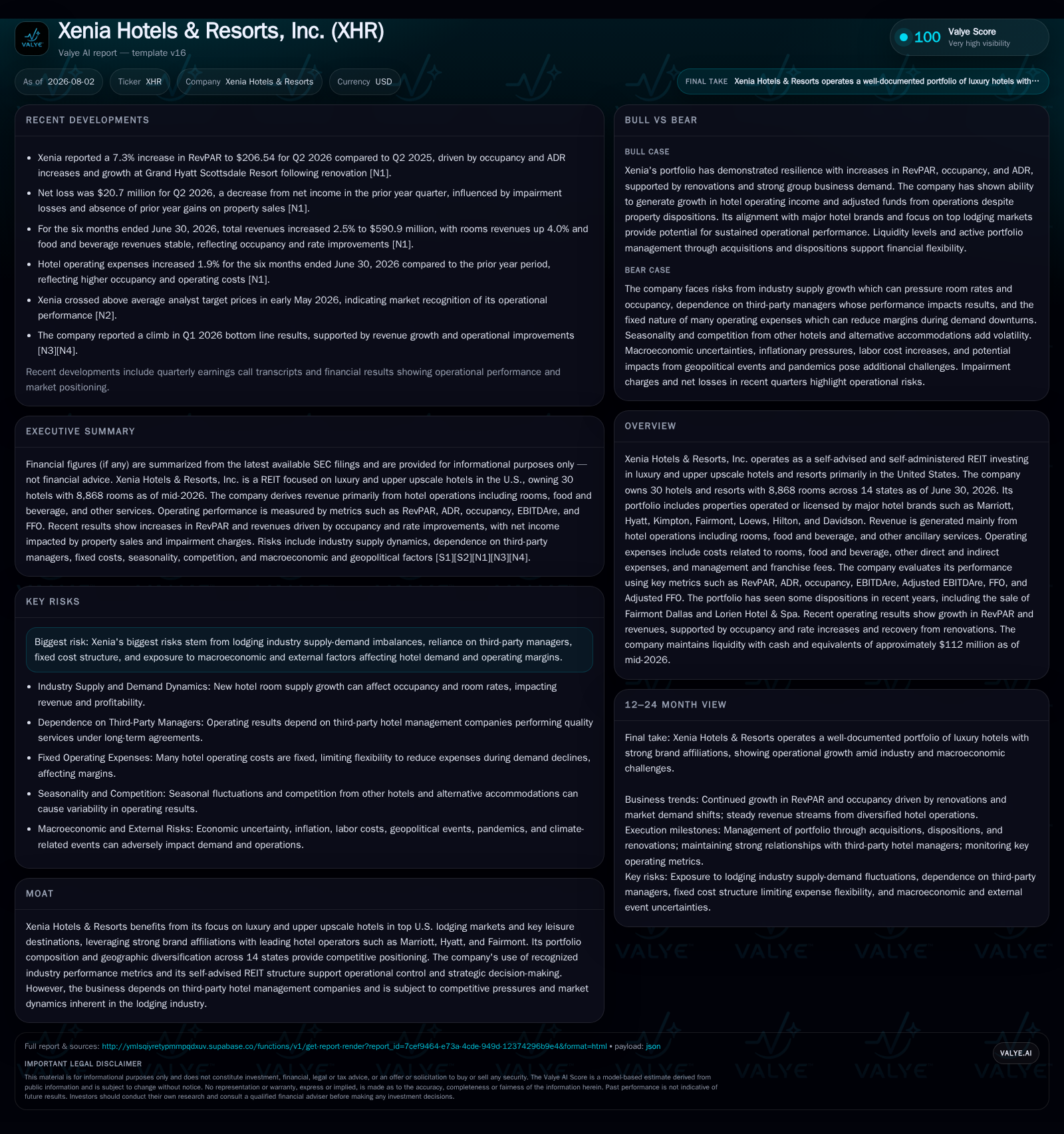
Xenia Hotels & Resorts, a self-advised lodging REIT focused on luxury and upper upscale hotels primarily in the U.S., reported sustained operating performance in Q2 2026 supported by strong brand affiliations and geographic diversification. While navigating macroeconomic headwinds such as inflation and supply chain disruptions, Xenia has maintained stable occupancy and ADR metrics through its reliance on leading third-party hotel operators. The company’s active capital strategy, including debt refinancing and selective mortgage paydowns, underpins its liquidity position and positions it to manage economic volatility and industry cyclicality. Key challenges remain around fixed expense structures, competitive supply growth, and evolving travel demand patterns, which the firm monitors closely to safeguard margins and cash flow.
Recent Operating Update
In its latest quarterly filing dated July 30, 2026, Xenia Hotels & Resorts (XHR) reported a stable operating environment for the second quarter ended June 30, 2026 [S2][S3]. The company's portfolio maintained robust occupancy levels supported by effective partnership with multiple premier hotel management companies such as Marriott and Hyatt. Despite ongoing macroeconomic headwinds including inflationary pressures on labor costs and materials for renovations as well as supply chain disruptions affecting FF&E replacement schedules, Xenia managed to uphold key operating metrics like RevPAR (revenue per available room) through disciplined revenue management strategies [S2]. Additionally, the company repaid $51.8 million of mortgage debt secured by the Grand Bohemian Hotel Orlando earlier in the year as part of an active approach to optimizing its debt maturity schedule [S21].
This recent activity underscores Xenia's emphasis on balancing operational resilience with proactive capital structure management during sector uncertainties.
Business Model
Xenia operates as a self-advised and self-administered real estate investment trust (REIT) specializing in ownership of luxury and upper upscale hotels predominantly within the United States [S1]. The company owns a portfolio of 30 properties aggregating approximately 8,868 rooms diversified across fourteen states [S1]. Its revenue model centers on earnings from underlying hotel operations — primarily room rentals supplemented by food and beverage services plus ancillary amenities such as conference facilities — with daily operations largely outsourced to established third-party hotel management firms via long-term contractual arrangements [S1].
The reliance on reputable operators like Marriott, Hilton, Kimpton, Hyatt, Loews, Fairmont and Davidson affords Xenia strategic advantages: access to strong brand recognition boosts customer loyalty and pricing power; professionalized operating expertise supports efficiency gains; yet it also introduces dependency risk if a partner underperforms or brand standards necessitate costly capital investment [S1]. Management fees paid to these partners represent a material operating expense line
Revenue generation is subject to volume drivers including occupancy rates influenced by local demand-supply dynamics; pricing dictated by ADR benchmarks relative to competitive sets; and guest spending patterns across room categories and services [S1]. Capital expenditure requirements are sustained both for routine FF&E replacements mandated by franchise agreements typically ranging from 3% to 5% of revenues held in reserve funds plus larger discretionary investments for renovations intended to enhance competitive positioning or comply with brand-imposed property improvement plans [S23]. The company's cash flows are therefore sensitive not only to transient market demand but also cyclical capital spending schedules.
Industry Structure and Competitive Position
Lodging REITs operate at the asset ownership tier of the hospitality value chain while contracting third parties for day-to-day management functions. In this setup, Xenia's main competitive factors lie in portfolio composition (segment focus on luxury/upscale), geographic diversification across major U.S. leisure & gateway markets mitigating localized downturns, brand affiliations that anchor customer acquisition via large-scale reservation systems, plus financial discipline preserving balance sheet flexibility.
Peers within this sector include Host Hotels & Resorts — notable for scale diversity; Pebblebrook Hotel Trust — targeting urban/resort niches; and Sunstone Hotel Investors — with concentrated upper upscale portfolios. Compared to these peers, Xenia manifests a concentrated luxury/upper upscale footprint with strong co-branding but faces typical risks around high fixed cost absorption given smaller scale relative to some competitors.
Competition extends beyond intra-sector peers to alternative accommodation providers such as short-term rental platforms that increasingly capture leisure traveler market share. Moreover, new hotel developments intensify supply-side pressure impacting local RevPAR levels industry-wide.
Growth Drivers
Structural demand drivers underpinning lodging REIT growth include ongoing economic expansion fostering business travel alongside rebounding leisure segments post-pandemic disruptions. As corporate travel normalizes with hybrid work models still encouraging some in-person meetings, group business revenue streams hold potential upside. Consumer preferences trending toward premium experiences fuel demand for luxury properties where Xenia holds strategic advantage.
Portfolio optimization through targeted acquisitions of assets aligning with brand strategies alongside dispositions of non-core or underperforming hotels can help sharpen asset quality metrics over time. Capital expenditures focused on refreshes or repositioning support competitive positioning relative to newer supply entrants.
Technological advancements improving booking efficiency plus enhanced guest experiences also contribute positively when leveraged via strong third-party operator relationships leveraging global distribution systems.
Geographic diversification reduces vulnerability to region-specific downturns or seasonal effects common in lodging markets.
Risks / Watchpoints / Growth Constraints
Xenia confronts risks emblematic of lodging REITs: exposure to cyclical shifts in travel demand prompted by macroeconomic volatility or geopolitical events can abruptly depress occupancy rates hurting EBITDAre margins [S2][S1]. Inflation particularly squeezes net operating income where wage pressure rises faster than achievable room rate increases constrained by competitive pricing power.
Supply side remains a key watch: incremental new hotel openings or expansions elevate supply causing downward pressure on RevPAR unless matched by commensurate demand growth [S1]. Fixed costs such as property tax obligations, franchise fees tied proportionally to revenue floors plus personnel expense hamper swift margin adjustment during downturns.
Third-party manager dependency poses operational risk if service quality deteriorates or alignment with owner interests weakens given contractual nature of relationships [S1]. Changes in consumer behavior like increased virtual meetings could structurally limit business travel volumes long term.
Maintaining compliance with debt covenants amidst interest rate fluctuations remains essential given approximately $1.37 billion total debt outstanding at ~5.5% average cost combined with $112 million cash reserves as liquidity buffer [F1]. Management’s capacity to refinance under favorable terms will dictate medium-term financial flexibility.
What To Watch Next
Future milestones include monitoring quarterly RevPAR trends especially ADR versus occupancy mix shifts signaling pricing power sustainability [S2]. Capital project execution outcomes influencing incremental EBITDA margins warrant close scrutiny given importance of asset modernization.
Any meaningful portfolio rebalancing activity disclosed would be key markers of strategic repositioning efforts.
Guidance updates or commentary on macro factors impacting bookings post-COVID normalization cycles—in sectors like group bookings—are likely informative for gauging operational rhythm ahead.
Financial Profile Discussion
As of June 30, 2026, Xenia held cash and equivalents totaling approximately $112 million alongside total debt nearing $1.37 billion yielding roughly net debt of $1.26 billion after cash subtraction [F1]. The weighted-average interest rate is near 5.49%, predominantly derived from a mix of senior notes due between 2029 and 2030 complemented by an $825 million revolving credit facility fully undrawn but available for liquidity buffer needs [S21][S1].
Recent refinancings including redemption of higher coupon notes have optimized overall interest expense profile while selective mortgage loan repayments improve amortization schedules reducing short-term refinancing risk [S21].
Operational cash flow generation coupled with revolving credit availability should provide adequate capacity for planned capital expenditures—routinely required under franchise standards—and distribution policy discretionary adjustments based on payout ratio considerations set forth by the Board [S21][S23]. The self-administered REIT structure enables direct control over capital allocation decisions facilitating timely responses to market conditions.
This analysis is based solely on publicly available information from SEC filings current as of July 30, 2026, supplemented by industry knowledge frameworks relevant to lodging REIT operations. It does not constitute investment advice or research views regarding securities trading or investment decisions.
Disclaimer: This is research-only, informational analysis and not investment advice. It may include AI-generated interpretation and general industry context. Always verify important details using primary sources.

Comments