
Amphenol’s Q2 Advances Highlight Acquisition Integration and AI Edge Expansion
Amphenol’s latest quarterly results illustrate ongoing acquisition integration success and growth in AI-enabled connectivity markets, reinforcing its competitive positioning in high-performance interconnect systems.
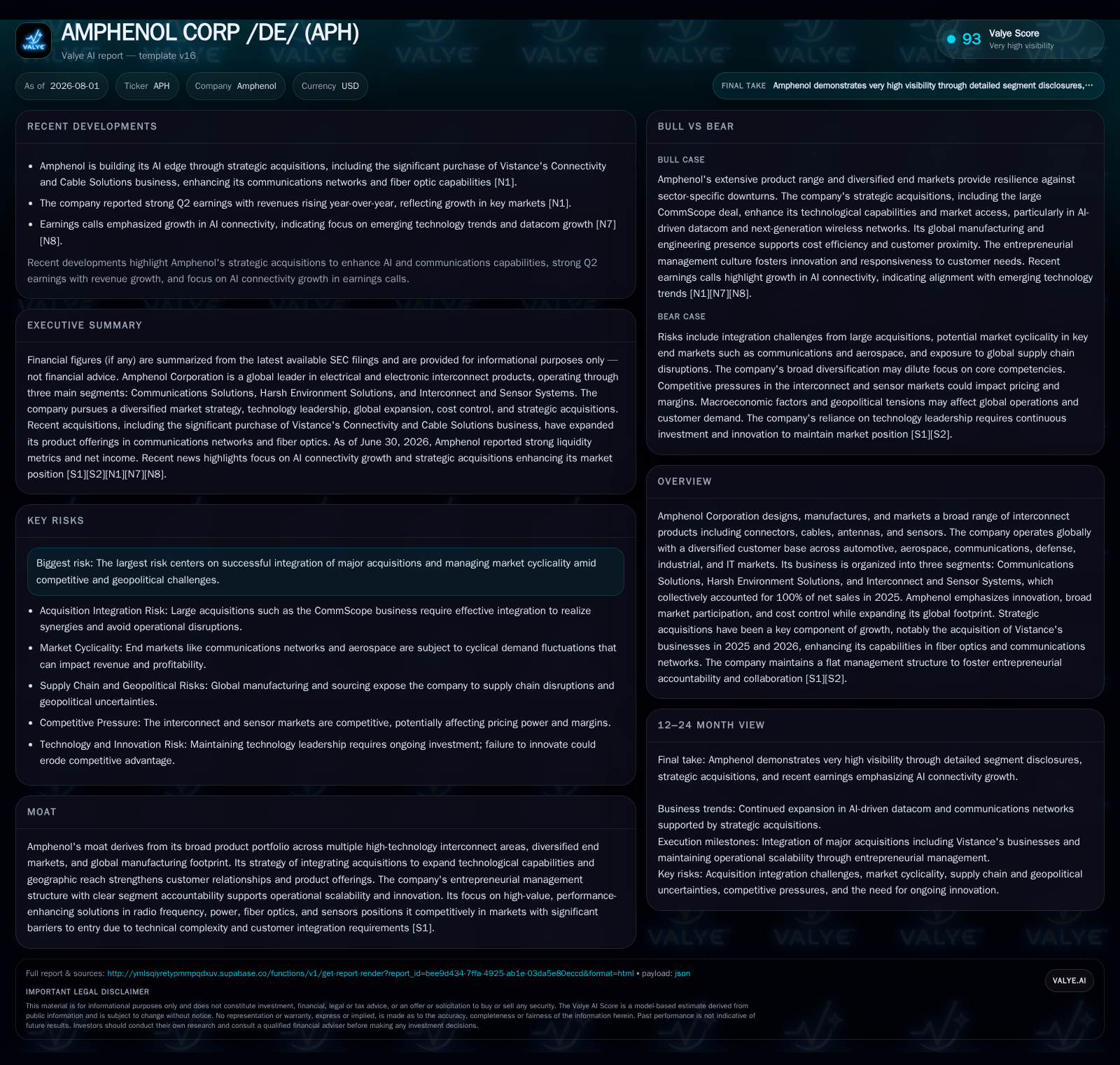
In its Q2 2026 filing, Amphenol Corporation showcased steady progress in integrating recent acquisitions, particularly those expanding its fiber optic and communications capabilities. The Communications Solutions segment saw revenue growth driven by rising demand for AI infrastructure components and enhanced high-speed data transmission products. The company’s three-segment business model, diversified across automotive, aerospace, communications, defense, industrial, and IT end markets, continues to provide revenue stability despite macroeconomic fluctuations. Operational metrics indicate improving order backlog and new product introductions supporting future growth. Risks persist around cyclical end-market demand and acquisition execution amid geopolitical challenges. Financially, Amphenol maintains strong liquidity with a healthy current ratio and manageable net debt to support strategic investments.
Q2 Results Underscore Acquisition Integration Momentum and AI-Driven Product Growth
Amphenol’s second-quarter 2026 filing revealed substantive momentum stemming from recent acquisitions—especially the integration of Vistance's fiber optic businesses finalized during 2025–2026—which continue to enhance the company's footprint in high-speed communications connectivity [S2], [S3]. This acquisition-driven expansion is directly linked to strength in the Communications Solutions segment where demand for AI edge connectivity products has surged amid accelerating deployment of data centers and telecommunication networks supporting artificial intelligence workloads [N2]. The Q2 results show improved order backlog levels alongside higher rates of new product introductions, signaling the commercial relevance of fiber optic interconnects combined with radio frequency (RF) components that underpin emerging AI infrastructure applications.
These operational updates reflect a strategic pivot towards capturing value from rapidly scaling digital ecosystems requiring complex interconnect systems capable of delivering high-speed data transmissions with low latency and power efficiency. Such developments place Amphenol in a favorable position relative to peers like TE Connectivity who also pursue diversified geographic exposure but may lack the same breadth of fiber optic-specific offerings brought by these acquisitions.
Business Model Insights: Segment Synergies Drive Revenue Mix Stability and Innovation
Amphenol's business is segmented into three distinct yet synergistic units: Communications Solutions (52% of 2025 net sales), Harsh Environment Solutions (26%), and Interconnect and Sensor Systems (22%) [S1]. Each segment targets differentiated end markets allowing portfolio balance that moderates cyclicality prevalent in sectors like automotive and aerospace. Communications Solutions specialize in connectors ranging from high-speed digital interfaces, RF components to fiber optics cables enabling next-generation telecom infrastructure.
Harsh Environment Solutions focus on ruggedized connectors and printed circuit assemblies designed for demanding applications such as aerospace and defense where reliability is paramount under extreme conditions. The Interconnect and Sensor Systems segment integrates sensor-based technologies with value-added cable assemblies catering to industrial automation and emerging IoT deployments. This tripartite segmentation supports an entrepreneurial management regime with clear general manager accountability designed to optimize operational leverage while fostering innovation critical for sustaining pricing power through complex customer solutions.
Competitive Dynamics: Peer Benchmarking Highlights Differentiated Product Breadth and Pricing Leverage
The electronic components sector features fierce competition among diversified manufacturers including Molex and TE Connectivity that compete primarily on product range, technology sophistication, geographic reach, and customer intimacy. Amphenol distinguishes itself through advanced ruggedized solutions targeting harsh environment niches coupled with expanding fiber optic interconnect expertise—a relatively higher-margin domain requiring technical complexity that limits new entrants.
Moreover, Amphenol's focus on custom value-added cable assemblies integrated with sensor systems provides additional pricing leverage compared to commodity connector producers [S1]. This combination supports defensible market positioning leveraging ongoing innovation cycles focused on radio frequency optimization for 5G/AI applications as well as enhanced manufacturing yields maintaining quality standards crucial for defense/aerospace customers
Growth Catalysts: AI Connectivity Expansion Fuels High-Value Interconnect Demand
Demand drivers underpinning Amphenol’s current growth trajectory are multi-faceted but notably include expansion of global telecommunications infrastructure encompassing 5G rollout and the fiber optic networks critical for ultra-fast data throughput necessary in AI compute frameworks [N3]. Complementary growth is achieved via automotive market penetration leveraging electrification trends including electric vehicles (EVs) that require specialized sensor-based interconnect assemblies.
Defense modernization programs also contribute by necessitating ruggedized sensor solutions optimized for tactical environments while industrial automation leverages IoT sensors integrated into assembly lines driving productivity enhancements. These secular tailwinds fuel continuous new product introductions supported by elevated R&D spending as a percentage of sales—metrics essential to validate continued technological relevance alongside organic ramp-up plus accretive contributions from acquisitions enhancing portfolio breadth systematically rather than piecemeal.
Operational Risks: Navigating Cyclicality and Integration Uncertainty Amid Geopolitical Tensions
Despite structural growth drivers, Amphenol faces inherent industry risks chiefly linked to end-market cyclical fluctuations prominently within automotive production volumes sensitive to global economic conditions [S1]. Additionally, integration execution risk remains significant given the scale of recent acquisitions such as Vistance businesses which must be assimilated efficiently to realize anticipated synergies without disrupting innovation pipelines or customer service levels.
Competitive pressures may also compress pricing particularly if raw material costs surge or supply chains face disruption amidst geopolitical trade tensions affecting component sourcing or manufacturing footprint optimization. Currency exchange fluctuations further complicate earnings stability given Amphenol’s extensive global operations requiring prudent hedging strategies alongside rigorous quality control measures mandatory in sectors like aerospace where failure tolerance approaches zero.
Near-Term Milestones: Order Book Trends, Product Launches, and Acquisition Closing Watchpoints
Critical upcoming indicators that will substantiate or challenge the current strategic thesis include monitoring order backlog changes reported in following quarters reflecting demand sustainability beyond seasonal patterns [S2]. Concurrently, the velocity of new product releases—especially those expanding AI connectivity capabilities or entering fiber optics adjacencies—should provide tangible signals regarding innovation pipeline health aligned with market needs.
Additionally, management commentary on acquisition-related integration milestones including cost synergy achievement timelines represents key transparency metrics investors typically track closely for validation that capital deployment translates effectively into profitable franchise extensions rather than merely dilutive overhead burden increments.
Financial Profile Discussion: Balance Sheet Positioning Supports Strategic Investment Amid Robust Margins
As of June 30, 2026, Amphenol reported a strong liquidity position with $4.7 billion in cash equivalents against $9.4 billion in current liabilities yielding a current ratio near 1.89—consistent with healthy short-term solvency [F1]. Total debt stood at approximately $17.2 billion with net debt after cash at roughly $12.4 billion illustrating ongoing leverage utilization predominantly directed toward funding strategic acquisitions expanding technological offerings.
Operating income margins remain robust per latest filings reflecting efficient cost control paired with favorable product mix concentrated in higher-margin segments such as Communications Solutions featuring fiber optics assemblies alongside proprietary sensor integrations [S2]. This margin profile underpins the company’s capability to invest further into R&D initiatives tailored toward next-generation connectivity platforms while balancing disciplined capital allocation prioritizing deleveraging flexibility when market conditions improve.
Disclaimer: This analysis is based solely on publicly available information including recent SEC filings and industry reports up to July/August 2026. It does not constitute investment advice or an offer to buy or sell securities.
Disclaimer: This is research-only, informational analysis and not investment advice. It may include AI-generated interpretation and general industry context. Always verify important details using primary sources.

Comments