
Tompkins Financial Strengthens Community Banking Model with Diverse Services and Stable Asset Quality
The latest quarterly update highlights Tompkins Financial Corp's steady performance amid evolving interest-rate and economic conditions.
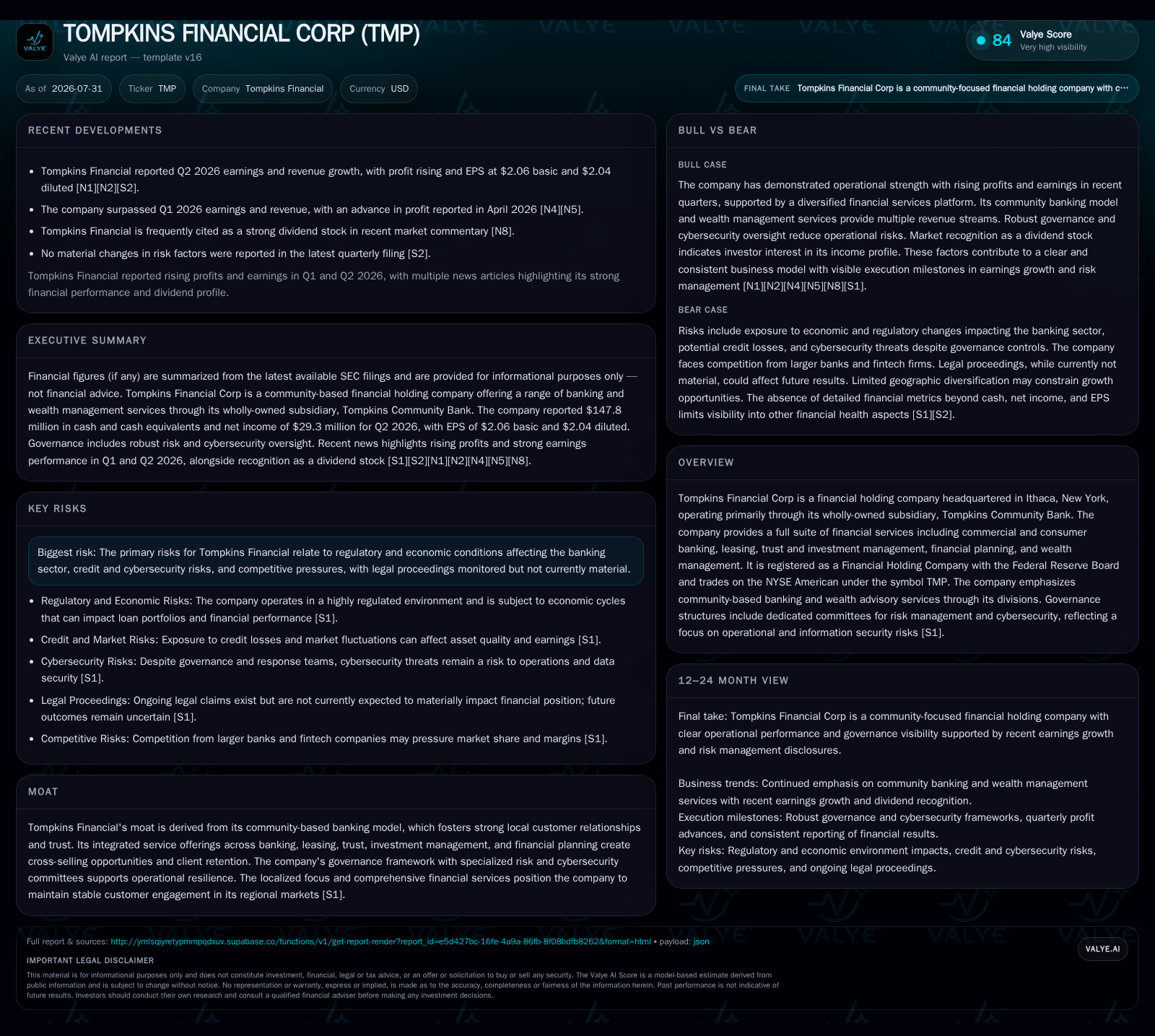
Tompkins Financial Corp reported solid second-quarter results supported by its community-focused banking approach and diversified financial services. The company's integrated business model spanning commercial and consumer loans, wealth management, leasing, and trust services enables cross-selling and stable client engagement. Effective risk governance structures, including cybersecurity oversight, support resilience amid regulatory and economic challenges. Key risks remain tied to credit quality and competitive pressures in the regional banking sector. Monitoring loan portfolio growth, net interest margin trends, and fee income contributions will be critical to assessing ongoing execution.
Recent Operating Update
A strategic pivot was evident with the sale of Tompkins Insurance Agencies (TIA) in late 2025 for $223 million, reflecting a refocus on core banking, asset management, leasing, and trust services which constitute the primary revenue streams today [S7]. This divestiture allowed redeployment of capital towards higher-yield assets.
Business Model Overview
Tompkins Financial operates principally through Tompkins Community Bank, leveraging its status as a registered financial holding company. Its revenue generation hinges on net interest income derived from lending activities funded by a robust deposit base characteristic of community banks valued for local relationships [S1]. In addition to traditional commercial and consumer loans, it derives meaningful fees from wealth management advisory services provided by its Tompkins Financial Advisors division—covering investment management, trust and estate administration, tax planning, as well as leasing arrangements for client equipment needs
This integrated model facilitates cross-selling opportunities that deepen client engagement, enhance retention rates, and diversify revenue to buffer against cyclicality typical in lending portfolios. The bank's community-centric ethos helps sustain relatively stable deposit inflows that fund asset deployment efficiently.
Industry Structure and Competitive Position
As a regional community bank headquartered in Ithaca, New York, Tompkins operates within an industry facing increasing pressure from larger national banks expanding into regional markets as well as fintech disruptors enhancing digital lending platforms. However, its moat lies in localized knowledge and trust cultivated through personalized service along with a broad financial product suite preventing customer attrition.
Peers such as Regions Financial Corporation or M&T Bank operate at much larger scales but often compete for overlapping geographic or market segments. Tompkins differentiates through deep local ties and an emphasis on holistic client solutions encompassing banking plus advisory services. Its business holding company structure requires adherence to Federal Reserve regulations mandating capital adequacy buffers which it has maintained prudently [S1].
Growth Drivers
Key growth drivers include expansion of the loan portfolio fueled by regional economic activity; enhancements in net interest margin achieved by managing duration gaps between assets and liabilities amid variable rate environments; increased fee income via wealth management product uptake; technology investments aimed at improving customer experience; and potential acquisitions of smaller financial entities to broaden regional footprint.
While no material asset quality deterioration was noted recently nor significant loan loss provisioning increases flagged [S2], continued vigilance is needed especially given inflationary pressures feeding into small business stress.
Interest rate risk presents both opportunities for margin improvement as well as re-pricing exposures that require careful asset-liability management [S1]. Regulatory demands impose constraints on operational flexibility including capital requirements while cybersecurity threats mandate sustained investment in detection and response capabilities—a focus area evidenced by formal committees charged with enterprise risk management oversight
Competition from both larger players with scale advantages and nimble fintech entrants could pressure pricing power on loans or deposit gathering capability.
Finally, legal proceedings exist but are not currently expected to materially impact financial condition based on disclosures [S14].
What to Watch Next
Investors should observe quarterly trends in loan originations relative to deposit growth rates to assess funding stability versus asset deployment effectiveness. Tracking changes in net interest margin will reveal how effectively Tompkins leverages rising rate backdrops.
Fee income trajectory from wealth management initiatives can signal diversification success beyond core lending reliance.
Efficiency ratios driven by cost control relative to revenue growth will indicate operational scalability potential.
Capital adequacy metrics will remain important given regulatory scrutiny in this sector.
Lastly, any updates from governance committees on cybersecurity readiness could serve as early indicators of mitigation efficacy against emergent threats.
Financial Profile Discussion
At quarter-end June 30, 2026, Tompkins held approximately $148 million in cash and equivalents providing ample liquidity for day-to-day operations and potential opportunistic investments or loan funding requirements [F1]
Net income for the calendar year ended December 31, 2025 stood at $161 million indicating respectable profitability aligned with reported top-line growth milestones [F1]. The sale of TIA notably streamlined operations reducing exposure outside core competencies while freeing up capital for higher yielding securities reinvestment—strategically positioning the balance sheet for net interest margin enhancement amidst an evolving macroeconomic environment [S7].
Operating expense discipline combined with controlled credit loss provisioning supports sustained pre-tax profitability though continuous monitoring is required given underlying economic sensitivity characteristic of regional community banks.
This analysis is based on information available as of July 31, 2026. It aims to provide an informed view into Tompkins Financial’s business model fundamentals within the context of regional community banking industry dynamics without offering investment advice.
Disclaimer: This is research-only, informational analysis and not investment advice. It may include AI-generated interpretation and general industry context. Always verify important details using primary sources.

Comments