
NRUC’s Member-Aligned Cooperative Finance Focuses on Rural Electric Utilities Amid Concentrated Credit Risks
National Rural Utilities Cooperative Finance Corporation maintains its niche as a cost-based lender to rural electric cooperatives, balancing steady loan portfolio growth with credit concentration and liquidity management.
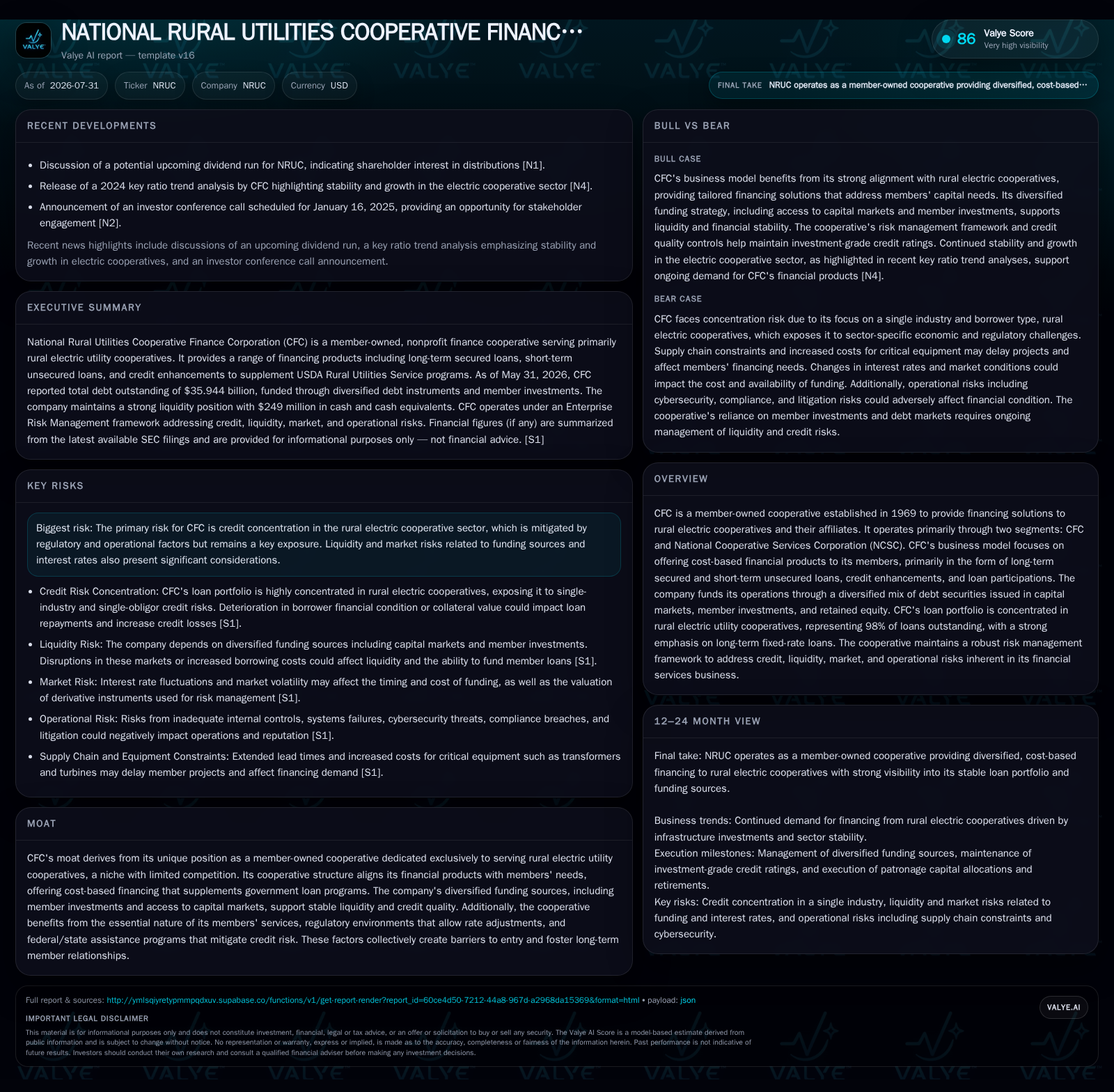
NRUC operates as a member-owned cooperative focused primarily on providing long-term fixed-rate loans and credit enhancements to rural electric utility cooperatives, representing 98% of its loan portfolio. Recent filings reveal modest growth in loans outstanding alongside disciplined capital allocations through patronage capital retirements designed to align earnings with members. The company's cooperative governance model and diversified funding structure bolster resilience, although its singular industry focus poses inherent credit concentration risk. Robust liquidity management and diversified debt issuance support stable operations despite evolving market and regulatory challenges.
Recent Operating Update and Strategic Capital Allocations
In July 2026, the Board authorized the retirement of $62 million in allocated net earnings to members [S1]. This payout represents half of FY2026's patronage capital allocation alongside a portion held from earlier years per policy. Such retirements demonstrate NRUC’s commitment to returning value consistent with cooperative principles while retaining sufficient capital internally for ongoing obligations.
Business Model Nuances: Cooperative Governance Anchoring Member-Aligned Lending
NRUC operates as a member-owned cooperative association dedicated exclusively to serving rural electric utility cooperatives and their affiliates [S1]. Its lending solutions are tailored primarily toward financing electric distribution, generation, transmission systems, and related infrastructure upgrades. Core products include:
- Long-term secured loans (up to 35 years) mainly fixed-rate,
- Short-term unsecured lines of credit,
- Credit enhancements via letters of credit and guarantees.
The cooperative structure aligns financial products with member needs by providing cost-based financing rather than seeking profit maximization. This is managed through the annual allocation of net earnings into patronage capital credited back to members proportionally based on their borrowing activity, helping reduce net financing costs over time [S1].
Funding sources blend capital market issuances — including secured collateral trust bonds and unsecured medium-term notes — with member investments that comprise approximately 12% of total debt outstanding (over $4.3 billion as of May 31, 2026) [S7][F1]. This diversified capital structure supports liquidity while reducing reliance on any single funding channel.
Industry Structure and Competitive Positioning
Within the niche cooperative finance sector serving rural utilities, NRUC stands out for its scale and specialized focus. It complements federal government programs like the USDA's Rural Utilities Service (RUS) by providing supplementary financing where RUS loan limits or conditions do not suffice [S1].
Competition is limited due to NRUC’s unique member-owned model combined with regulatory environments favoring electric cooperatives’ rate-setting autonomy in most states. This allows borrowers flexibility in passing through cost increases without regulatory delays – a key factor supporting credit stability [S8]. Moreover, their exclusive territories insulated from investor-owned utilities’ competition contribute to operating resilience.
Peer groups include government-backed lenders such as RUS direct programs, commercial banks lending selectively into rural utilities, smaller agricultural credit associations, and capital markets investors holding collateral trust bonds issued by such cooperatives.
NRUC’s integrated relationship through its subsidiary NCSC expands offerings into project finance for renewables and telecommunications infrastructure among rural members [S6], broadening strategic reach without diluting core electric lending expertise.
Growth Drivers: Infrastructure Needs and Regulatory Tailwinds
Underlying demand stems from ongoing infrastructure modernization efforts among member cooperatives requiring funding for grid reliability enhancements, technology upgrades (smart metering), and renewable integration projects. Government incentives for rural broadband expansion funded partly via NCSC telecom loans also represent emerging growth vectors [S6].
Demographic trends toward sustained rural population activity underpin steady electricity usage levels essential for the sector’s revenue base. Additionally, federal/state assistance programs mitigating credit risk during disasters fortify borrowers’ repayment capacity under stress scenarios.
Regulatory environments that allow rate flexibility enable borrower margins adequate for servicing NRUC loans—an essential stability factor that differentiates this sector from broader utility lending subject to stricter public utility commissions.
Risks and Watchpoints: Concentration and Liquidity Management
NRUC bears significant credit concentration risk given that roughly 98% of loans anchor in the rural electric utility cooperative sector with limited diversification across industries or borrower types [S17].
Interest rate risk emerges from the mismatch between predominantly long-term fixed-rate loans extended to members and variable short-term borrowings used alongside hedging strategies such as interest rate swaps [S20][S16]. Effective derivative use is critical in managing net interest margin stability.
Finally, operational risks tied to underwriting accuracy, changes in regulatory frameworks affecting cooperative financing structures, or downturns in borrower financial health remain cyclical watchpoints given economic sensitivities in rural regions.
What To Watch Next
Key upcoming markers include execution transparency around patronage capital retirement cycles and any shifts in board policies impacting allocations or retained equity balances scheduled over coming fiscal years [S1]. Loan portfolio growth trends particularly within renewables-linked project financing through NCSC may materially affect revenue composition if scaled substantially.
The pace and volumes of new debt issuance across different instruments versus maturing liabilities will provide insights into liquidity management effectiveness amid evolving macroeconomic conditions impacting interest rates.
Finally, assessing any material changes or enhancements in borrower credit ratings methodologies or allowances for credit losses will indicate evolving internal risk oversight quality [S8][S23].
Financial Profile Discussion
As of May 31, 2026, NRUC reported total debt approximating $28.3 billion against cash plus equivalents near $249 million—a leverage profile consistent with its function as a specialized lender facilitating large-scale infrastructure finance [F1]. Net cash outflow reflects typical asset-liability matching challenges given long-duration assets funded partially by shorter-term debt instruments.
Loan portfolio expansion drives incremental debt issuances evidenced by a $1.2 billion increase over prior twelve months [S11], aligned with members’ infrastructure spending cycles.
Member investment contributions remain a meaningful component of stable funding at ~12%, reflecting strong alignment between borrower-membership base participating directly in NRUC’s indebtedness instruments rather than purely external capital market investors [S7][F1].
Overall liquidity metrics indicate prudent balance sheet stewardship necessary within an industry exposed inherently to single-sector cyclicality but underpinned by extensive government-backed support programs.
Disclaimer
This analysis is intended solely for informational purposes based on publicly available filings as of July 2026. It does not constitute investment advice or research views. Readers should conduct independent due diligence before forming conclusions regarding the company.
Disclaimer: This is research-only, informational analysis and not investment advice. It may include AI-generated interpretation and general industry context. Always verify important details using primary sources.

Comments