
Artisan Partners Strengthens Autonomy Model and Navigates Fee Pressure in Q2
Q2 2026 results highlight Artisan’s resilience through autonomous investment teams amid volatile asset flows and fee compression.
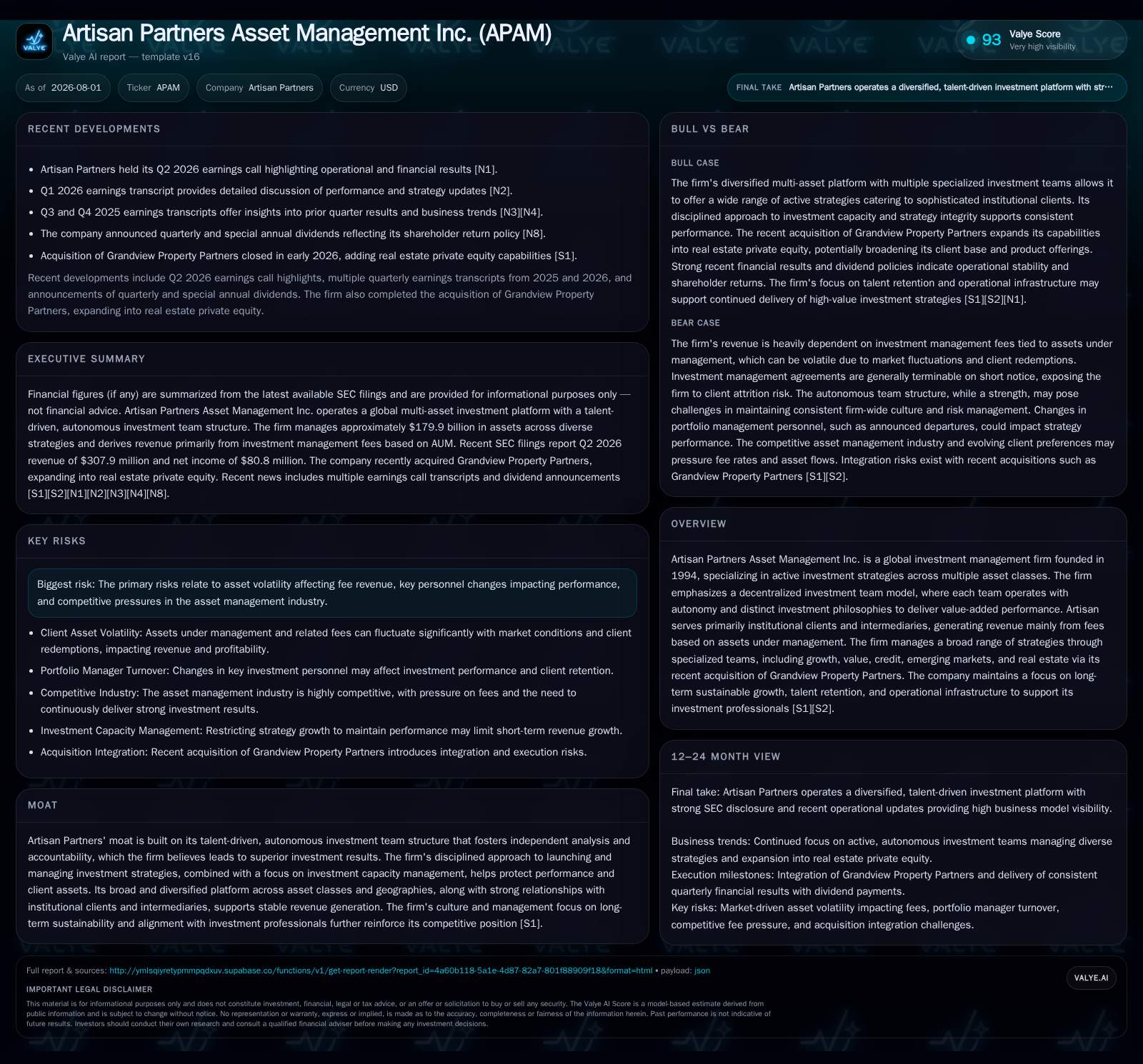
Artisan Partners reported a mixed Q2 2026, marked by fluctuating assets under management (AUM) impacted by market volatility and client flows, which in turn pressured fee revenues. Despite these headwinds, the firm’s decentralized investment team model continues to foster differentiated active strategies with strong client retention, supporting sustainable revenue streams. Capacity management and a recent real estate acquisition underscore Artisan’s disciplined growth focus. Key risks remain tied to talent retention and broader industry fee compression, but operational execution and investment autonomy remain core competitive strengths.
Q2 Operational Results Signal Resilience Amid Market Fluctuations
In its Q2 2026 filing, Artisan Partners reported total assets under management declined notably due to unfavorable market conditions combined with net client outflows [S2][S3]. This contraction directly pressured management fee revenue, the firm's primary income source. However, despite these headwinds, Artisan maintained performance fee contributions driven by select strategies outperforming benchmarks. The volatile asset environment underscores how macroeconomic shifts promptly reverberate through asset managers’ fee bases. Artisan's reported data suggest that while near-term revenue was challenged by the external environment, the company’s diversified multi-asset platform demonstrated relative resilience by limiting larger-scale client withdrawals [S2]. Sustained or improved net inflows in coming quarters or consistent investment performance relative to peers would confirm recovery and pricing power amidst fee compression.
Autonomous Investment Teams Define Artisan’s Business Model Advantage
Artisan’s distinctive decentralized model—in which independent specialized investment teams operate with significant autonomy—is foundational to its competitive moat. Each team develops tailored investment philosophies and processes responsible for their respective strategies’ performance outcomes [S1]. This structure fosters accountability and encourages differentiated active management approaches that appeal to sophisticated institutional clients seeking value-added returns beyond index tracking products. The firm’s commitment to empowering these teams promotes not only superior investment results over time but also aids talent retention—a critical asset in an intensely competitive labor market for portfolio managers.
Moreover, Artisan strategically manages investment capacity within each strategy to avoid diluting returns as new investor capital accumulates. The company is willing to close or limit new investments when capacity thresholds approach levels that could harm performance [S1]. This discipline reflects the firm’s prioritization of long-term sustainable returns over short-term asset growth. Empirical KPIs such as portfolio managers’ tenure lengths and turnover rates are especially important indicators of insulating the firm from disruptive personnel changes that historically have led to client redemptions.
Competitive Landscape: Peer Benchmarking of Fee Pressure and Team Structure
Within the active asset management sector, Artisan stands alongside firms like T. Rowe Price and Janus Henderson sharing similar emphases on autonomous team models designed for differentiated alpha generation. Compared with BlackRock—whose scale benefits passive strategies—Artisan’s more boutique-like platform targets niche active segments less exposed to near-term passive fee erosion but still vulnerable to broad industry-wide fee compression trends. The growing shift toward lower-cost alternatives across the industry places pressure on traditional fee rates per AUM; however, Artisan's focus on high-value active strategies partially insulates it through performance fees linked directly to excess returns.
Distribution remains heavily intermediary-driven at Artisan, targeting institutional clients who typically seek long-term partnership arrangements rather than transactional engagements—this client segmentation further supports more stable cash flows versus retail-driven competitors facing higher churn risk.
Growth Catalysts: Capacity Discipline and New Strategy Initiatives
Artisan’s growth trajectory leverages disciplined capacity management, ensuring existing strategies maintain robust performance profiles while new strategy launches expand addressable markets without diluting return potential [S1]. The recent strategic acquisition of Grandview Property Partners enhances Artisan's real estate capabilities—a growing asset class for institutional investors looking beyond liquid equities and fixed income into alternatives with income stability features [S16].
Such acquisitions complement organic growth initiatives by diversifying revenue streams and increasing platform breadth without sacrificing the culture of autonomy cherished within individual teams. Positive net inflows post-acquisition and timely mandate wins will serve as confirmations for sustained growth prospects.
Risk Factors Highlight Talent Retention and Market Volatility Challenges
Artisan acknowledges key risks concentrated around human capital dependency; portfolio manager departures have previously triggered notable client outflows from affected strategies [S1][S10]. Given the firm's decentralized nature, individual teams’ results significantly impact overall firm AUM and fee income stability. Competition for experienced portfolio managers is intense—with alternative workplaces like multi-manager platforms creating additional recruiting challenges. The firm's succession planning efforts partially mitigate this risk but do not eliminate inherent exposure.
Market volatility also remains a pervasive risk factor impacting assets under management downwardly during equity drawdowns or credit-market stress scenarios. Such fluctuations reduce the aggregate fee pool and can complicate revenue forecasting.
Operational risks tied to regulatory compliance intensify as the company expands geographically and product-wise, requiring ongoing investments in infrastructure—failure here could increase compliance costs or reputational damage risks.
Watching The Road Ahead: Key Momentum Indicators for Income Stability
Investors should monitor Artisan’s quarterly reported net inflows/outflows closely as an early indicator of client confidence amid volatile markets. Stability or improvement in net flows would validate investment team effectiveness at retaining assets despite external pressures. Additionally, tracking portfolio manager turnover rates would shed light on potential disruptions within teams critical to maintaining performance leadership.
Distribution channel evolution metrics—specifically intermediary research views—and new strategy launches or mandates will provide signals on expanding reach despite challenging broader intermediate landscape dynamics.
Monitoring fee revenue per AUM trends will help clarify whether Artisan can sustain effective pricing power amid persistent industry-wide compression pressures.
Financial Profile Discussion: Recent Earnings Connect Operating Execution with Profitability
Operating expense ratios appear disciplined reflecting efficient support for autonomous teams without excessive overhead expansion proportional to AUM fluctuations. Maintaining this leverage over future earnings cycles will be crucial as top-line growth encounters headwinds from fee compressions prevailing throughout asset management.
Overall, financial execution aligns cohesively with Artisan's strategic emphasis on stable organic growth supported by investment autonomy and capacity discipline rather than aggressive scale expansion or shareholder return maximization currently.
This analysis synthesizes publicly available filings as of July 31, 2026 ([S1], [S2], [S3]) alongside established industry frameworks without providing investment research views or forecasts.
Disclaimer: This is research-only, informational analysis and not investment advice. It may include AI-generated interpretation and general industry context. Always verify important details using primary sources.

Comments