
Dominion Energy's Strategic Position Through Merger Uncertainty and Regulatory Dynamics
Dominion Energy reported steady regulated utility operations in Q2 2026 amid ongoing merger approval challenges and evolving environmental policy impacts.
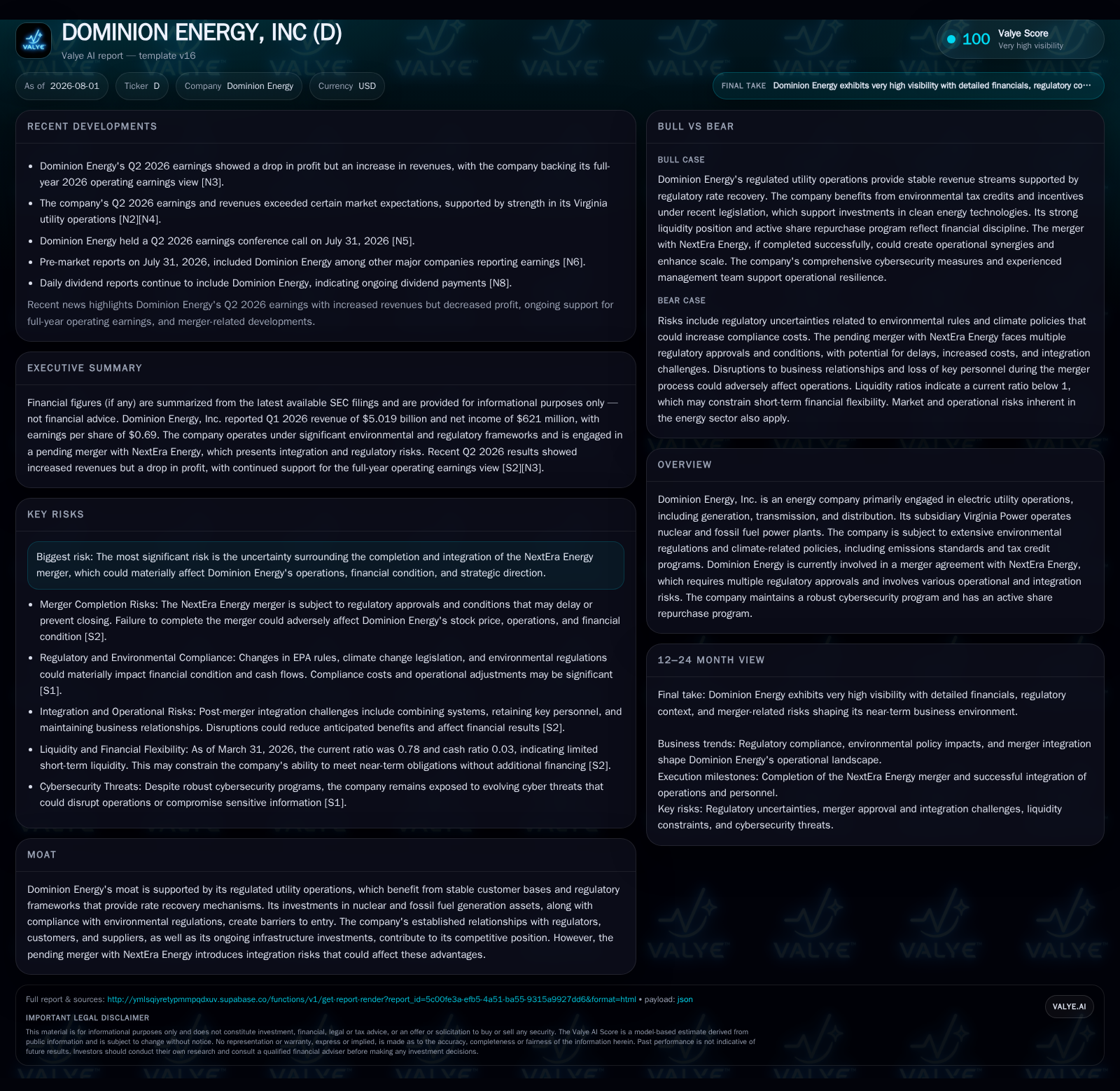
In its July 2026 quarterly filing, Dominion Energy demonstrated operational resilience within its core regulated electric utility business, characterized by stable electricity sales volumes and continued investment in infrastructure. However, uncertainty around the regulatory approval and integration of its pending merger with NextEra Energy presents a significant near-term risk that could alter its strategic direction. Additionally, shifting environmental regulations and carbon emissions standards remain critical factors influencing future cost structures and capital allocation. Dominion's stable rate-regulated cash flows and disciplined capex programs support growth potential despite these headwinds.
Q2 Operating Performance Under Regulated Utility Stability
Dominion Energy's latest quarterly report for Q2 2026 highlights a continuation of core stability within its regulated electric utility operations. Key performance indicators such as megawatt-hours (MWh) sold remain consistent quarter-over-quarter, underscoring steady customer demand across residential, commercial, and industrial segments governed by cost-of-service frameworks. This steady demand underpins predictable revenues generated primarily through approved rate cases that allow recovery of operating expenses plus an authorized return on its regulated rate base consisting of generation (notably nuclear and fossil fuel assets), transmission, and distribution infrastructure [S2][N2]. Despite broader market pressures including inflationary cost trends elsewhere in the economy, operating and maintenance expenses have been managed within regulatory allowance ceilings without shifting to customers prematurely. This maintained operational discipline validates Dominion’s foundational strength amidst near-term uncertainties surrounding external regulatory events [N3]. The company's systematic investments help preserve system reliability metrics such as SAIDI (System Average Interruption Duration Index) and SAIFI (System Average Interruption Frequency Index), which are central to maintaining regulatory goodwill and consumer trust.
Merger Approval Process: Regulatory Hurdles and Integration Risk Implications
The most consequential development challenging Dominion's outlook remains the pending merger agreement with NextEra Energy. The July filings reaffirm the multifaceted regulatory landscape governing this transaction: approvals are required not only from federal bodies such as the Federal Energy Regulatory Commission (FERC) and the Nuclear Regulatory Commission (NRC), but also multiple state public utility commissions including Virginia, North Carolina, and South Carolina [S2][S3]. Each entity evaluates the merger through lenses of competition impact, grid reliability, consumer protection, and environmental commitments. Given NextEra’s prominence as a large renewable energy developer juxtaposed with Dominion’s traditionally fossil/nuclear-heavy asset base, regulators may impose significant conditions ranging from divestitures to operational safeguards.
Notably, the merger agreement provisions permit NextEra Energy to accept potentially burdensome conditions without unilateral right for Dominion to halt closing absent consent—introducing integration risk even if approvals are granted. Precedents in utility M&A illustrate that protracted regulatory reviews often inject uncertainty that can affect both companies' strategic investments and raise execution costs [S2]. This complexity underscores why sustained operational excellence in standalone regulated businesses is critical while awaiting final adjudication.
Foundations of Dominion’s Revenue Model: Cost-of-Service Regulation & Rate Base Growth
Dominion's business model centers on delivering electricity under cost-of-service regulation frameworks. Revenues derive largely from volumetric sales measured in MWh combined with allowed returns on a capital-intensive rate base encompassing power plants (primarily nuclear & fossil), transmission lines, substations, and distribution networks serving end-use customers [S1]. Utilities maintain steady cash flow by filing periodic rate cases with regulators who authorize rates sufficient to recover prudently incurred costs plus compensation aligned with regulated return on equity targets.
This model promotes financial predictability because fluctuations in commodity fuel costs or demand shifts are typically mitigated through tariff adjustments or fuel cost pass-through mechanisms embedded in rate structures. Also beneficial is the diversification across generation types reducing exposure to single-fuel volatility risks. Continued capital expenditures expand the regulated rate base increasing future allowed returns while investments in grid modernization improve system resilience—a key differentiator versus merchant power competitors who face more volatile pricing dynamics.
Environmental Policies & Compliance: Navigating Carbon Emissions Standards and Renewables Mandates
Dominion faces evolving environmental regulation landscapes that shape capital deployment strategies. The company’s filings detail recent EPA initiatives including tightening mercury & air toxics standards with continuous emission monitoring requirements alongside federal proposals oscillating between strengthening then loosening CO2 emission guidelines for fossil-fired generation [S1]. State-level renewable portfolio standards add regional compliance layers driving incremental renewables integration alongside retirement plans for older coal plants.
Such regulations increase compliance costs but also align with Dominion’s publicly stated commitment to net-zero greenhouse gas emissions by 2050—necessitating accelerating investment in decarbonization technologies such as carbon capture or enhanced nuclear capabilities. While relief from certain federal emissions rules was proposed mid-2025, the overall trend remains toward stricter air quality standards which require ongoing adaptation. Compliance expenditures must be carefully balanced against regulatory-approved recovery to avoid margin compression.
Industry Landscape: Peer Generation Mix and Regulatory Positioning Relative to Competitors
Relative to peers like NextEra Energy which leads in wind/solar development within a vertically integrated regulated framework, Dominion retains a more traditional generation mix emphasizing nuclear baseload complemented by fossil fuel plants. This difference influences each company’s pathway through decarbonization challenges and regulatory scrutiny. Peers such as Duke Energy or Southern Company share similar exposure to regulatory rate case cycles but vary in regional policy environments affecting renewable penetration velocity.
These peers illustrate critical trade-offs between scale economies achievable through asset diversification versus specialized renewable expertise potentially unlocking incentive-rich markets. Dominion's established relationships with multiple state commissions foster reasonable rate case outcomes supporting constructive capital return opportunities compared to less regulated independent power producers or merchant generators subject to market price risks.
Growth Catalysts: CapEx Programs, Grid Modernization, and Renewable Integration Momentum
Capital expenditures remain a potent lever for Dominion's growth trajectory by incrementally increasing its regulated rate base size—thus enlarging future allowed earnings capacity under cost-of-service tariffs. The company continues investing in grid modernization projects targeting enhanced reliability metrics (e.g., reduced SAIDI/SAIFI) which regulators favorably consider during rate case deliberations [S1][S2]. Federal tax incentives via clean energy credits catalyze economically viable renewables additions bolstering alignment with environmental goals while preserving shareholder value.
Moreover, expansion into advanced transmission capabilities supports integration of distributed energy resources—essential for meeting grid reliability amid increasing electrification trends. These growth drivers are cautiously managed within capital discipline norms ensuring sustained operating income margins while navigating potentially fluctuating regulatory ceilings.
Risks Ahead: Regulatory Delays, Merger Uncertainty & Environmental Rulemaking Effects
Key risks prominently feature protracted approval processes for the NextEra merger which could either delay anticipated synergies or trigger costly concessions impacting pro forma economics [S2][S3]. A failure or abandonment scenario would require strategic recalibration potentially straining investor sentiment.
Simultaneously, tightening environmental compliance mandates risk elevating operating and capital costs not fully recoverable if regulators tighten allowed cost parameters unexpectedly. While Dominion has bolstered cybersecurity measures to protect asset integrity amidst heightened threat environments—a prudent operational safeguard—the broader risks from natural disasters or commodity price swings persist.
The intersection of these uncertainties demands close monitoring of regulatory feedback timelines and adaptive capital planning calibrated against confirmed policy shifts.
"Looking Ahead": Key Milestones for Merger Approvals, Operational Metrics & Regulatory Filings
Dominion’s near-term outlook hinges on several binary milestones: formal decisions by FERC/NRC on merger consent; state utility commission rulings especially Virginia’s; issuance of next comprehensive rate case orders impacting revenue trajectories; as well as announcements regarding EPA rule finalization affecting permitted emission levels [S2][S3]
Tracking system peak demand trends alongside MWh sales growth will provide signals about enduring electricity consumption patterns supporting revenue stability. Likewise, any changes in capital spending cadence reflect adjustment strategies responding to both merger timeline clarity and evolving climate policies.
Clear communication of these developments will be pivotal in investors' ability to validate assumptions about Dominion's strategic positioning over the coming quarters.
Financial Profile Discussion: Leverage Structure Supports Strategic Flexibility but Requires Monitoring
While substantial indebtedness provides funding capacity necessary for ongoing CapEx programs critical to expanding the regulated rate base, it requires vigilant management especially if unforeseen integration costs arise post-merger or if regulatory delays constrain cash flow accretion profiles.
In sum, Dominion's financial structure sustains flexibility but underscores the importance of successful deal closure and stable operating performance to maintain investment-grade credit metrics.
This analysis synthesizes available public filings up to July 31, 2026 emphasizing how Dominion Energy balances a stable utility business foundation against externalities driven by merger dynamics and environmental regulatory evolution without extending beyond confirmed evidence sources [S1][S2][S3][F1][N2][N3]. It avoids speculative forecasts focusing instead on identifying concrete operational drivers and risks shaping its near- to medium-term trajectory.
Disclaimer: This is research-only, informational analysis and not investment advice. It may include AI-generated interpretation and general industry context. Always verify important details using primary sources.

Comments