
Live Nation's Venue Network and Sponsorship Growth Drive Revenue Amid Execution Risks
Live Nation’s integrated live entertainment platform sustains momentum through expanding venue control and rising sponsorship, while operational and leverage risks linger.
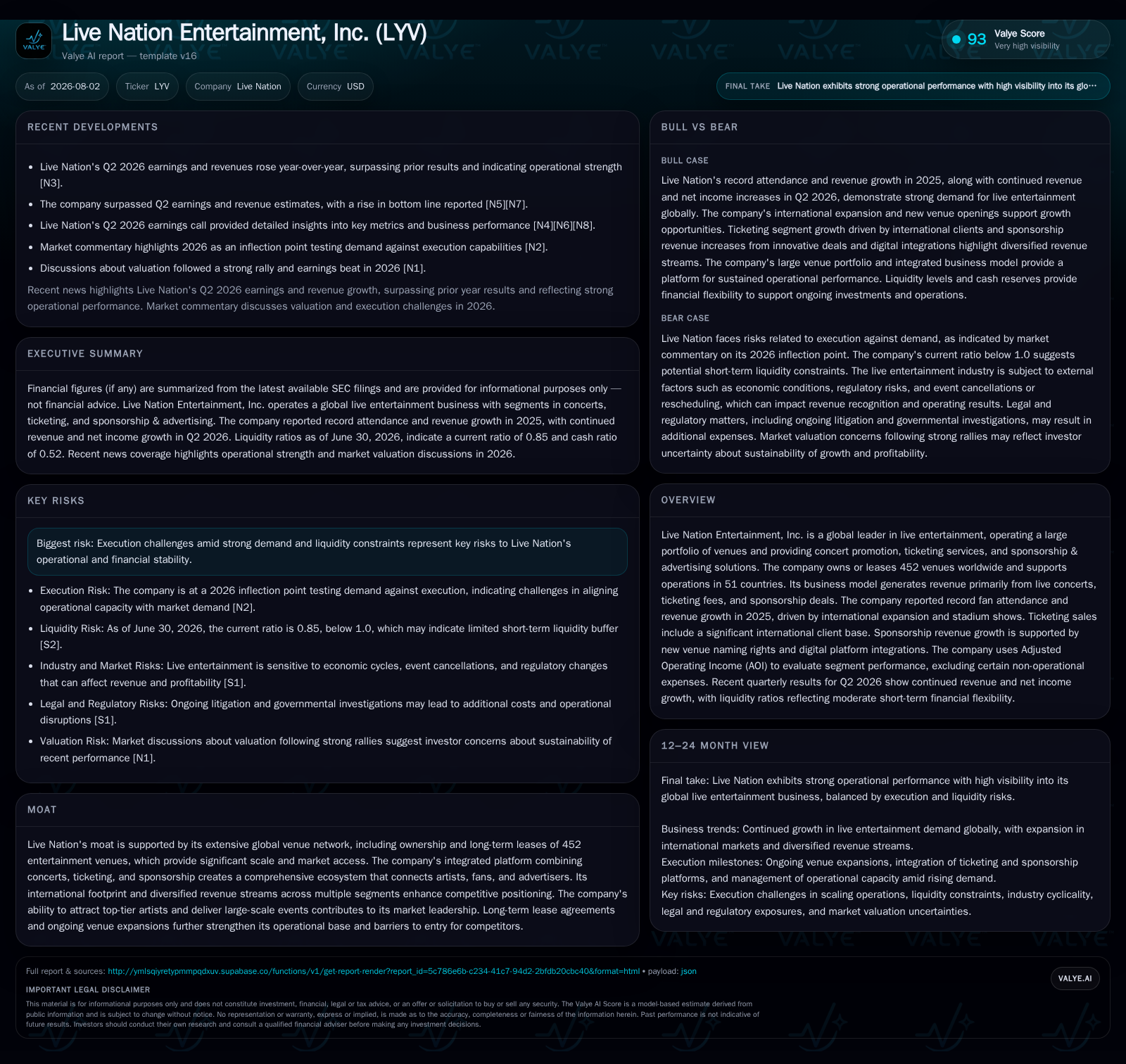
Live Nation Entertainment reported continued revenue and net income growth in Q2 2026 driven by robust concert attendance and growing sponsorship revenues. The company’s differentiated business model combines extensive venue ownership and leasing with concert promotion and a dominant ticketing platform, creating a high-barrier ecosystem connecting artists, fans, and advertisers. International expansion and naming rights deals fuel sponsorship income, but increasing operational complexity amid strong demand presents execution risks. Financially, the firm carries significant debt but maintains liquidity supported by cash reserves and revolving credit facilities, navigating covenant requirements. Key upcoming indicators include event scheduling success, sponsorship renewal pace, and debt covenant compliance.
Recent Operating Update: Sustained Momentum during Execution Complexity
ulfillment with cost control.
Business Model: Integrated Live Entertainment Ecosystem
Live Nation operates a vertically integrated business model encompassing concert promotion, ticketing services via Ticketmaster, venue ownership or leasing, and sponsorship & advertising. As of December 31, 2025, it owns or leases 452 venues globally with operations spanning 51 countries [S1]. This extensive venue control not only unlocks direct revenue streams from events and hospitality (e.g., concessions) but also secures premium placement for advertising partnerships including naming rights — an increasingly important revenue driver. Ticketing fees arise as variable commissions on gross transaction value (GTV) from sales processed on its digital platforms worldwide.
Revenue mechanics hinge on several levers: gross ticket sales volume influenced by artist bookings and fan demand; average ticket price where premium experiences or large stadium events elevate spend; sponsorship agreements tied to venue branding or event-level advertising; plus ancillary income such as merchandise or concessions at venues. Margins vary across segments—ticketing platforms enjoy scalable fee income with relatively fixed tech costs whereas venues require ongoing CapEx investments but benefit from scale efficiencies.
Customer profiles include concertgoers paying directly for tickets, advertisers purchasing exposure across venues and events, corporate sponsors securing rights for marketing activation, and artists contracted for performances. Contracts with artists often involve advance guarantees balanced against event revenue shares. The interplay between effective artist booking strategies and fan engagement levels fundamentally drives ticket volume.
Industry Structure & Competitive Position
The live entertainment industry features several peer categories: concert promoters like AEG Presents; ticketing providers such as AXS Group; venue operators managing physical assets; plus advertising agencies activating sponsorship contracts. Live Nation’s scale ranks it among the largest global players with a moat anchored in its combined ownership/leasing of hundreds of venues globally coupled with a dominant integrated ticketing platform enhancing customer stickiness.
This integration creates high barriers to entry — competitors struggle to replicate the combined access to artists via promoter relationships, control over premier venues enabling unique event opportunities, plus proprietary digital ticketing capabilities crucial for seamless fan experience. The company’s diversified geographic footprint mitigates localized economic downturn risk but introduces complexity in managing variable regulatory environments.
Growth Drivers
International expansion remains a key catalyst. New venue openings or acquisitions broaden market access especially in emerging live entertainment hubs where consumer discretionary spending is rising [S1]. Large-scale stadium tours continue to draw record attendance fueling both ticket sales GTV growth and attracting premium sponsors seeking brand association with marquee events.
The ramp-up of sponsorship revenue through innovative naming rights deals complements organic growth [N10]. Sponsorship contracts increasingly integrate digital elements allowing better targeting through Ticketmaster’s platforms — a strategic advantage over peers lacking this cross-segment integration
Technological enhancement of the ticketing platform supports improved fan engagement via dynamic pricing tools, fraud mitigation measures protecting consumer trust, and personalized marketing augmentations driving cross-selling of merchandise or VIP experiences. Meanwhile capital expenditure programs investing in venue refurbishments aim to elevate onsite hospitality which boosts per capita spending beyond baseline ticket sales.
Risks & Watchpoints
Execution complexity looms as a critical risk with higher event volumes straining coordination logistics globally [S2],[N10]. Failures here could erode reputation or lead to costly cancellations impacting revenue realization. From a regulatory standpoint, ongoing antitrust investigations targeting Ticketmaster’s market conduct pose material uncertainty — adverse rulings might mandate divestitures or operational changes disrupting the integrated model [S19],[S20]. Consumer protection lawsuits alleging deceptive pricing strategies further expose legal expense risks.
Financial covenants impose step-wise maximum leverage ratios starting Q1 2026 with reductions scheduled annually thereafter [S11],[S13]. Non-compliance could trigger accelerated debt repayments restricting strategic flexibility.
These indicators will illuminate whether Live Nation can sustain its growth trajectory while containing operational risks within its complex global footprint.
Financial Profile Discussion
As of June 30, 2026, Live Nation reported cash and cash equivalents of approximately $9.1 billion against total debt near $9.3 billion yielding net debt roughly $210 million—reflective of near-net cash status balanced against significant gross liabilities typical for capital-intensive live entertainment firms [F1]. However, the current ratio stands at about 0.85 given current liabilities exceeding current assets largely due to short-term client cash related to tickets collected on behalf of clients that are not self-financings—a working capital nuance common in this industry [F1].
The company has proactively refinanced its credit facilities recently extending maturities into the early 2030s while issuing several tranches of convertible senior notes at low coupon rates (around 2.875%) [S8],[S16]. Debt covenants restrict leverage with annual step-downs planned from about 6.75x consolidated EBITDA measured net debt down by increments through coming years forcing disciplined deleveraging efforts [S11],[S13].
Operating income margins remain robust near mid-single digits percent range (5% operating margin in 2025) despite large revenue base exceeding $25 billion annually driven by scale economies across events plus recurring sponsorship fees which tend to carry better incremental returns than pure concert fees [F1],[S10],[S26]. Net income attributable to common shareholders reached approximately $496 million in 2025 demonstrating profitability amid substantial investment cycles [F1].
Liquidity needs are balanced between funding working capital fluctuations linked to timing differences in client cash flows versus ongoing investments in venues technology upgrades aimed at sustaining long-term competitive positioning [S18]. Capital expenditure segmentation between maintenance versus revenue-generating expansions underscores management’s dual focus on asset renewal plus growth projects aligning with strategic priorities.
This analysis synthesizes publicly available SEC filings and recent news without offering investment advice or forecasts. The complex interplay between Live Nation's operational scale, financial leverage, regulatory environment, and evolving consumer behaviors demands continued scrutiny of execution efficiency alongside macroeconomic conditions shaping discretionary spending on live entertainment.
Disclaimer: This is research-only, informational analysis and not investment advice. It may include AI-generated interpretation and general industry context. Always verify important details using primary sources.

Comments