
BigBear.ai Expands AI Offerings with Ask Sage Acquisition Amid Rising Government AI Demand
BigBear.ai strengthens its position in mission-critical AI solutions via generative AI and edge computing for government clients.
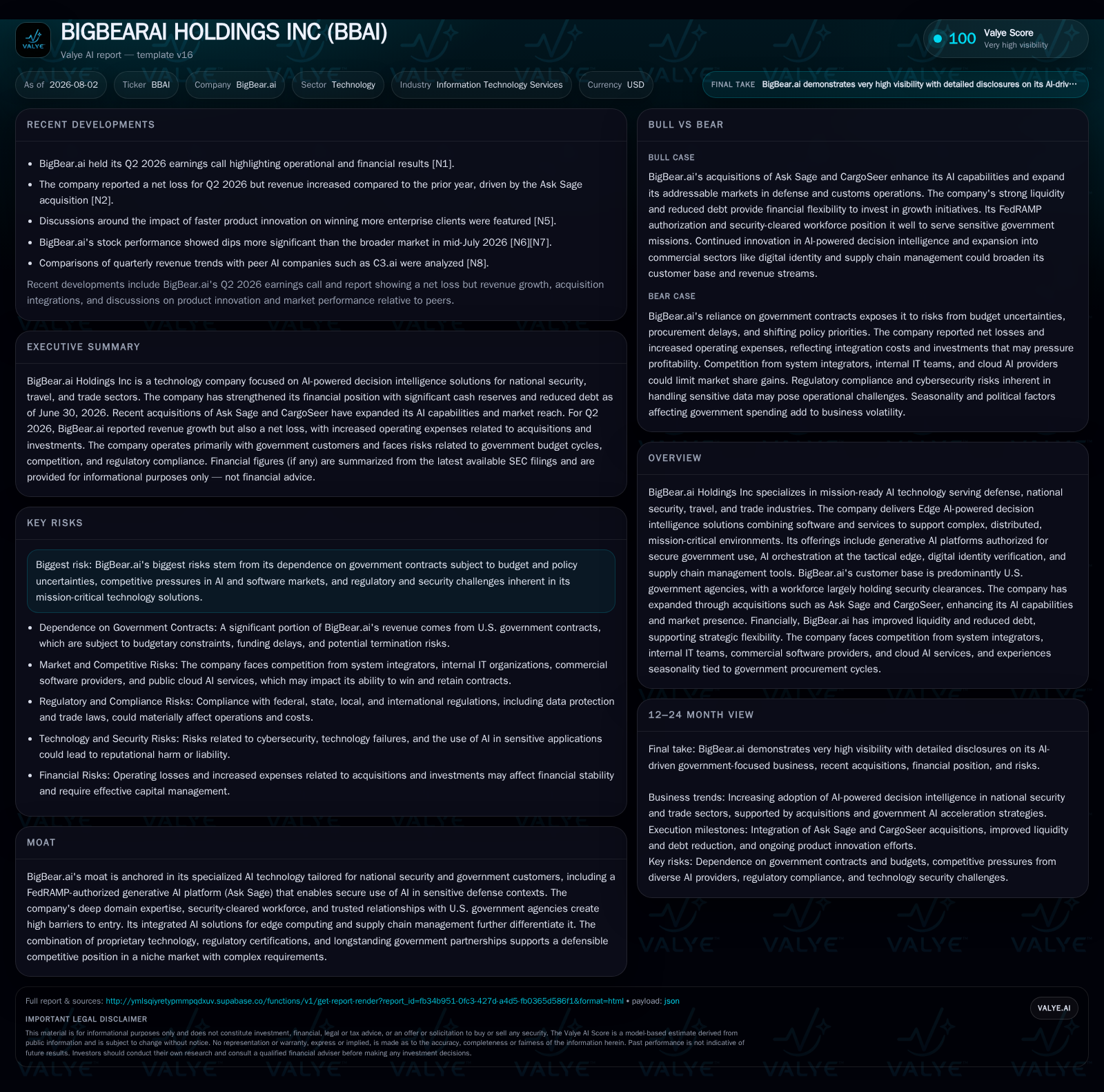
BigBear.ai Holdings Inc completed a major acquisition of Ask Sage, securing a FedRAMP-authorized generative AI platform to augment its defense-focused AI portfolio. The company’s growth strategy leans on government contracts driven by U.S. federal AI acceleration policies, while grappled with increased SG&A expenses reflecting integration and sales investments. Positioned in a niche of highly regulated, security-cleared government AI services, BigBear.ai faces growth opportunities from rising demand for decision intelligence in national security, supply chain, and digital identity — yet must navigate government budget uncertainties and competitive pressures. Its improved liquidity and reduced net debt support ongoing investments amid sustained operating losses.
Recent Operating Update
BigBear.ai Holdings Inc’s latest quarterly filing dated July 30, 2026 reveals critical strategic moves reshaping its business trajectory. The company closed the acquisition of Ask Sage, Inc. on December 31, 2025, investing approximately $272 million predominantly in cash to secure a FedRAMP-authorized generative AI platform purpose-built for secure government and enterprise operations [S2]. This acquisition significantly broadens BigBear.ai’s technology base into multi-modal generative AI—a rapidly evolving area prioritized by the U.S. government’s new AI initiatives.
Additionally, BigBear.ai closed the purchase of CargoSeer Ltd’s assets in January 2026 for about $5 million [S2]. CargoSeer adds unified AI decision support tailored to customs and border operations—a natural extension aligned with BigBear.ai’s national security and trade focus. These acquisitions underpin a pivot toward composable AI solutions interfacing across edge computing environments critical to defense and supply-chain intelligence.
Business Model
BigBear.ai’s core revenue stream arises from licensing proprietary Edge AI-powered decision intelligence platforms integrated with professional services such as implementation, user customization, training, and ongoing support. The company primarily secures multi-year contracts with U.S. federal government agencies focused on highly sensitive mission-critical use cases including national defense intelligence analysis, digital identity verification in secure environments, and supply chain oversight.
Revenue mechanics rely heavily on subscription or usage-based licensing tied to platform deployment combined with project-based professional services—common in government SaaS procurement cycles. High security clearance requirements for staff underpin the ability to operate within classified or restricted settings that few competitors can match.
The addition of Ask Sage integrates a FedRAMP-authorized generative AI platform authorized for secure federal use—breaking new ground in offering scalable generative models compliant with strict regulatory frameworks [S1]. This capability differentiates BigBear.ai within the niche government-focused segment where data sensitivity precludes broad public cloud alternatives.
Industry Structure and Competitive Position
The market BigBear.ai serves sits at the intersection of federal IT contracting for advanced analytics/National Security Artificial Intelligence (NSAI) solutions. Key competitors are a mix of specialized government IT contractors (e.g., Leidos), analytics platforms oriented to defense (e.g., Palantir Technologies), generalist AI SaaS providers like C3.ai adapting to public sector needs, alongside cybersecurity firms integrating threat analytics (e.g., CrowdStrike).
BigBear.ai’s defensible moat emerges chiefly from its FedRAMP-compliant generative AI (Ask Sage), strong base of security-cleared personnel embedded alongside customers daily, and enduring agency relationships built over years serving complex mission profiles [S1]. Given the classified nature of much work combined with long sales cycles driven by bureaucratic procurement processes plus regulatory hurdles (FedRAMP certification is non-trivial), these factors erect high barriers to entry.
However, the competitive landscape intensifies as large system integrators extend their AI offerings into edge computing scenarios while commercial cloud providers push harder into regulated markets through partnerships or enhanced compliance tooling.
Growth Drivers
The U.S. government's publication of its "AI Acceleration Strategy" in early 2026 signals an inflection point fueling demand for companies like BigBear.ai that provide responsive mission-ready AI solutions bridging research breakthroughs to battlefield application [S1]. This strategy includes "Pace-Setting Projects" designed to fast-track operationalizing emerging technologies such as generative models at tactical edges.
Key growth drivers include: increasing budget allocation toward secure Edge AI deployments; regulatory mandates enforcing FedRAMP-compliant platforms; expansion into trade-related domains like customs processing via CargoSeer; rising enterprise interest in digital identity verification bolstered by biometrics; and an evolving set of recurring revenue contracts reflecting subscription-like models rather than purely project-based engagements.
Additionally, broader adoption trends around generative AI technology in sensitive environments create new market openings where Ask Sage’s certified platform is well positioned. Strategic acquisitions accelerate capability penetration beyond organic development timelines.
Risks and Constraints
BigBear.ai faces significant risks tied mainly to dependency on U.S. federal budget allocations which can be volatile due to political shifts or macroeconomic pressures—funding shortfalls or delays could affect contract awards or renewals materially [S1]. Long sales cycles customary in government IT contracting add uncertainty alongside pressure for demonstrable impact before expansions.
Operationally, integrating complex acquisitions like Ask Sage while managing escalating SG&A requires careful margin discipline—rising costs may weigh on earnings further until economies of scale emerge. Competition from larger defense contractors or cloud incumbents could erode market share if not mitigated by continuous innovation or faster product delivery.
Furthermore, retention of qualified security-cleared staff remains vital given the niche talent pool; loss could impair customer trust or program continuity.
Cybersecurity threats remain acute given mission-critical applications handled; failure here could jeopardize contracts or reputation.
Finally, regulatory landscapes evolve rapidly especially around generative AI ethics frameworks; missteps might bring compliance risks or reputational harm.
What to Watch Next
Upcoming milestones include quantifiable ARR growth linked to expanded Ask Sage platform adoption across federal customers during remainder of 2026. Monitoring backlog size tied to Pace-Setting Project contracts will indicate sales momentum aligned with government acceleration efforts.
Watch closely how successfully BigBear.ai integrates CargoSeer operationally into overall supply chain offerings—its cross-border trade implications represent meaningful commercial opportunity if expanded beyond initial footholds.
Margin trajectory guided by SG&A leverage signals will be telling as management weighs ongoing investment against profitability targets amid competitive pressures.
Additionally, issuance activity under recent Open Market Sale Agreement suggests readiness to access capital markets opportunistically for growth funding or balance sheet flexibility [S3].
Finally, regulatory filings clarifying conversion terms on outstanding convertible notes maturing late 2026 may impact capital structure dynamics near term.
Financial Profile Discussion
As of June 30, 2026, BigBear.ai reported cash and equivalents totaling approximately $36.3 million against total debt of about $17.7 million resulting in negative net debt around $18.6 million—a favorable liquidity position supporting operational demands [F1], [S2]. Current assets substantially exceed current liabilities yielding a strong current ratio near 5.67 which indicates solid short-term financial flexibility [F1].
Despite these positives on liquidity, trailing results show sizable operating losses anchored around -$213.9 million as per latest year-end data reflecting ongoing investment-heavy phases particularly behind acquisitions integration and R&D ramp-up [F1]. Interest expense declined somewhat due to earlier conversions reducing average debt principal balances but remains a noteworthy line item given convertible notes structure [S2].
Overall capital resources appear adequate for sustaining growth initiatives including R&D outlays critical for keeping pace in advanced Edge AI software development aligned with shifting government demands.
This analysis synthesizes recent SEC filings through July 30-31, 2026 combined with contextual industry understanding relevant for navigating BigBear.ai's operational environment without extending speculative forward-looking investment guidance.
Disclaimer: This is research-only, informational analysis and not investment advice. It may include AI-generated interpretation and general industry context. Always verify important details using primary sources.

Comments