
Imperial Oil Strengthens Integrated Operations with Emphasis on Environmental Capex and Upstream Discipline
Q2 2026 results underscore Imperial Oil’s resilience and strategic focus amid regulatory and commodity dynamics.
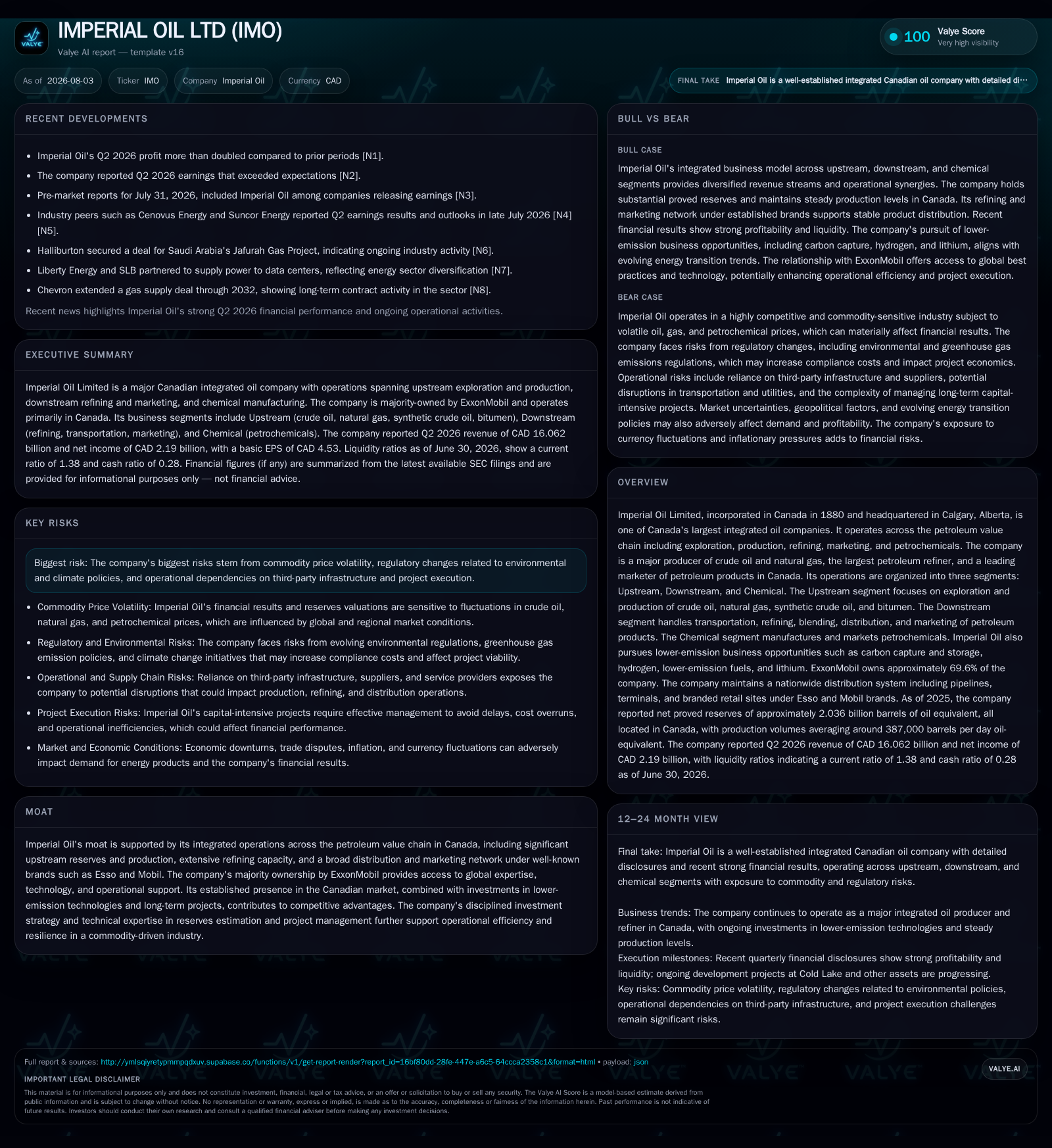
Imperial Oil’s latest quarterly filing reveals robust upstream and downstream performance driven by stable production volumes and refining operations, alongside increased environmental capital expenditures. The company’s integrated model, supported by ExxonMobil’s majority ownership, positions it well within Canada’s petroleum industry, though it faces typical sector risks including regulatory compliance costs and commodity price volatility. Strategic investments in carbon capture and lower-emission technologies, coupled with disciplined capital allocation, are central to maintaining competitive advantage and navigating evolving market conditions.
Recent Operating Update
Imperial Oil's second quarter 2026 report demonstrates continued operational resilience in both upstream and downstream segments despite ongoing regulatory headwinds affecting Canadian producers [S2]. Production volumes have remained stable under provincial regulations limiting gross crude oil output to manage reservoir longevity. Notably, the company has not faced recent mandatory production curtailments following the 2019-2021 Alberta restrictions repeal but continues to monitor potential future interventions [S1]. The downstream unit maintained strong refinery throughput supported by efficient utilization rates and product blending capabilities that leverage integrated operations to mitigate cyclical commodity volatility.
A significant near-term development is the company's marked increase in environmental capital spending. Environmental expenditures reached approximately CAD 1.7 billion in 2025 with forecasts indicating an upward trajectory to nearly CAD 2.0 billion in 2026 [S1]. These investments are largely directed towards air, land, and water protection initiatives across operation sites including remediation projects. Capital spending on environmental technologies such as carbon capture and storage aligns with industry trends favoring lower-emission business opportunities amid tightening federal and provincial regulations.
Business Model: Integrated Oil & Gas Producer with Canadian Market Focus
Imperial Oil operates as one of Canada’s largest integrated petroleum companies encompassing three segments: Upstream (exploration and production), Downstream (refining and marketing), and Chemicals (petrochemical manufacturing) [S1]. The upstream segment primarily produces heavy hydrocarbons including bitumen — a viscous form of crude extracted mostly from oil sands — synthetic crude oil derived from upgrading bitumen, natural gas, and conventional light crude oils within Canada. This domestic resource base offers strategic control over reserves but also subjects the firm exclusively to Canadian resource governance.
Downstream operations include transportation infrastructure managing crude inflows to refineries, capacity utilization averaging substantial throughput rates per day, blending refined fuels designed for market specifications, plus extensive retail distribution networks branded under Esso and Mobil. This vertical integration allows Imperial Oil to capture value through multiple stages of the petroleum value chain thus smoothing earnings cyclicality inherent in commodity markets.
Chemical manufacturing stages products into petrochemicals essential for plastics and other industrial applications adding diversification beyond fuels [S1]. Monetization stems from physical commodity sales with upstream revenue tethered largely to realized crude prices adjusted for royalty payments mandated by provincial governments that vary by resource type and volume produced.
Industry Structure and Competitive Position
Imperial shares the Canadian integrated oil landscape with peers such as Suncor Energy and Cenovus Energy while benefiting from ExxonMobil's majority stake (~69.6%), granting access to advanced technology transfer (e.g., extraction methods), capital markets strength, operational best practices, and global scale synergies [S1]. This affiliation reinforces operational efficiency critical under capital-intensive conditions characterized by project scale complexity and long development lead times.
Unlike independent producers focused solely on exploration or midstream pipeline operators specializing in logistics, Imperial’s integrated model buffers earnings exposure via downstream margins even when upstream commodity realizations face downward pressure. Compared globally to majors such as Chevron or Shell, Imperial remains regionally concentrated but leverages mature asset bases yielding a steady production profile supported by proven reserves totaling over two billion barrels oil-equivalent located exclusively in Canada [S1]
Growth Drivers
Key growth vectors combine resource development with technological innovation:
- Expansion of upstream reserves primarily sustains output via modest development drilling (4 productive wells net in 2025) focused on reserve replacement rather than aggressive exploration [S1].
- Investment increases in refining infrastructure accommodate stricter fuel standards while allowing more complex feedstock processing enhancing downstream product quality.
- Petrochemical segment growth aligns with industrial demand for composites amid global supply-chain reconfigurations.
- Environmental capex reflects adaptation to evolving government mandates encouraging adoption of carbon capture/storage technology reducing greenhouse gas emissions.
- Strategic use of ExxonMobil expertise optimizes capital deployment management.
Government policies supportive of energy infrastructure combined with stabilized or recovering commodity prices enhance favorable business conditions relative to cyclical downturns. Additionally, growing regional energy demand within North America supports sustained feedstock utilization.
Risks and Constraints
Several factors impose caution on prospects:
- Commodity price volatility remains paramount; price swings materially affect revenue particularly upstream margins which dominate profitability despite integrated hedging where feasible [S4].
- Regulatory risks include further tightening of greenhouse gas emission caps or changing royalty structures potentially elevating operating costs or restricting production flexibility [S8][S12].
- Dependency on third-party pipeline infrastructure could constrain market access or increase transportation costs if disruptions or policy changes occur.
- Capital intensity necessitates disciplined investment; failure in project execution or cost overruns could impair returns.
- Litigation risk surrounds environmental compliance failures or community opposition which may delay permits or impose remediation liabilities.
- Currency exposure presents translation risk given Canadian dollar reporting against U.S.-dollar priced commodities without currently active currency derivatives mitigating this effect [S26].
- Shifting market dynamics owing to energy transition trends demand continual innovation investment potentially diluting near-term free cash flow.
What to Watch Next
Investors should monitor upcoming quarterly updates for confirmation of production trends intersecting any renewed government policy actions impacting output limits. Tracking incremental steps in carbon capture project deployments or pilot low-emission fuel offerings will signal progress toward sustainability goals central to future strategy adherence.
Operational markers include:
- Refinery utilization rates sustaining above prior averages indicates continued downstream strength supporting margin resilience.
- Environmental capex pacing relative to projections reflects regulatory compliance management.
- Evaluations on reserve replacement ratios reveal upstream asset life sustainability.
- Financial releases indicating capital expenditure discipline versus returns amid commodity price fluctuations provide insight into management’s strategic balance.
Management changes noted mid-2026 suggest ongoing governance evolution but no immediate strategy shifts reported [S3]
Financial Profile Discussion
As of Q2 2026, Imperial Oil reports cash & equivalents standing at approximately CAD 2.84 billion against total debt near CAD 3.97 billion yielding net debt around CAD 1.13 billion [F1][S2]. Current assets of CAD 13.94 billion and current liabilities of CAD 10.13 billion imply a current ratio near 1.38x, reflecting adequate short-term liquidity for the sector's capital intensity [F1].
This analysis synthesizes Imperial Oil’s latest reported data combined with contextual industry understanding emphasizing how integrated operations mitigate certain sector cyclicality while elevating complexity given regulatory demands. Continued focus on environmental investments aligns with evolving standards crucial for long-term operational licenses. Caution remains warranted towards market-driven factors influencing revenue streams intrinsic to commodity-dependent enterprises.
This discussion does not constitute investment advice but aims to clarify operational positioning with reference to publicly filed disclosures as of August 3, 2026 [S2][F1]
Disclaimer: This is research-only, informational analysis and not investment advice. It may include AI-generated interpretation and general industry context. Always verify important details using primary sources.

Comments