
Diodes Inc. Advances Profitability and Growth with Strategic ElevATE Acquisition
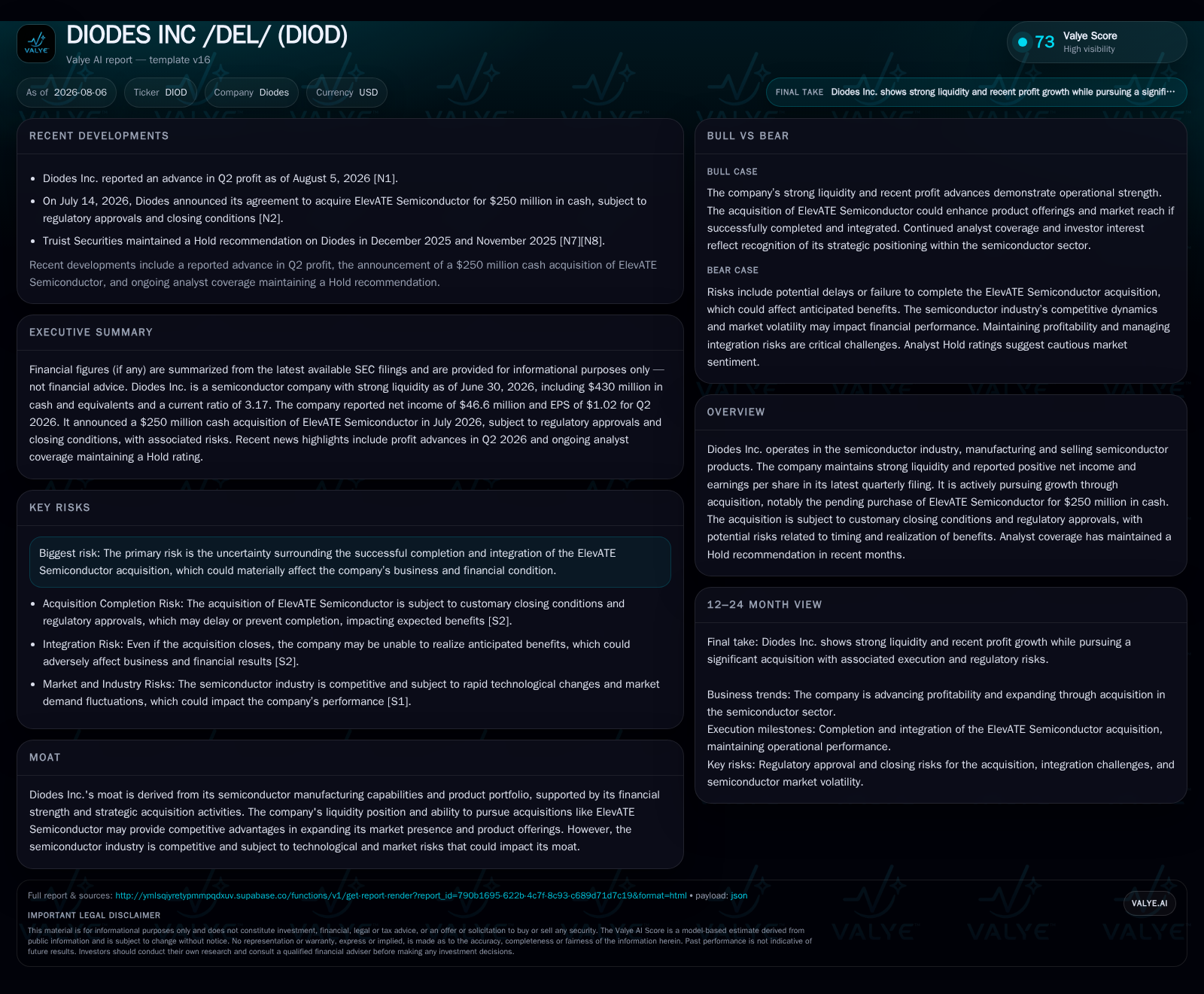
Diodes’ Q2 2026 results demonstrate improving profitability supported by robust liquidity while the pending ElevATE Semiconductor acquisition marks a key growth inflection amid industry competition and cyclical risks.
Diodes Incorporated reported positive net income growth and maintained a strong liquidity position in Q2 2026, underpinning operational stability in a cyclical semiconductor market. The company’s $250 million cash agreement to acquire ElevATE Semiconductor aims to broaden its discrete semiconductor portfolio and expand into complementary markets, although completion remains subject to regulatory approval, with integration execution risk. Diodes balances revenue resilience from design-win-driven discrete products with industry challenges such as pricing pressure and demand volatility. Key near-term metrics to watch include book-to-bill trends and acquisition progress.
Quarterly Operating Results Confirm Positive Profit Momentum
In its latest Q2 2026 filing dated August 5, Diodes Incorporated reported continued operational progress marked by positive net income gains that reinforce the company’s profit momentum amid the semiconductor industry's cyclical nature [S2][S5]. Though detailed numeric revenue figures for the quarter are not explicitly outlined in the excerpted filings, the firm disclosed maintaining a powerful liquidity position with cash and equivalents at approximately $430 million as of June 30, 2026 [F1]. The current ratio was notably high at 3.17, indicating robust short-term asset coverage over liabilities [F1]. This financial footing is critical for semiconductor manufacturers like Diodes who manage capital-intensive production cycles and component supply chains. Sustained profitability amid the evolving demand landscape signals operational discipline while navigating inventory reductions within channels—an essential metric given industry-wide inventory adjustments [S5].
ElevATE Semiconductor Acquisition: Strategic Expansion with Execution Risks
On July 10, 2026, Diodes entered into a definitive merger agreement to acquire ElevATE Semiconductor for a base cash consideration of $250 million plus potential earnouts up to $50 million contingent on future revenue and gross margin performance through 2030 [S3][S9][N1]. This deal underscores Diodes’ strategic intent to augment its discrete semiconductor product portfolio with complementary technologies offered by ElevATE, aiming to strengthen market penetration across diverse electronics OEM verticals. The transaction remains conditional on customary regulatory clearances including antitrust approval under the Hart-Scott-Rodino Act as well as other closing conditions detailed in the merger agreement [S9][S18]. Any delays or failure to secure these consents pose tangible risks of postponed realization or dilution of anticipated synergies.
The acquisition’s strategic rationale aligns with typical IDM expansion approaches where bolt-on deals enable portfolio extension faster than organic R&D cycles alone can achieve. However, integration complexities common in semiconductor mergers—such as harmonizing manufacturing process flows, consolidating supply chains, and aligning sales channels—could impact near-term operating results if not effectively managed. The post-merger earnout mechanism further reflects management’s cautious posture on achievable financial outcomes tied directly to ElevATE’s future operational metrics [S18]. Such structures are increasingly prevalent in technology sector transactions where market conditions remain volatile.
How Diodes’ Product Portfolio Supports Resilience in a Cyclical Market
Diodes predominantly manufactures discrete semiconductor components such as diodes, transistors, rectifiers, and integrated circuits employed across various consumer electronics, automotive systems, industrial equipment, and computing platforms [S1]. Revenue is primarily generated through direct sales to OEMs and authorized distributors under long-term supply agreements that often depend on sustained design wins. These design wins serve as gateways for recurring revenue streams tied closely to product lifecycle stability but expose Diodes to volume fluctuations triggered by end-market demand cycles.
The company’s relatively broad product mix provides some buffer against individual segment softness yet introduces exposure to pricing pressures typical in commoditized component categories. Gross margin evolution will depend on optimizing product mix toward higher-margin items supported by continuous innovation in packaging and testing capabilities that add differentiation [S1]. Capacity utilization rates also critically influence margin leverage given fixed manufacturing cost bases intrinsic to IDM models. Controlling foundry dependency or maintaining wafer fabrication assets enhances agility but requires balancing capital expenditures against forecasted demand trajectories.
Competitive Landscape Against IDMs: Peers Highlight Key Industry Benchmarks
Within the IDM peer universe dominated by Analog Devices, ON Semiconductor, Vishay Intertechnology, Texas Instruments, and Skyworks Solutions—companies characterized by varying degrees of focus on analog, power management, RF semiconductors, or discrete components—Diodes occupies a mid-tier niche largely centered on discrete semiconductors [S1]. Relative scale constrains pricing flexibility versus larger incumbents who command broader design-tail modes across multiple architectures.
The competitive differentiation lies partly in Diodes’ capacity to sustain agile innovation cycles tied closely to customer development needs and secure design wins that translate into backlog visibility—a leading indicator of book-to-bill ratio trends vital for forecasting order momentum. Unlike fabless peers relying solely on external foundries, IDM status implies control over some wafer processing stages, which can mitigate supply chain disruptions if capacity is efficiently managed. However, capital intensity limits rapid scaling without incremental investments or M&A activity as evidenced by the ElevATE pursuit.
Growth Catalysts: Design Wins, Capacity Leverage, and Market Tailwinds
Demand drivers for Diodes span secular trends such as increased semiconductor content per device in automotive electrification (EVs) and autonomous systems; industrial automation including smart manufacturing; burgeoning IoT device adoption; plus ongoing growth in data center infrastructure requiring power-efficient components [S1][N1]. New design wins especially in Tier-1 automotive suppliers or emerging industrial robotics segments can materially enhance attach rates while diversifying end-market exposure beyond historically volatile consumer electronics.
Capacity utilization improvements directly affect operating leverage; modest expansions timed with anticipated demand persistence allow for margin enhancement without overinvestment risk. Channel inventory normalization following prior tech cycle overstocks further supports stable book-to-bill ratios that benchmark demand health within the supply chain ecosystem.
Strategically acquired portfolio additions such as ElevATE provide access to differentiated technologies or regional customer bases enabling cross-selling opportunities that amplify future revenue streams [N1]. Successful integration could accelerate time-to-market advantages for both legacy Diodes products and newly acquired solutions.
Risk Factors Enduring: Acquisition Integration, Pricing Pressure, and Demand Cycles
Key risks remain around successfully completing the ElevATE acquisition given regulatory approval uncertainties including potentially protracted government review processes [S9]. Delays impede benefit realization timelines while unsuccessful deal closure could derail expansion efforts predicated on enhanced product scope.
Additionally, industry-standard pricing elasticity constrains gross margin expansion potential amid competitive match-for-match tactics across commoditized component lines. Product lifecycle erosion due to rapid technological obsolescence requires persistent R&D investment which may pressure margins if volumes soften during downturns.
Cyclicality typical to semiconductor IDMs causes pronounced order book fluctuations measured by the book-to-bill ratio—a crucial metric signaling whether new orders align with shipments or backlog growth. Downturn phases result in inventory destocking events adversely affecting revenues before recovery cycles materialize again. Fluctuating channel inventory levels must be monitored carefully alongside direct sales trends.
What Investors Should Monitor Next — Pipeline, Book-to-Bill Ratio Trends & Integration Milestones
In forthcoming quarters, tracking interim book-to-bill ratios will reveal evolving demand strength post-acquisition announcement as new order inflows correlate with shipment execution [S7][S3]. Positive trajectories would signal healthy pipeline conversion supporting order backlog growth essential for revenue predictability.
Closer scrutiny of regulatory clearance announcements regarding ElevATE is warranted given their pivotal role in closing timing impacting earnings visibility. Post-closing milestones including technology integration effectiveness alongside synergy capture will validate strategic rationale over multi-year horizons.
Gross margin mix shifts favoring higher-value products via new design wins or enriched portfolio offerings present upside levers worthy of attention. Capital expenditure cadence aligned with capacity optimization plans will reflect management’s commitment to balancing prudent investment against market opportunity.
Financial Profile Discussion: Liquidity Strength Supports Strategic Flexibility
Diodes’ latest balance sheet snapshots reaffirm substantial liquidity resources underpinning operational agility: cash plus equivalents totaled approximately $430 million as of Q2 2026 quarter-end with current assets exceeding current liabilities nearly threefold yielding a current ratio of about 3.17 [F1]. This liquidity buffer empowers funding of capital expenditures consistent with manufacturing capacity demands alongside flexible capital deployment toward acquisitions such as ElevATE without compromising financial stability.
Although total debt details remain incompletely disclosed in recent filings beyond older Taiwanese dollar-denominated balances from historical points [F1], absence of material outstanding US credit facility borrowings per prior disclosure suggests manageable leverage levels supporting investment-grade credit profile assumptions [S25]. Free cash flow generation tied primarily to efficient working capital management combined with selective capex spending enhances self-funding capability reducing external funding dependency.
Overall financial strength projects confidence that Diodes can strategically pursue expansion initiatives while navigating inherent cyclicality embedded within semiconductor manufacturing cycles.
This analysis integrates Diodes Inc.’s most recent quarterly disclosures augmented by event filings concerning strategic acquisition actions within an evolving semiconductor landscape typified by technological dynamism and demand cyclicality. While operational profitability trends are encouraging alongside robust liquidity metrics supporting balanced capital allocation priorities, near-term execution risks warrant close monitoring especially related to ElevATE merger completion timeline and synergy realization pace. Industry KPIs like book-to-bill ratio trajectories combined with margin mix evolution serve as critical barometers guiding assessment of sustainability of growth prospects amid competitive IDM peer dynamics. This report reflects current evidence-based perspectives without offering investment advice or price expectations.
Disclaimer: This is research-only, informational analysis and not investment advice. It may include AI-generated interpretation and general industry context. Always verify important details using primary sources.

Comments